• HOME
  • NEWS
  • EXPLORE
    • CAREER
      • Companies
      • Jobs
    • EVENTS
    • iGEM
      • News
      • Team
    • PHOTOS
    • VIDEO
    • WIKI
  • BLOG
  • COMMUNITY
    • FACEBOOK
    • INSTAGRAM
    • TWITTER
Saturday, February 7, 2026
BIOENGINEER.ORG
No Result
View All Result
  • Login
  • HOME
  • NEWS
  • EXPLORE
    • CAREER
      • Companies
      • Jobs
        • Lecturer
        • PhD Studentship
        • Postdoc
        • Research Assistant
    • EVENTS
    • iGEM
      • News
      • Team
    • PHOTOS
    • VIDEO
    • WIKI
  • BLOG
  • COMMUNITY
    • FACEBOOK
    • INSTAGRAM
    • TWITTER
  • HOME
  • NEWS
  • EXPLORE
    • CAREER
      • Companies
      • Jobs
        • Lecturer
        • PhD Studentship
        • Postdoc
        • Research Assistant
    • EVENTS
    • iGEM
      • News
      • Team
    • PHOTOS
    • VIDEO
    • WIKI
  • BLOG
  • COMMUNITY
    • FACEBOOK
    • INSTAGRAM
    • TWITTER
No Result
View All Result
Bioengineer.org
No Result
View All Result
Home NEWS Science News Biology

The dinosaur in the cupboard under the stairs

Bioengineer by Bioengineer
February 18, 2020
in Biology
Reading Time: 3 mins read
0
IMAGE
Share on FacebookShare on TwitterShare on LinkedinShare on RedditShare on Telegram

IMAGE

Credit: Dr Anthony Romilio


The mystery surrounding dinosaur footprints on a cave ceiling in Central Queensland has been solved after more than a half a century.

University of Queensland palaeontologist Dr Anthony Romilio discovered pieces to a decades-old puzzle in an unusual place – a cupboard under the stairs of a suburban Sydney home.

“The town of Mount Morgan near Rockhampton has hundreds of fossil footprints and has the highest dinosaur track diversity for the entire eastern half of Australia,” Dr Romilio said.

“Earlier examinations of the ceiling footprints suggested some very curious dinosaur behaviour; that a carnivorous theropod walked on all four legs.

“You don’t assume T. rex used its arms to walk, and we didn’t expect one of its earlier predatory relatives of 200 million years ago did either.”

Researchers wanted to determine if this dinosaur did move using its feet and arms, but found accessing research material was difficult.

“For a decade the Mount Morgan track site has been closed, and the published 1950s photographs don’t show all the five tracks,” Dr Romilio said.

However Dr Romilio had a chance meeting with local dentist Dr Roslyn Dick, whose father found many dinosaur fossils over the years.

“I’m sure Anthony didn’t believe me until I mentioned my father’s name – Ross Staines,” Ms Dick said.

“Our father was a geologist and reported on the Mount Morgan caves containing the dinosaur tracks in 1954.

“Besides his published account, he had high-resolution photographs and detailed notebooks, and my sisters and I had kept it all.

“We even have his dinosaur footprint plaster cast stored under my sister’s Harry Potter cupboard in Sydney.”

Dr Romilio said the wealth and condition of ‘dinosaur information’ archived by Ms Dick and her sisters Heather Skinner and Janice Millar was amazing.

“I’ve digitised the analogue photos and made a virtual 3D model of the dinosaur footprint, and left the material back to the family’s care,” he said.

“In combination with our current understanding of dinosaurs, it told a pretty clear-cut story.”

The team firstly concluded that all five tracks were foot impressions – that none were dinosaur handprints.

Also the splayed toes and moderately long middle digit of the footprints resembled two-legged herbivorous dinosaur tracks, differing from prints made by theropods.

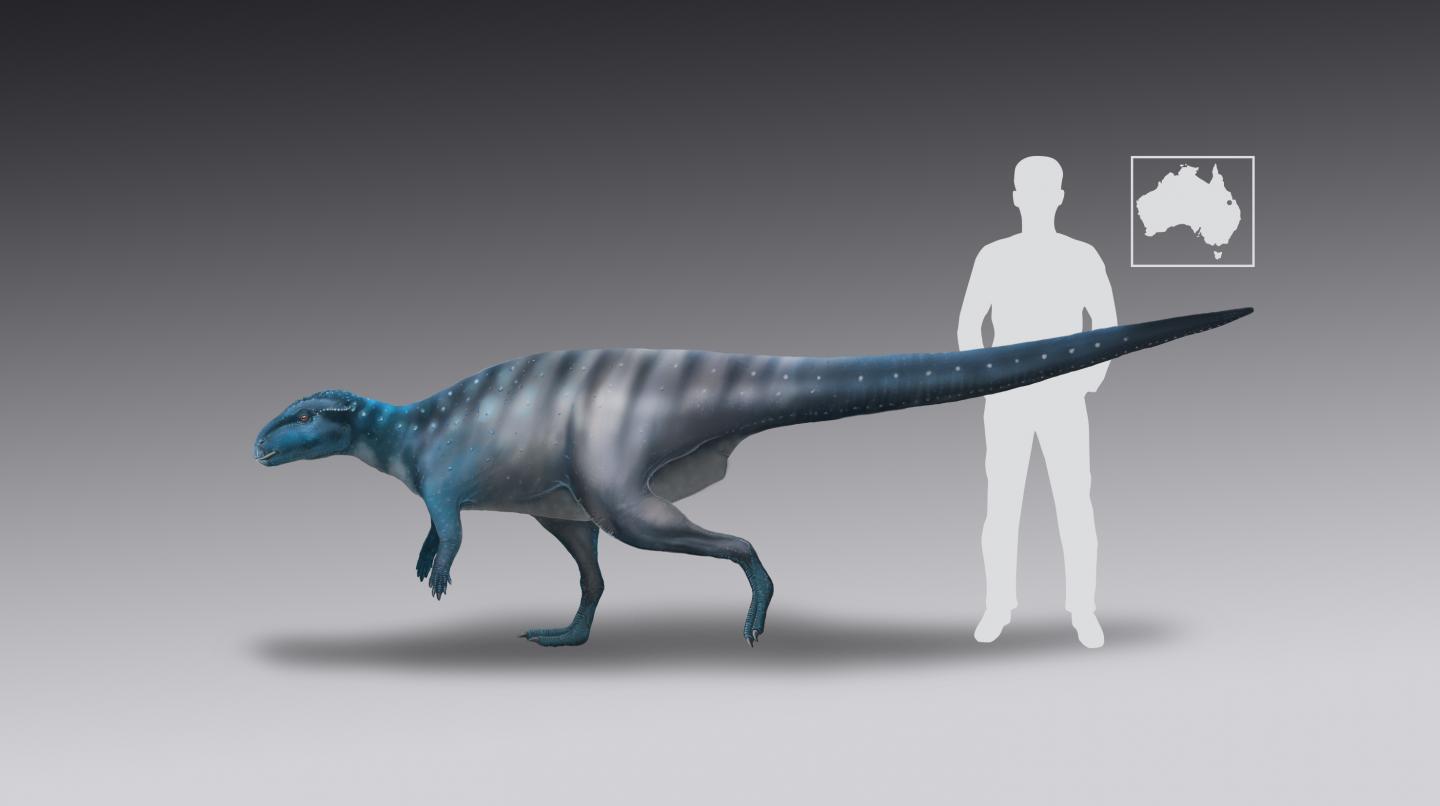
“Rather than one dinosaur walking on four legs, it seems as though we got two dinosaurs for the price of one – both plant-eaters that walked bipedally along the shore of an ancient lake,” Dr Romilio said.

“The tracks lining the cave-ceiling were not made by dinosaurs hanging up-side-down, instead the dinosaurs walked on the lake sediment and these imprints were covered in sand.

“In the Mount Morgan caves, the softer lake sediment eroded away and left the harder sandstone in-fills.”

###

The research has been published in Historical Biology (DOI: 10.1080/08912963.2020.1720014).

The 3D virtual model of the Staines’ family track is available for download.

Media Contact
Anthony Romilio
[email protected]
61-430-514-169

Original Source

https://www.uq.edu.au/news/article/2020/02/dinosaur-cupboard-under-stairs

Related Journal Article

http://dx.doi.org/10.1080/08912963.2020.1720014

Tags: ArchaeologyBiologyEvolutionPaleontologyPhysiology
Share12Tweet8Share2ShareShareShare2

Related Posts

Florida Cane Toad: Complex Spread and Selective Evolution

Florida Cane Toad: Complex Spread and Selective Evolution

February 7, 2026
New Study Uncovers Mechanism Behind Burn Pit Particulate Matter–Induced Lung Inflammation

New Study Uncovers Mechanism Behind Burn Pit Particulate Matter–Induced Lung Inflammation

February 6, 2026

DeepBlastoid: Advancing Automated and Efficient Evaluation of Human Blastoids with Deep Learning

February 6, 2026

Navigating the Gut: The Role of Formic Acid in the Microbiome

February 6, 2026
Please login to join discussion

POPULAR NEWS

  • Robotic Ureteral Reconstruction: A Novel Approach

    Robotic Ureteral Reconstruction: A Novel Approach

    82 shares
    Share 33 Tweet 21
  • Digital Privacy: Health Data Control in Incarceration

    63 shares
    Share 25 Tweet 16
  • Study Reveals Lipid Accumulation in ME/CFS Cells

    57 shares
    Share 23 Tweet 14
  • Breakthrough in RNA Research Accelerates Medical Innovations Timeline

    53 shares
    Share 21 Tweet 13

About

We bring you the latest biotechnology news from best research centers and universities around the world. Check our website.

Follow us

Recent News

TPMT Expression Predictions Linked to Azathioprine Side Effects

Improving Dementia Care with Enhanced Activity Kits

Decoding Prostate Cancer Origins via snFLARE-seq, mxFRIZNGRND

Subscribe to Blog via Email

Enter your email address to subscribe to this blog and receive notifications of new posts by email.

Join 73 other subscribers
  • Contact Us

Bioengineer.org © Copyright 2023 All Rights Reserved.

Welcome Back!

Login to your account below

Forgotten Password?

Retrieve your password

Please enter your username or email address to reset your password.

Log In
No Result
View All Result
  • Homepages
    • Home Page 1
    • Home Page 2
  • News
  • National
  • Business
  • Health
  • Lifestyle
  • Science

Bioengineer.org © Copyright 2023 All Rights Reserved.