• HOME
  • NEWS
  • EXPLORE
    • CAREER
      • Companies
      • Jobs
    • EVENTS
    • iGEM
      • News
      • Team
    • PHOTOS
    • VIDEO
    • WIKI
  • BLOG
  • COMMUNITY
    • FACEBOOK
    • INSTAGRAM
    • TWITTER
Saturday, February 7, 2026
BIOENGINEER.ORG
No Result
View All Result
  • Login
  • HOME
  • NEWS
  • EXPLORE
    • CAREER
      • Companies
      • Jobs
        • Lecturer
        • PhD Studentship
        • Postdoc
        • Research Assistant
    • EVENTS
    • iGEM
      • News
      • Team
    • PHOTOS
    • VIDEO
    • WIKI
  • BLOG
  • COMMUNITY
    • FACEBOOK
    • INSTAGRAM
    • TWITTER
  • HOME
  • NEWS
  • EXPLORE
    • CAREER
      • Companies
      • Jobs
        • Lecturer
        • PhD Studentship
        • Postdoc
        • Research Assistant
    • EVENTS
    • iGEM
      • News
      • Team
    • PHOTOS
    • VIDEO
    • WIKI
  • BLOG
  • COMMUNITY
    • FACEBOOK
    • INSTAGRAM
    • TWITTER
No Result
View All Result
Bioengineer.org
No Result
View All Result
Home NEWS Science News Health

Portable lab you plug into your phone can diagnose illnesses like coronavirus

Bioengineer by Bioengineer
February 6, 2020
in Health
Reading Time: 2 mins read
0
IMAGE
Share on FacebookShare on TwitterShare on LinkedinShare on RedditShare on Telegram

Smartphone lab delivers test results in ‘spit’ second
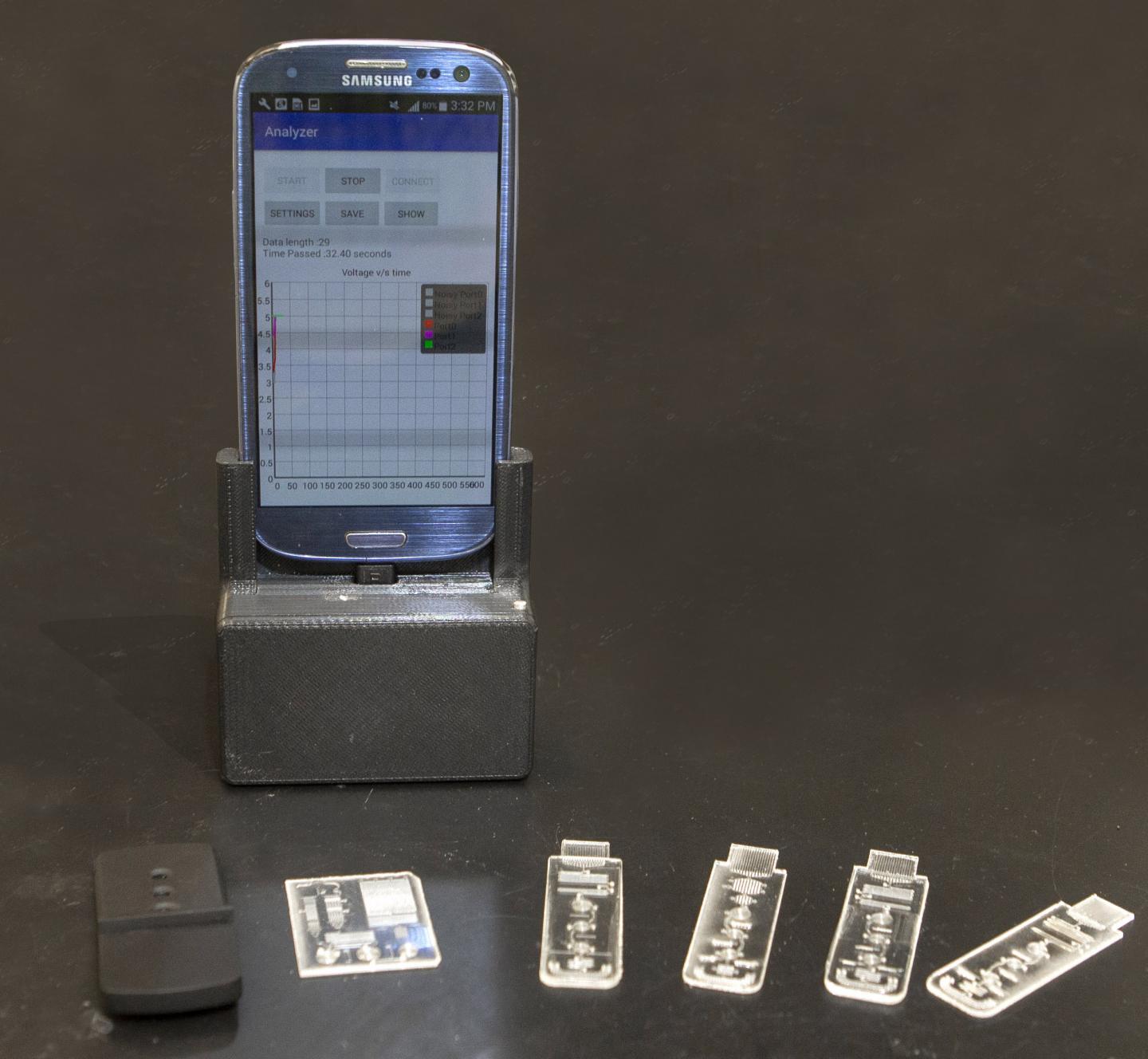
IMAGE

Credit: Joseph Fuqua II/UC Creative Services


Engineers with the University of Cincinnati have created a tiny portable lab that plugs into your phone, connecting it automatically to a doctor’s office through a custom app UC developed.

The lab the size of a credit card can diagnose infectious diseases such as coronavirus, malaria, HIV or Lyme disease or countless other health conditions like depression and anxiety.

The patient simply puts a single-use plastic lab chip into his or her mouth then plugs that into a slot in the box to test the saliva.

The device automatically transmits results to the patient’s doctor through a custom app UC created for nearly instant results.

UC professor Chong Ahn and his research team used the smartphone device to test for malaria. But the device could be used for smart point of care testing for countless chronic or infectious diseases or to measure hormones related to stress.

“Right now it takes several hours or even days to diagnose in a lab, even when people are showing symptoms. The disease can spread,” Ahn said.

The study was published in the Nature journal Microsystems & Nanoengineering.

His research team created a novel lab chip that uses natural capillary action, the tendency for a liquid to adhere to a surface, to draw a sample down two channels called a “microchannel capillary flow assay.” One channel mixes the sample with freeze-dried detection antibodies. The other contains a freeze-dried luminescent material to read the results when the split samples combine again on three sensors.

Ahn said the device is accurate, simple to use and inexpensive.

“The performance is comparable to laboratory tests. The cost is cheaper. And it’s user-friendly,” Ahn said. “We wanted to make it simple so anyone could use it without training or support.”

UC doctoral student Sthitodhi Ghosh, the study’s lead author, said the biggest advancement in the device is in the novel design of its tiny channels that naturally draw the sample through the sensor arrays using capillary flow. Ahn is Ghosh’s Ph.D. advisor.

“The entire test takes place on the chip automatically. You don’t have to do anything. This is the future of personal healthcare,” Ghosh said.

While the device has applications for diagnosing or monitoring viruses or other diseases, Ahn said he sees potential in the field of mental health, where doctors already utilize smartphones to help track the wellness of patients.

###

Media Contact
Michael Miller
[email protected]
609-675-8616

Original Source

https://www.uc.edu/news/articles/2020/02/n20888657.html

Related Journal Article

http://dx.doi.org/10.1038/s41378-019-0108-8

Tags: AIDS/HIVBiomedical/Environmental/Chemical EngineeringDiagnosticsElectrical Engineering/ElectronicsEpidemiologyInfectious/Emerging DiseasesMedicine/Health
Share12Tweet8Share2ShareShareShare2

Related Posts

Evaluating Pediatric Emergency Care Quality in Ethiopia

February 7, 2026

TPMT Expression Predictions Linked to Azathioprine Side Effects

February 7, 2026

Improving Dementia Care with Enhanced Activity Kits

February 7, 2026

Decoding Prostate Cancer Origins via snFLARE-seq, mxFRIZNGRND

February 7, 2026
Please login to join discussion

POPULAR NEWS

  • Robotic Ureteral Reconstruction: A Novel Approach

    Robotic Ureteral Reconstruction: A Novel Approach

    82 shares
    Share 33 Tweet 21
  • Digital Privacy: Health Data Control in Incarceration

    63 shares
    Share 25 Tweet 16
  • Study Reveals Lipid Accumulation in ME/CFS Cells

    57 shares
    Share 23 Tweet 14
  • Breakthrough in RNA Research Accelerates Medical Innovations Timeline

    53 shares
    Share 21 Tweet 13

About

We bring you the latest biotechnology news from best research centers and universities around the world. Check our website.

Follow us

Recent News

Evaluating Pediatric Emergency Care Quality in Ethiopia

TPMT Expression Predictions Linked to Azathioprine Side Effects

Improving Dementia Care with Enhanced Activity Kits

Subscribe to Blog via Email

Enter your email address to subscribe to this blog and receive notifications of new posts by email.

Join 73 other subscribers
  • Contact Us

Bioengineer.org © Copyright 2023 All Rights Reserved.

Welcome Back!

Login to your account below

Forgotten Password?

Retrieve your password

Please enter your username or email address to reset your password.

Log In
No Result
View All Result
  • Homepages
    • Home Page 1
    • Home Page 2
  • News
  • National
  • Business
  • Health
  • Lifestyle
  • Science

Bioengineer.org © Copyright 2023 All Rights Reserved.