• HOME
  • NEWS
  • EXPLORE
    • CAREER
      • Companies
      • Jobs
    • EVENTS
    • iGEM
      • News
      • Team
    • PHOTOS
    • VIDEO
    • WIKI
  • BLOG
  • COMMUNITY
    • FACEBOOK
    • INSTAGRAM
    • TWITTER
Saturday, March 28, 2026
BIOENGINEER.ORG
No Result
View All Result
  • Login
  • HOME
  • NEWS
  • EXPLORE
    • CAREER
      • Companies
      • Jobs
        • Lecturer
        • PhD Studentship
        • Postdoc
        • Research Assistant
    • EVENTS
    • iGEM
      • News
      • Team
    • PHOTOS
    • VIDEO
    • WIKI
  • BLOG
  • COMMUNITY
    • FACEBOOK
    • INSTAGRAM
    • TWITTER
  • HOME
  • NEWS
  • EXPLORE
    • CAREER
      • Companies
      • Jobs
        • Lecturer
        • PhD Studentship
        • Postdoc
        • Research Assistant
    • EVENTS
    • iGEM
      • News
      • Team
    • PHOTOS
    • VIDEO
    • WIKI
  • BLOG
  • COMMUNITY
    • FACEBOOK
    • INSTAGRAM
    • TWITTER
No Result
View All Result
Bioengineer.org
No Result
View All Result
Home NEWS Science News Biology

Can chickpea genes save mustard seeds from blight disease?

Bioengineer by Bioengineer
January 29, 2020
in Biology
Reading Time: 2 mins read
0
IMAGE
Share on FacebookShare on TwitterShare on LinkedinShare on RedditShare on Telegram

IMAGE

Credit: Urooj Fatima, Priyadarshini Bhorali, and Muthappa Senthil-Kumar


During visits to fields in Assam, Rajasthan and Uttar Pradesh, India, plant biologists Muthappa Senthil-Kumar and Urooj Fatima found mustard plants infested with Alternaria blight disease. They also noticed that an adjacent field of chickpeas were completely uninfected.

Alternaria blight caused by fungal pathogen devastates Brassica crops such as cabbage, cauliflower, broccoli, and mustard seed. Highly infectious, this fungus can infect the host plant at all stages of growth. Currently Alternaria blight is managed by chemical fungicides, but recently efforts have been made to utilize breeding and modern biotechnological approaches to develop blight-resistant crop varieties.

Non-host resistance (NHR) is the most durable resistance against fungal pathogens. While Alternaria typically penetrates the epidermis or the stomata of a host plant, this is unable to deploy this attack on plants protected by NHR. To protect Brassica crops from this fungus, scientists are studying the mechanisms of NHR in order to develop improved crop varieties.

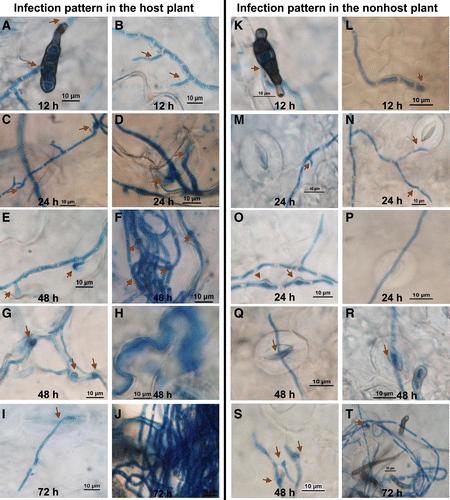
In a study published in MPMI, plant biologists in India detailed their research comparing the response of a host plant (mustard) and a non-host plant (chickpea) to the fungus on a morpho-pathological level. They found that the chickpea actively suppressed the fungal development, penetration, and colonization even after hours of infection.

They also studied chickpea transcripts to pinpoint several genes involved in the plant’s pathogen defense.

“These genes are interesting candidates for additional study to determine their precise involvement in NHR,” said Senthil-Kumar, who conducts research through the National Institute of Plant Genome Research. “These genes could then be transferred to mustard plants to develop blight-resistance crops.”

For more information about this study, read “Morpho-Pathological and Global Transcriptomic Analysis Reveals the Robust Nonhost Resistance Responses in Chickpea Interaction with Alternaria brassicae” published in the December issue of Molecular Plant-Microbe Interactions (MPMI).

###

Media Contact
Ashley Bergman Carlin
[email protected]
651-994-3832

Related Journal Article

http://dx.doi.org/10.1094/MPMI-05-19-0117-R

Tags: Agricultural Production/EconomicsAgricultureCell BiologyFood/Food ScienceMicrobiologyMolecular BiologyPlant Sciences
Share12Tweet8Share2ShareShareShare2

Related Posts

How to sway group opinions: Encourage opponents to stay undecided

How to sway group opinions: Encourage opponents to stay undecided

March 23, 2026
Deep Learning Model Maps How Individual Cells Shape Disease Outcomes

Deep Learning Model Maps How Individual Cells Shape Disease Outcomes

March 20, 2026

Removing only 15 female sharks annually could endanger the entire population, scientists warn

March 20, 2026

Scientists Urge Fragrance Industry to Transition from Sustainability Talk to Active Funding of Plant Conservation

March 20, 2026
Please login to join discussion

POPULAR NEWS

  • blank

    Revolutionary AI Model Enhances Precision in Detecting Food Contamination

    96 shares
    Share 38 Tweet 24
  • Imagine a Social Media Feed That Challenges Your Views Instead of Reinforcing Them

    1003 shares
    Share 397 Tweet 248
  • Uncovering Functions of Cavernous Malformation Proteins in Organoids

    54 shares
    Share 22 Tweet 14
  • Promising Outcomes from First Clinical Trials of Gene Regulation in Epilepsy

    51 shares
    Share 20 Tweet 13

About

We bring you the latest biotechnology news from best research centers and universities around the world. Check our website.

Follow us

Recent News

In-Sensor Cryptography Links Physical Process to Digital Identity

Can Psychosocial Factors Influence Cancer Risk?

Depression Factors in Elderly: Pre vs. Post-COVID Analysis

Subscribe to Blog via Email

Success! An email was just sent to confirm your subscription. Please find the email now and click 'Confirm' to start subscribing.

Join 78 other subscribers
  • Contact Us

Bioengineer.org © Copyright 2023 All Rights Reserved.

Welcome Back!

Login to your account below

Forgotten Password?

Retrieve your password

Please enter your username or email address to reset your password.

Log In
No Result
View All Result
  • Homepages
    • Home Page 1
    • Home Page 2
  • News
  • National
  • Business
  • Health
  • Lifestyle
  • Science

Bioengineer.org © Copyright 2023 All Rights Reserved.