Credit: NIST
Researchers at the National Institute of Standards and Technology (NIST) and their colleagues have for the first time created and imaged a novel pair of quantum dots — tiny islands of confined electric charge that act like interacting artificial atoms. Such “coupled” quantum dots could serve as a robust quantum bit, or qubit, the fundamental unit of information for a quantum computer. Moreover, the patterns of electric charge in the island can’t be fully explained by current models of quantum physics, offering an opportunity to investigate rich new physical phenomena in materials.
Unlike a classical computer, which relies on binary bits that have just one of two fixed values — “1” or “0” — to store memory, a quantum computer would store and process information in qubits, which can simultaneously take on a multitude of values. Therefore, they could perform much larger, more complex operations than classical bits and have the potential to revolutionize computing.
Electrons orbit the center of a single quantum dot similar to the way they orbit atoms. The charged particles can only occupy specific permitted energy levels. At each energy level, an electron can occupy a range of possible positions in the dot, tracing out an orbit whose shape is determined by the rules of quantum theory. A pair of coupled quantum dots can share an electron between them, forming a qubit.
To fabricate the quantum dots, the NIST-led team, which included researchers from the University of Maryland NanoCenter and the National Institute for Materials Science in Japan, used the ultrasharp tip of a scanning tunneling microscope (STM) as if it were a stylus of an Etch A Sketch. Hovering the tip above an ultracold sheet of graphene (a single layer of carbon atoms arranged in a honeycomb pattern), the researchers briefly increased the voltage of the tip.
The electric field generated by the voltage pulse penetrated through the graphene into an underlying layer of boron nitride, where it stripped electrons from atomic impurities in the layer and created a pileup of electric charge. The pileup corralled freely floating electrons in the graphene, confining them to a tiny energy well.
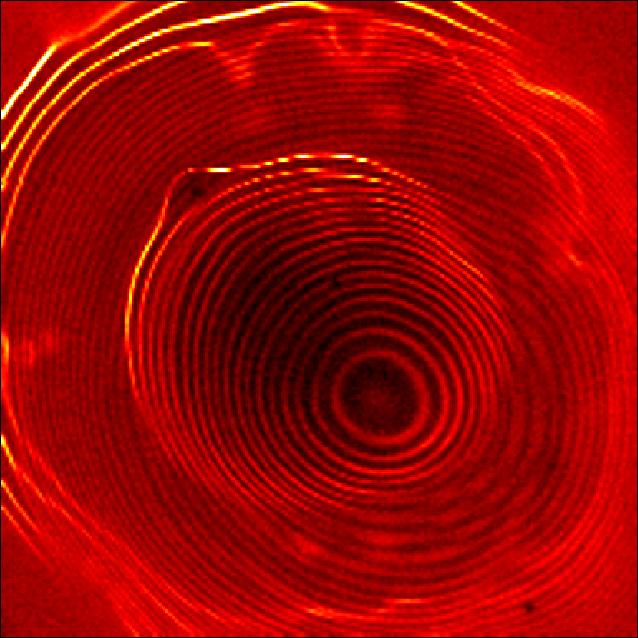
But when the team applied a magnetic field of 4 to 8 tesla (about 400 to 800 times the strength of a small bar magnet), it dramatically altered the shape and distribution of the orbits that the electrons could occupy. Rather than a single well, the electrons now resided within two sets of concentric, closely spaced rings within the original well separated by a small empty shell. The two sets of rings for the electrons now behaved as if they were weakly coupled quantum dots.
This is the first time that researchers have probed the interior of a coupled quantum dot system so deeply, imaging the distribution of electrons with atomic resolution (see illustration), noted NIST co-author Daniel Walkup. To take high-resolution images and spectra of the system, the team took advantage of a special relationship between the size of a quantum dot and the spacing of the energy levels occupied by the orbiting electrons: The smaller the dot, the greater the spacing, and the easier it is to distinguish between adjacent energy levels.
In a previous quantum dot study using graphene, the team applied a smaller magnetic field and found a structure of rings, resembling a wedding cake, centered on a single quantum dot, which is the origin of the concentric quantum dot rings. By using the STM tip to construct dots about half the diameter (100 nanometers) of dots that they had previously studied, the researchers succeeded in revealing the full structure of the coupled system.
The team, which included Walkup, Fereshte Ghahari, Christopher Gutiérrez and Joseph Stroscio at NIST and the Maryland NanoCenter, describes its findings today in Physical Review B.
The way in which the electrons are shared between the two coupled dots can’t be explained by accepted models of quantum dot physics, said Walkup. This puzzle may be important to solve if coupled quantum dots are eventually to be used as qubits in quantum computing, Stroscio noted.
###
Media Contact
Ben P. Stein
[email protected]
301-975-2763
Original Source
https:/
Related Journal Article
http://dx.