• HOME
  • NEWS
  • EXPLORE
    • CAREER
      • Companies
      • Jobs
    • EVENTS
    • iGEM
      • News
      • Team
    • PHOTOS
    • VIDEO
    • WIKI
  • BLOG
  • COMMUNITY
    • FACEBOOK
    • INSTAGRAM
    • TWITTER
Friday, January 16, 2026
BIOENGINEER.ORG
No Result
View All Result
  • Login
  • HOME
  • NEWS
  • EXPLORE
    • CAREER
      • Companies
      • Jobs
        • Lecturer
        • PhD Studentship
        • Postdoc
        • Research Assistant
    • EVENTS
    • iGEM
      • News
      • Team
    • PHOTOS
    • VIDEO
    • WIKI
  • BLOG
  • COMMUNITY
    • FACEBOOK
    • INSTAGRAM
    • TWITTER
  • HOME
  • NEWS
  • EXPLORE
    • CAREER
      • Companies
      • Jobs
        • Lecturer
        • PhD Studentship
        • Postdoc
        • Research Assistant
    • EVENTS
    • iGEM
      • News
      • Team
    • PHOTOS
    • VIDEO
    • WIKI
  • BLOG
  • COMMUNITY
    • FACEBOOK
    • INSTAGRAM
    • TWITTER
No Result
View All Result
Bioengineer.org
No Result
View All Result
Home NEWS Science News Chemistry

NRL researchers’ golden touch enhances quantum technology

Bioengineer by Bioengineer
January 29, 2020
in Chemistry
Reading Time: 3 mins read
0
IMAGE
Share on FacebookShare on TwitterShare on LinkedinShare on RedditShare on Telegram

IMAGE

Credit: Jeremy Robinson/U.S. Naval Research Laboratory


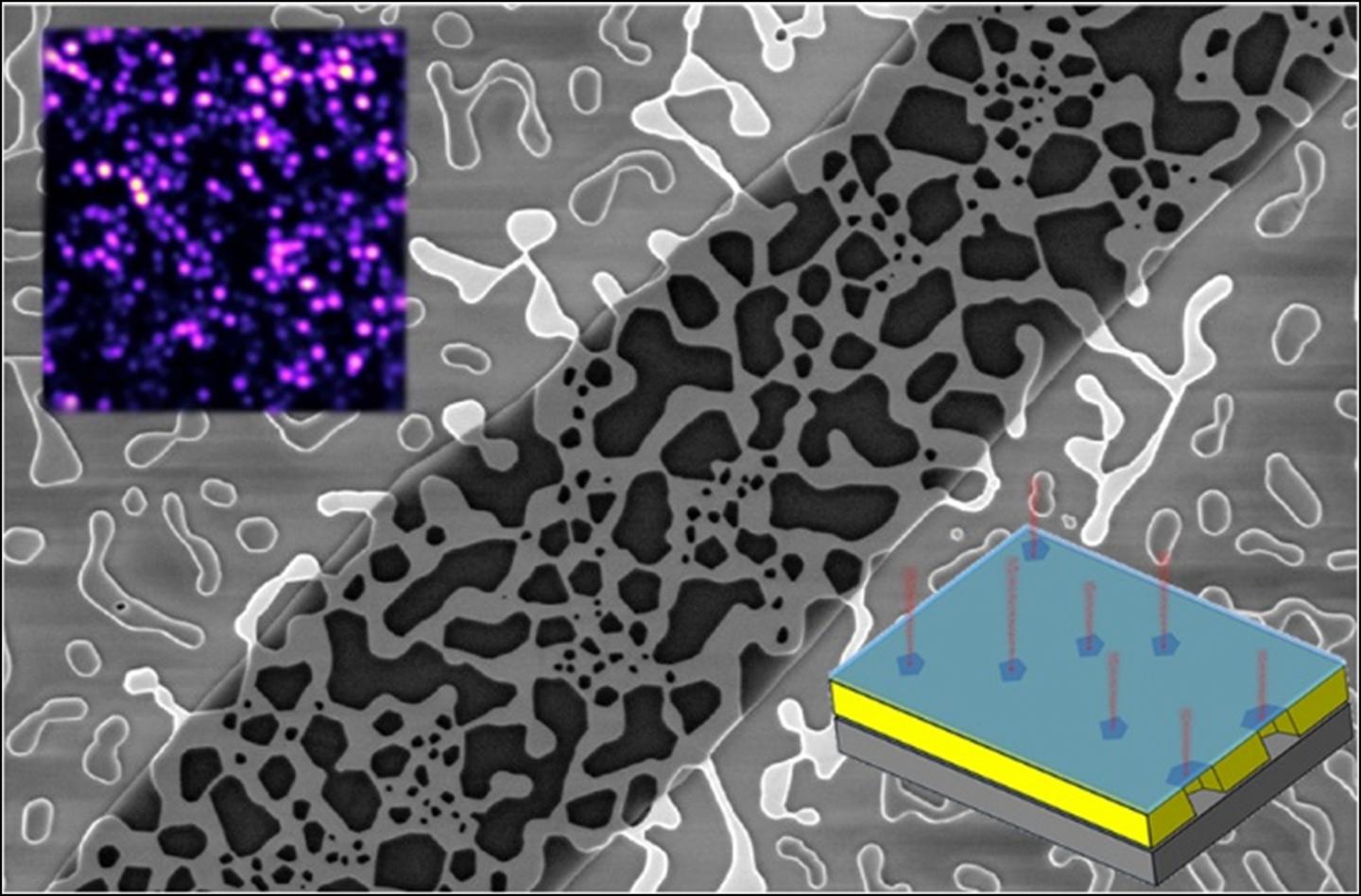
WASHINGTON – Scientists at the U.S. Naval Research Laboratory discovered a new platform for quantum technologies by suspending two-dimensional (2-D) crystals over pores in a slab of gold. This new approach may help develop new materials for secure communication and sensing technologies based on the unique laws of physics at the atomic levels.

“We never expected these atomically thin materials could influence the ordering of all of the atoms in such a relatively large slab of gold,” said Jeremy Robinson, a materials research scientist at NRL. “When heated, the metal reflows to form a porous structure and the gold atoms lock into registry with the atoms in the 2-D layer on top.”

The research team expected to observe dewetting, a process resulting from interaction between surfaces of two solids. Instead of droplets forming on the glass base underneath the gold, heating caused a reorientation of the underlying metal slab. The gold became porous throughout and this physical change led researchers to test for other side effects of the merger.

“We also discovered this combination can create a large number of quantum light sources in a, sort of, ready-made network,” said Andrew Yeats, research physicist at NRL. “The alignment between atomic layers may facilitate energy transfer between the emitters through the gold framework that connects them.”

Researchers verified light emanating from the 2-D semiconductors comes out as single light particles, or photons. These emitters can transfer energy to each other through the gold layer.

“We shine light on one part of the sample and we look at the light coming off at another part,” Robinson said. “This teaches us how energy can be coupled into the gold layer at one point, propagated to a different quantum emitter site far away and re-emitted as light that we could see.”

The ability to remotely control the piping of energy to a single-photon emitter makes this an attractive system for quantum technology.

“As we get better at controlling how the 2-D semiconductor interacts with pores in the metal film, it’s easy to imagine different technologies that could use these properties.” Robinson said. “Sensors are a good first target, which can take advantage of the atomically thin membranes stretched across the porous metal framework.”

While researchers conducted this work using a gold slab underneath the thin semiconductor layer, other metals can respond the same way as the gold. The NRL team continues to investigate how various material combinations and structures can create single photon sources with unique properties, a key component of secure communications.

###

Learn more information about quantum technology at:
https://www.nature.com/articles/s41467-019-13857-0

About the U.S. Naval Research Laboratory

NRL is a scientific and engineering command dedicated to research that drives innovative advances for the Navy and Marine Corps from the seafloor to space and in the information domain. NRL headquarters is located in Washington, D.C., with major field sites in Stennis Space Center, Mississippi, Key West, Florida, and Monterey, California, and employs approximately 2,500 civilian scientists, engineers and support personnel.

Media Contact
Maria Estacion
[email protected]
202-404-6422

Related Journal Article

http://dx.doi.org/10.1038/s41467-019-13857-0

Tags: Atomic/Molecular/Particle PhysicsChemistry/Physics/Materials SciencesMaterialsNanotechnology/MicromachinesSuperconductors/Semiconductors
Share12Tweet8Share2ShareShareShare2

Related Posts

Selective GlcNAc to GalNAc Epimerization via Kinetic Control

Selective GlcNAc to GalNAc Epimerization via Kinetic Control

January 15, 2026
blank

Thermal [2+2] Cycloaddition Builds Gem-Difluoro Bicycloalkanes

January 13, 2026

Cobalt-Catalyzed Thioester Coupling via Siloxycarbene

January 12, 2026

Advancing Alkene Chemistry: Homologative Difunctionalization Breakthrough

January 8, 2026
Please login to join discussion

POPULAR NEWS

  • Enhancing Spiritual Care Education in Nursing Programs

    155 shares
    Share 62 Tweet 39
  • PTSD, Depression, Anxiety in Childhood Cancer Survivors, Parents

    147 shares
    Share 59 Tweet 37
  • Robotic Ureteral Reconstruction: A Novel Approach

    76 shares
    Share 30 Tweet 19
  • Study Reveals Lipid Accumulation in ME/CFS Cells

    53 shares
    Share 21 Tweet 13

About

We bring you the latest biotechnology news from best research centers and universities around the world. Check our website.

Follow us

Recent News

Carbon Fiber Boosts Zirconium Diboride in 3D Printing

Revolutionary Support Program for Families of Cancer Patients

Spatial Multiomics Uncovers Immune Dysfunction in Parkinson’s, IBD

Subscribe to Blog via Email

Success! An email was just sent to confirm your subscription. Please find the email now and click 'Confirm' to start subscribing.

Join 71 other subscribers
  • Contact Us

Bioengineer.org © Copyright 2023 All Rights Reserved.

Welcome Back!

Login to your account below

Forgotten Password?

Retrieve your password

Please enter your username or email address to reset your password.

Log In
No Result
View All Result
  • Homepages
    • Home Page 1
    • Home Page 2
  • News
  • National
  • Business
  • Health
  • Lifestyle
  • Science

Bioengineer.org © Copyright 2023 All Rights Reserved.