• HOME
  • NEWS
  • EXPLORE
    • CAREER
      • Companies
      • Jobs
    • EVENTS
    • iGEM
      • News
      • Team
    • PHOTOS
    • VIDEO
    • WIKI
  • BLOG
  • COMMUNITY
    • FACEBOOK
    • INSTAGRAM
    • TWITTER
Saturday, February 7, 2026
BIOENGINEER.ORG
No Result
View All Result
  • Login
  • HOME
  • NEWS
  • EXPLORE
    • CAREER
      • Companies
      • Jobs
        • Lecturer
        • PhD Studentship
        • Postdoc
        • Research Assistant
    • EVENTS
    • iGEM
      • News
      • Team
    • PHOTOS
    • VIDEO
    • WIKI
  • BLOG
  • COMMUNITY
    • FACEBOOK
    • INSTAGRAM
    • TWITTER
  • HOME
  • NEWS
  • EXPLORE
    • CAREER
      • Companies
      • Jobs
        • Lecturer
        • PhD Studentship
        • Postdoc
        • Research Assistant
    • EVENTS
    • iGEM
      • News
      • Team
    • PHOTOS
    • VIDEO
    • WIKI
  • BLOG
  • COMMUNITY
    • FACEBOOK
    • INSTAGRAM
    • TWITTER
No Result
View All Result
Bioengineer.org
No Result
View All Result
Home NEWS Science News Health

Iron nanorobots show their true mettle

Bioengineer by Bioengineer
January 28, 2020
in Health
Reading Time: 2 mins read
0
IMAGE
Share on FacebookShare on TwitterShare on LinkedinShare on RedditShare on Telegram

IMAGE

Credit: 2019 KAUST


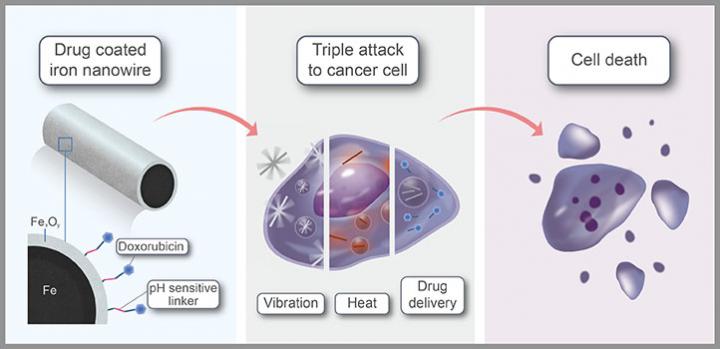
Drug-coated iron nanowires that can be guided to the site of a tumor using an external magnetic field before activating a three-step cancer-killing mechanism could provide an effective option for cancer therapy.

Co-developed by KAUST researchers, these nanowires release their drug cargo inside cancer cells, while also punching holes in the cell’s membrane and delivering a blast of heat. While the combination therapy maximizes cancer cell death, its highly targeted nature should minimize side effects.

Iron was the obvious material to make the nanowires, says Jürgen Kosel, who leads the group at KAUST, which includes Jasmeen Merzaban and Boon Ooi, and who co-led the work with researchers from CIC biomaGUNE in San Sebastian, Spain.

The first consideration is safety. “Iron, in molecular form, is a native material in our bodies, essential for oxygen transport,” Kosel explains. The nanowires comprise an iron core, coated with an iron oxide shell. “Iron-oxide-based nanomaterials have been approved by regulatory bodies for use in magnetic resonance imaging and as a dietary supplement in cases of nutrition deficiency,” he says.

In addition to their biocompatibility, the magnetic properties of iron-based materials are a key benefit. “Using harmless magnetic fields, we can transport them; concentrate them in the desired area; rotate or make them vibrate, such as we did in this study; and even detect them through magnetic resonance imaging,” says Aldo Martínez-Banderas, a member of Kosel’s team. Applying low-power magnetic fields, the team agitated the nanowires in a way that opened the membrane of target cells, inducing cell death.

The additional advantage is that core-shell nanowires strongly absorb near-infrared light, heating up as they do so. Because light at this wavelength can penetrate far into the body, the nanowires could be heated using lasers directed at the tumor site. “The core?shell nanowires showed an extremely high photothermal conversion efficiency of more than 80 percent, which translated into a large intracellular heat dose,” Martínez-Banderas says.

Finally, the anticancer drug doxorubicin was attached to the nanowires via pH-sensitive linkers. As the tumor environment is typically more acidic than healthy tissue, the linker selectively degraded in or near tumor cells, releasing the drug where it is needed. “The combination of treatment resulted in nearly complete cancer cell ablation and was more effective than individual treatments or the anticancer drug alone,” Martínez-Banderas says.

“Taken together, the capabilities of iron-based nanomaterials make them very promising for the creation of biomedical nanorobots, which could revolutionize healthcare,” Kosel adds. “While this might seem futuristic, the developments are well on their way.”

###

Media Contact
Carolyn Unck
[email protected]

Original Source

https://discovery.kaust.edu.sa/en/article/924/iron-nanorobots-show-their-true-mettle

Related Journal Article

http://dx.doi.org/10.1021/acsami.9b17512

Tags: Biomedical/Environmental/Chemical EngineeringBiotechnologycancerCell BiologyElectrical Engineering/ElectronicsMolecular BiologyNanotechnology/MicromachinesTechnology/Engineering/Computer Science
Share12Tweet8Share2ShareShareShare2

Related Posts

Evaluating Pediatric Emergency Care Quality in Ethiopia

February 7, 2026

TPMT Expression Predictions Linked to Azathioprine Side Effects

February 7, 2026

Improving Dementia Care with Enhanced Activity Kits

February 7, 2026

Decoding Prostate Cancer Origins via snFLARE-seq, mxFRIZNGRND

February 7, 2026
Please login to join discussion

POPULAR NEWS

  • Robotic Ureteral Reconstruction: A Novel Approach

    Robotic Ureteral Reconstruction: A Novel Approach

    82 shares
    Share 33 Tweet 21
  • Digital Privacy: Health Data Control in Incarceration

    63 shares
    Share 25 Tweet 16
  • Study Reveals Lipid Accumulation in ME/CFS Cells

    57 shares
    Share 23 Tweet 14
  • Breakthrough in RNA Research Accelerates Medical Innovations Timeline

    53 shares
    Share 21 Tweet 13

About

We bring you the latest biotechnology news from best research centers and universities around the world. Check our website.

Follow us

Recent News

Evaluating Pediatric Emergency Care Quality in Ethiopia

TPMT Expression Predictions Linked to Azathioprine Side Effects

Improving Dementia Care with Enhanced Activity Kits

Subscribe to Blog via Email

Success! An email was just sent to confirm your subscription. Please find the email now and click 'Confirm' to start subscribing.

Join 73 other subscribers
  • Contact Us

Bioengineer.org © Copyright 2023 All Rights Reserved.

Welcome Back!

Login to your account below

Forgotten Password?

Retrieve your password

Please enter your username or email address to reset your password.

Log In
No Result
View All Result
  • Homepages
    • Home Page 1
    • Home Page 2
  • News
  • National
  • Business
  • Health
  • Lifestyle
  • Science

Bioengineer.org © Copyright 2023 All Rights Reserved.