• HOME
  • NEWS
  • EXPLORE
    • CAREER
      • Companies
      • Jobs
    • EVENTS
    • iGEM
      • News
      • Team
    • PHOTOS
    • VIDEO
    • WIKI
  • BLOG
  • COMMUNITY
    • FACEBOOK
    • INSTAGRAM
    • TWITTER
Saturday, February 7, 2026
BIOENGINEER.ORG
No Result
View All Result
  • Login
  • HOME
  • NEWS
  • EXPLORE
    • CAREER
      • Companies
      • Jobs
        • Lecturer
        • PhD Studentship
        • Postdoc
        • Research Assistant
    • EVENTS
    • iGEM
      • News
      • Team
    • PHOTOS
    • VIDEO
    • WIKI
  • BLOG
  • COMMUNITY
    • FACEBOOK
    • INSTAGRAM
    • TWITTER
  • HOME
  • NEWS
  • EXPLORE
    • CAREER
      • Companies
      • Jobs
        • Lecturer
        • PhD Studentship
        • Postdoc
        • Research Assistant
    • EVENTS
    • iGEM
      • News
      • Team
    • PHOTOS
    • VIDEO
    • WIKI
  • BLOG
  • COMMUNITY
    • FACEBOOK
    • INSTAGRAM
    • TWITTER
No Result
View All Result
Bioengineer.org
No Result
View All Result
Home NEWS Science News

Let the europium shine brighter

Bioengineer by Bioengineer
January 21, 2020
in Science News
Reading Time: 2 mins read
0
IMAGE
Share on FacebookShare on TwitterShare on LinkedinShare on RedditShare on Telegram

IMAGE

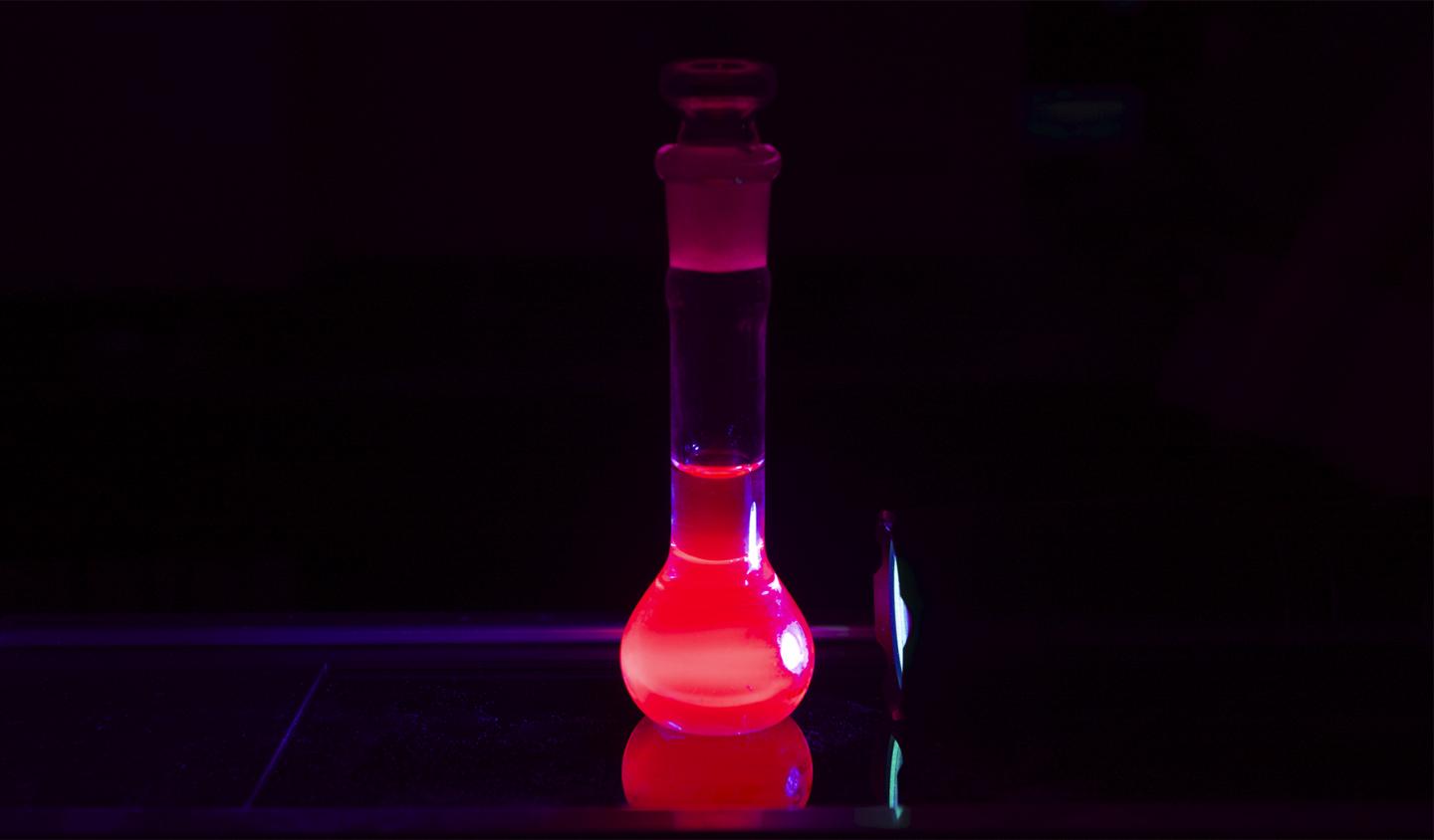
Credit: WPI-ICReDD, Hokkaido University

A stacked nanocarbon antenna makes a rare earth element shine 5 times more brightly than previous designs, with applications in molecular light-emitting devices.

A unique molecular design developed by Hokkaido University researchers causes a europium complex to shine more than five times brighter than the best previous design when it absorbs low energy blue light. The findings were published in the journal Communications Chemistry, and could lead to more efficient photosensitizers with a wide variety of applications.

Photosensitizers are molecules that become excited when they absorb light and then transfer this excited energy to another molecule. They are used in photochemical reactions, energy conversion systems, and in photodynamic therapy, which uses light to kill some kinds of early-stage cancer.

The design of currently available photosensitizers often leads to inevitable energy loss, and so they are not as efficient in light absorption and energy transfer as scientists would like. It also requires high energy light such as UV for excitation.

Yuichi Kitagawa and Yasuchika Hasegawa of Hokkaido University’s Institute for Chemical Reaction Design and Discovery (WPI-ICReDD) worked with colleagues in Japan to improve the design of conventional photosensitizers.

Their concept is based on extending the lifetime of a molecular energy state called the triplet excited state and reducing gaps between energy levels within the photosensitizer molecule. This would lead to more efficient use of photons and reduced energy loss.

The researchers designed a nanocarbon “antenna” made of coronene, a polycyclic aromatic hydrocarbon containing six benzene rings. Two nanocarbon antennas are stacked one on top of the other and then connected on either side to the rare Earth metal europium. Extra connectors are added to strengthen the bonds between the nanocarbon antennas and europium. When the nanocarbon antennas absorb light, they transfer this energy to europium, causing the complex to emit red light.

Experiments showed the complex best absorbed light with wavelengths of 450nm. When a blue LED (light-emitting diode) light was shone on the complex, it glowed more than five times brighter than the europium complex which until now had the strongest reported emission under blue light. The researchers also demonstrated that the complex can bear high temperatures above 300? thanks to its rigid structure.

“This study provides insights into the design of photosensitizers and can lead to photofunctional materials that efficiently utilize low energy light,” says Yuichi Kitagawa of the research team. The new design could be applied to fabricate molecular light-emitting devices, among other applications, the researchers say.

###

Media Contact
Naoki Namba
[email protected]
81-117-062-185

Original Source

https://www.global.hokudai.ac.jp/blog/let-the-europium-shine-brighter/

Related Journal Article

http://dx.doi.org/10.1038/s42004-019-0251-z

Tags: Chemistry/Physics/Materials SciencesIndustrial Engineering/ChemistryMaterials
Share12Tweet8Share2ShareShareShare2

Related Posts

Inflammasome Protein ASC Drives Pancreatic Cancer Metabolism

February 7, 2026

Phage-Antibiotic Combo Beats Resistant Peritoneal Infection

February 7, 2026

Boosting Remote Healthcare: Stepped-Wedge Trial Insights

February 7, 2026

Barriers and Boosters of Seniors’ Physical Activity in Karachi

February 7, 2026
Please login to join discussion

POPULAR NEWS

  • Robotic Ureteral Reconstruction: A Novel Approach

    Robotic Ureteral Reconstruction: A Novel Approach

    82 shares
    Share 33 Tweet 21
  • Digital Privacy: Health Data Control in Incarceration

    63 shares
    Share 25 Tweet 16
  • Study Reveals Lipid Accumulation in ME/CFS Cells

    57 shares
    Share 23 Tweet 14
  • Breakthrough in RNA Research Accelerates Medical Innovations Timeline

    53 shares
    Share 21 Tweet 13

About

We bring you the latest biotechnology news from best research centers and universities around the world. Check our website.

Follow us

Recent News

Inflammasome Protein ASC Drives Pancreatic Cancer Metabolism

Phage-Antibiotic Combo Beats Resistant Peritoneal Infection

Boosting Remote Healthcare: Stepped-Wedge Trial Insights

Subscribe to Blog via Email

Enter your email address to subscribe to this blog and receive notifications of new posts by email.

Join 73 other subscribers
  • Contact Us

Bioengineer.org © Copyright 2023 All Rights Reserved.

Welcome Back!

Login to your account below

Forgotten Password?

Retrieve your password

Please enter your username or email address to reset your password.

Log In
No Result
View All Result
  • Homepages
    • Home Page 1
    • Home Page 2
  • News
  • National
  • Business
  • Health
  • Lifestyle
  • Science

Bioengineer.org © Copyright 2023 All Rights Reserved.