• HOME
  • NEWS
  • EXPLORE
    • CAREER
      • Companies
      • Jobs
    • EVENTS
    • iGEM
      • News
      • Team
    • PHOTOS
    • VIDEO
    • WIKI
  • BLOG
  • COMMUNITY
    • FACEBOOK
    • INSTAGRAM
    • TWITTER
Thursday, March 26, 2026
BIOENGINEER.ORG
No Result
View All Result
  • Login
  • HOME
  • NEWS
  • EXPLORE
    • CAREER
      • Companies
      • Jobs
        • Lecturer
        • PhD Studentship
        • Postdoc
        • Research Assistant
    • EVENTS
    • iGEM
      • News
      • Team
    • PHOTOS
    • VIDEO
    • WIKI
  • BLOG
  • COMMUNITY
    • FACEBOOK
    • INSTAGRAM
    • TWITTER
  • HOME
  • NEWS
  • EXPLORE
    • CAREER
      • Companies
      • Jobs
        • Lecturer
        • PhD Studentship
        • Postdoc
        • Research Assistant
    • EVENTS
    • iGEM
      • News
      • Team
    • PHOTOS
    • VIDEO
    • WIKI
  • BLOG
  • COMMUNITY
    • FACEBOOK
    • INSTAGRAM
    • TWITTER
No Result
View All Result
Bioengineer.org
No Result
View All Result
Home NEWS Science News Chemistry

Active asteroid unveils fireball identity

Bioengineer by Bioengineer
January 15, 2020
in Chemistry
Reading Time: 2 mins read
0
IMAGE
Share on FacebookShare on TwitterShare on LinkedinShare on RedditShare on Telegram

IMAGE

Credit: NAOJ/Kasuga et al.


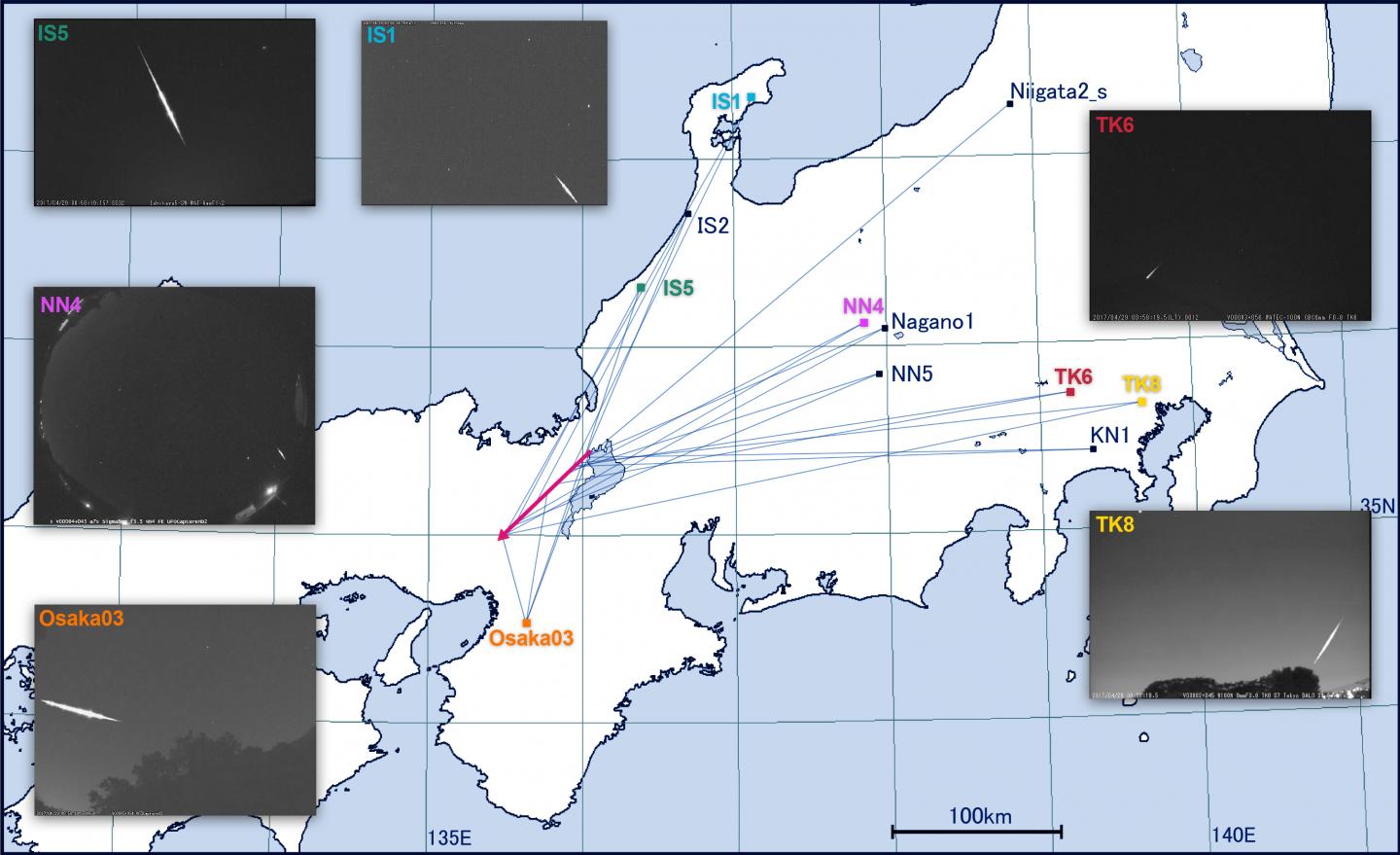
At around 1 a.m. local standard time on April 29, 2017, a fireball flew over Kyoto, Japan. Compared to other fireballs spotted from Earth, it was relatively bright and slow. Now, scientists have determined not only what the fireball was, but also where it came from.

“We uncovered the fireball’s true identity,” says Toshihiro Kasuga, paper author and visiting scientist at the National Astronomical Observatory of Japan and Kyoto Sangyo University. “It has a similar orbit to that of the near-Earth asteroid 2003 YT1, which is likely its parent body.”

2003 YT1, a binary asteroid first detected in 2003, appears to have been active in the past, meaning it fissured and released dust particles, such as the one responsible for the 2017 fireball. It does not currently show any activity, though, according to Kasuga. However, the researchers found that the orbit, estimated radiant point, velocity and appearance date of the 2017 fireball are all consistent with dust particles that originated from 2003 YT1.

“The potential break-up of the rock could be dangerous to life on Earth,” Kasuga says. “The parent body 2003 YT1 could break up, and those resulting asteroids could hit the Earth in the next 10 million years or so, especially because 2003 YT1 has a dust production mechanism.”

The researchers found that this dust production mechanism, or the asteroid’s likelihood of releasing dust and rock particles, stems from its rotational instability in a process called the YORP effect. When the asteroid is warmed by the Sun, the energy results in a small thrust, which can produce a corresponding recoil, depending on the gravitational pull and other physical variables. The recoil can twist the asteroid, introducing a rotational change. The change can be at physical odds with the gravity and/or other forces, and force the asteroid to physically break — even just a little, a process which produces dust.

“The released particles can enter Earth’s atmosphere and appear as fireballs, which is exactly what happened in 2017,” says Kasuga.

According to Kasuga, that particular fireball was not a threat to Earth, as it was estimated to only be a few centimeters in size. Something so small would burn up before it reached the surface.

“The 2017 fireball and its parent asteroid gave us a behind-the-scenes look at meteors,” says Kasuga. “Next, we plan to further research predictions for potentially hazardous objects approaching the Earth. Meteor science can be a powerful asset for taking advanced steps towards planetary defense.”

###

Other contributors include Mikiya Sato, Masayoshi Ueda, and Yasunori Fujiwara, all of the Nippon Meteor Society. Chie Tsuchiya and Jun-Ichi Watanabe, both of the National Astronomical Observatory of Japan, also co-authored the paper.

Media Contact
Hitoshi Yamaoka
[email protected]

Original Source

https://www.nao.ac.jp/en/news/science/2020/20200115-prc.html

Related Journal Article

http://dx.doi.org/10.3847/1538-3881/ab4e1b

Tags: AstronomyAstrophysicsComets/AsteroidsMeteorologySpace/Planetary Science
Share12Tweet8Share2ShareShareShare2

Related Posts

Isolated H2-Reduced Clusters Boost CO2-to-Methanol Catalysis

Isolated H2-Reduced Clusters Boost CO2-to-Methanol Catalysis

March 25, 2026
blank

Physicists Identify Electronic Drivers Behind Flat Band Quantum Materials

March 21, 2026

Würzburg Chemistry Professor Claudia Höbartner Receives Prestigious Honor

March 20, 2026

Scientists Reveal How Magnets Control Metamaterial Behavior

March 20, 2026
Please login to join discussion

POPULAR NEWS

  • blank

    Revolutionary AI Model Enhances Precision in Detecting Food Contamination

    96 shares
    Share 38 Tweet 24
  • Imagine a Social Media Feed That Challenges Your Views Instead of Reinforcing Them

    1003 shares
    Share 397 Tweet 248
  • Uncovering Functions of Cavernous Malformation Proteins in Organoids

    54 shares
    Share 22 Tweet 14
  • Promising Outcomes from First Clinical Trials of Gene Regulation in Epilepsy

    51 shares
    Share 20 Tweet 13

About

We bring you the latest biotechnology news from best research centers and universities around the world. Check our website.

Follow us

Recent News

In-Sensor Cryptography Links Physical Process to Digital Identity

Can Psychosocial Factors Influence Cancer Risk?

Depression Factors in Elderly: Pre vs. Post-COVID Analysis

Subscribe to Blog via Email

Success! An email was just sent to confirm your subscription. Please find the email now and click 'Confirm' to start subscribing.

Join 78 other subscribers
  • Contact Us

Bioengineer.org © Copyright 2023 All Rights Reserved.

Welcome Back!

Login to your account below

Forgotten Password?

Retrieve your password

Please enter your username or email address to reset your password.

Log In
No Result
View All Result
  • Homepages
    • Home Page 1
    • Home Page 2
  • News
  • National
  • Business
  • Health
  • Lifestyle
  • Science

Bioengineer.org © Copyright 2023 All Rights Reserved.