• HOME
  • NEWS
  • EXPLORE
    • CAREER
      • Companies
      • Jobs
    • EVENTS
    • iGEM
      • News
      • Team
    • PHOTOS
    • VIDEO
    • WIKI
  • BLOG
  • COMMUNITY
    • FACEBOOK
    • INSTAGRAM
    • TWITTER
Saturday, February 7, 2026
BIOENGINEER.ORG
No Result
View All Result
  • Login
  • HOME
  • NEWS
  • EXPLORE
    • CAREER
      • Companies
      • Jobs
        • Lecturer
        • PhD Studentship
        • Postdoc
        • Research Assistant
    • EVENTS
    • iGEM
      • News
      • Team
    • PHOTOS
    • VIDEO
    • WIKI
  • BLOG
  • COMMUNITY
    • FACEBOOK
    • INSTAGRAM
    • TWITTER
  • HOME
  • NEWS
  • EXPLORE
    • CAREER
      • Companies
      • Jobs
        • Lecturer
        • PhD Studentship
        • Postdoc
        • Research Assistant
    • EVENTS
    • iGEM
      • News
      • Team
    • PHOTOS
    • VIDEO
    • WIKI
  • BLOG
  • COMMUNITY
    • FACEBOOK
    • INSTAGRAM
    • TWITTER
No Result
View All Result
Bioengineer.org
No Result
View All Result
Home NEWS Science News Health

School indoor air quality cannot be reliably assessed based on pupils’ symptoms

Bioengineer by Bioengineer
January 14, 2020
in Health
Reading Time: 2 mins read
0
IMAGE
Share on FacebookShare on TwitterShare on LinkedinShare on RedditShare on Telegram

IMAGE

Credit: Finnish Institute for Health and Welfare


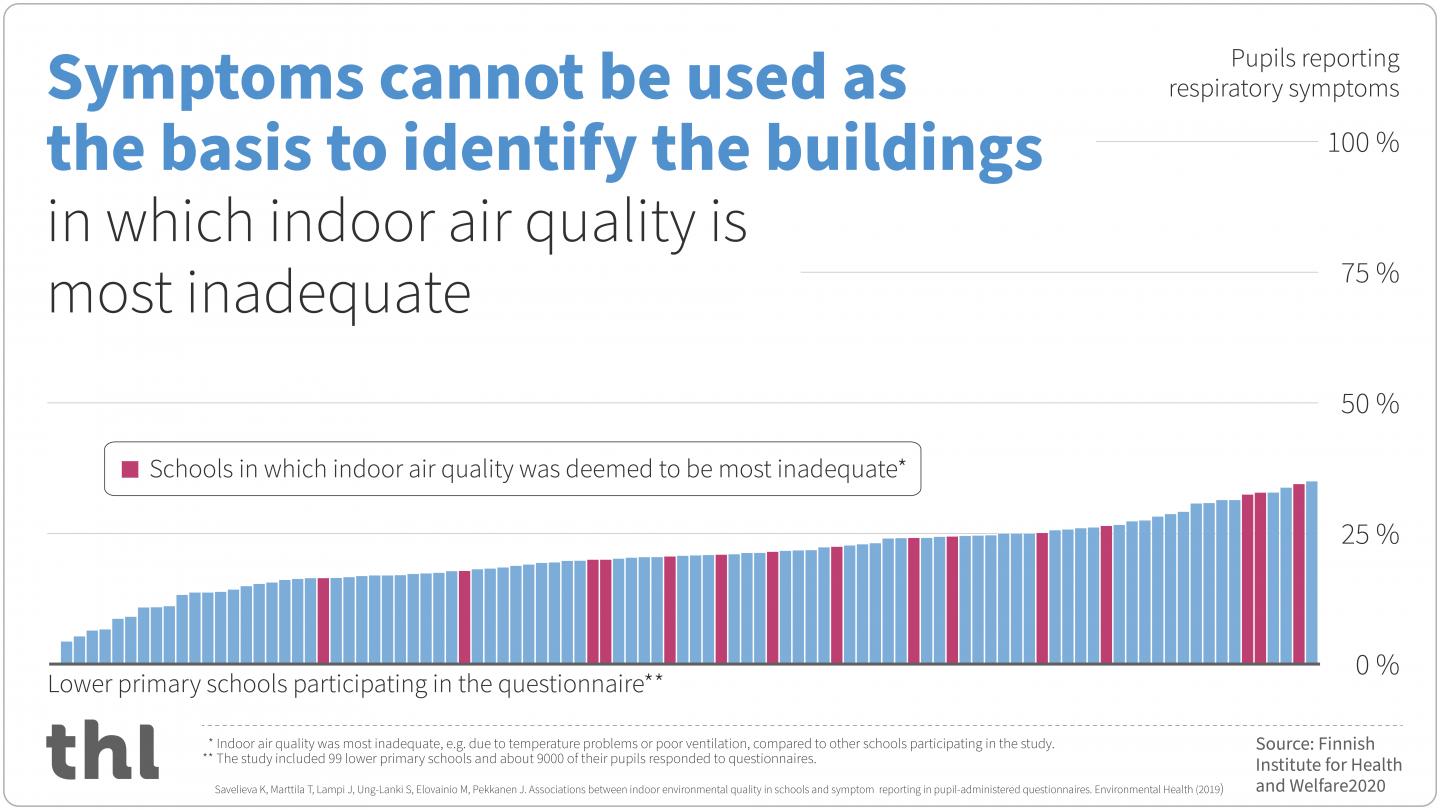
In school buildings with indoor air quality related problems, such as moisture damage, temperature problems or poor ventilation, pupils experience slightly more symptoms than in buildings in which conditions are stated to be good based on expert evaluation.

However, the association between indoor air quality of the school building and the pupils’ symptoms was so weak that it is not possible to reliably assess the quality of the indoor air based on the amount of reported symptoms. This was found in a recent study, by the Finnish Institute for Health and Welfare and the University of Helsinki, which was published in the scientific journal Environmental Health.

The researchers found that inadequate indoor air quality was connected to the pupils’ respiratory and general symptoms, such as colds, coughs and headaches. Some link to lower airway or skin symptoms was also found, but not to eye symptoms.

It is worth maintaining and investigating buildings

Earlier research also suggests that symptoms are not a good marker of the indoor air quality of a building.

“We need more research on how much indoor air impurities explain the differences in symptoms between schools, in comparison to other factors that influence symptoms. To date, these other factors have been remarkably little researched,” said Professor Juha Pekkanen.

Besides indoor air, other factors that influence symptoms include the age of the person, their health and stress levels, including how well they are doing and feeling at work and school, and beliefs and concerns about the risks of poor indoor air. The fact that many issues influence people’s symptoms in indoor environments needs to be considered when interpreting the results of indoor air questionnaires.

“Questionnaires aimed at building users provide valuable additional information for the management of indoor air quality problems. However, the decisions on renovations should be based primarily on data obtained by investigating the building,” said Chief Physician Jussi Lampi.

The study included 129 lower and upper primary school buildings in the Helsinki area. The building conditions were assessed based on the City of Helsinki’s evaluations. The Finnish Institute of Health and Welfare’s indoor air questionnaire was used to gather data about pupils’ symptoms. More than 12,000 pupils responded to the questionnaire. The response rate was 60%.

###

Media Contact
Juha Pekkanen
[email protected]
358-405-081-077

Original Source

https://thl.fi/en/web/thlfi-en/-/study-school-indoor-air-quality-cannot-be-reliably-assessed-based-on-pupils-symptoms

Related Journal Article

http://dx.doi.org/10.1186/s12940-019-0555-6

Tags: Immunology/Allergies/AsthmaMedicine/Health
Share12Tweet8Share2ShareShareShare2

Related Posts

Personalized Guide to Understanding and Reducing Chemicals

February 7, 2026

Inflammasome Protein ASC Drives Pancreatic Cancer Metabolism

February 7, 2026

Phage-Antibiotic Combo Beats Resistant Peritoneal Infection

February 7, 2026

Boosting Remote Healthcare: Stepped-Wedge Trial Insights

February 7, 2026
Please login to join discussion

POPULAR NEWS

  • Robotic Ureteral Reconstruction: A Novel Approach

    Robotic Ureteral Reconstruction: A Novel Approach

    82 shares
    Share 33 Tweet 21
  • Digital Privacy: Health Data Control in Incarceration

    63 shares
    Share 25 Tweet 16
  • Study Reveals Lipid Accumulation in ME/CFS Cells

    57 shares
    Share 23 Tweet 14
  • Breakthrough in RNA Research Accelerates Medical Innovations Timeline

    53 shares
    Share 21 Tweet 13

About

We bring you the latest biotechnology news from best research centers and universities around the world. Check our website.

Follow us

Recent News

Personalized Guide to Understanding and Reducing Chemicals

Inflammasome Protein ASC Drives Pancreatic Cancer Metabolism

Phage-Antibiotic Combo Beats Resistant Peritoneal Infection

Subscribe to Blog via Email

Enter your email address to subscribe to this blog and receive notifications of new posts by email.

Join 73 other subscribers
  • Contact Us

Bioengineer.org © Copyright 2023 All Rights Reserved.

Welcome Back!

Login to your account below

Forgotten Password?

Retrieve your password

Please enter your username or email address to reset your password.

Log In
No Result
View All Result
  • Homepages
    • Home Page 1
    • Home Page 2
  • News
  • National
  • Business
  • Health
  • Lifestyle
  • Science

Bioengineer.org © Copyright 2023 All Rights Reserved.