Polypropylene glycol-based biomaterial compatible with body tissue
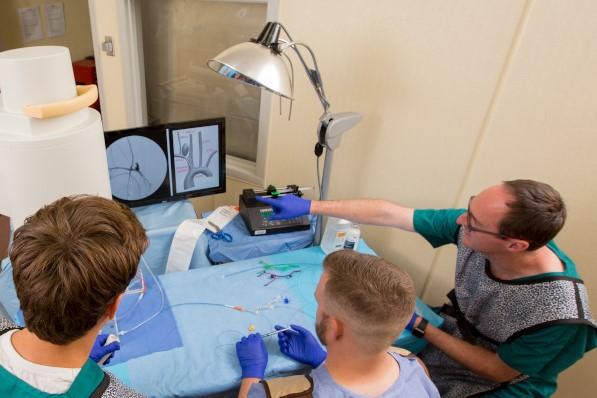
Credit: Northern Arizona University
Tim Becker, an associate professor of practice in the Department of Mechanical Engineering at Northern Arizona University, is developing a polypropylene glycol-based biomaterial called PPODA-QT, which is similar to body tissue, to treat aneurysms in the brain and improve outcomes for stroke and potential stroke patients.
An aneurysm is an abnormal pouch or bulge that forms in a weakened wall of a blood vessel. When it occurs in the brain, it can look like a berry hanging off a stem. Often unnoticed and untreated, a cerebral aneurysm can burst suddenly, cause bleeding into the brain and result in a catastrophic stroke.
According to the Brain Aneurysm Foundation, 6.5 million people in the United States have unruptured cerebral aneurysms. About 30,000 will suffer from a ruptured aneurysm each year. When that happens, Becker says 15 percent of patients die before they can receive medical treatment; 25 percent die despite medical treatment; and only one in four will make a full recovery.
“Current methods used to treat aneurysms, especially larger ones, are inadequate as long-term solutions,” Becker said. “About 20 years ago, if you had an aneurysm and doctors found out before it burst, you would have to have brain surgery to clip it to keep it from rupturing. About 15 years ago, surgeons began using tiny catheters inserted inside the blood vessel from the leg to place metal coils into the aneurysm to keep it from growing. The metal devices out there now are better than brain surgery, but don’t adequately fill the space and allow the blood vessel and aneurysm to heal completely.”
Becker, a medical device engineer, believes PPODA-QT can effectively plug the ballooning aneurysm, enable tissue to regrow over the material and heal the main vessel.
“We’re targeting those larger aneurysms, which can be as big as a quarter, because those are hard to treat. They always seem to grow back in about three years. With so much blood pressure pushing on the weakened blood vessels, blood flow finds a way back in and can still burst. The PPODA-QT material is compatible with the body and can fill that aneurysm space effectively, leaving a smooth surface for healing. It’s a better and more natural option for the body than a wire coil.”
Becker is one of the founders of a medical products company called Aneuvas Technologies Inc. (ATI), which has created a biomaterial device for treating aneurysms. Through a grant from the National Institutes of Health, ATI has granted NAU a subaward of $550,000 over the next two years for Becker’s team in the Bioengineering Devices Lab (BDL) to conduct translational research and help develop new and better versions of the polymer and optimize its use.*
“NAU researchers, including engineering, physics and biomedical sciences students, will create new benchtop blood vessel models with properties that are similar to human vessels, to test how well biomaterials can stop blood flow and treat the aneurysm,” Becker said. “We’ll also be testing many different aneurysm devices, including coils, and comparing them.”
Becker aims to assess the long-term mechanical stability of PPODA-QT as a method for treating larger aneurysms, and develop and assess delivery techniques to insert the material into these aneurysms in an effort to reduce their recurrence rates.
“The hope is that we can detect aneurysms earlier, select a device that will treat the aneurysm and not have it grow back,” he said.
The project combines the clinical device experience at ATI, the neurovascular engineering and materials testing capabilities in the BDL at NAU and clinical research being conducted at Barrow Neurological Institute in Phoenix.
“With the currently assembled group of technical, medical and business expertise, FDA approval of an innovative product and its path to commercialization is within reach,” Becker said.
###
*To protect NAU, faculty and students from any potential conflict of interest, a robust conflict of interest plan has been developed and implemented through the Office of the Vice President for Research for this project.
Media Contact
Kerry Bennett
[email protected]
928-523-5556
Original Source
https:/