• HOME
  • NEWS
  • EXPLORE
    • CAREER
      • Companies
      • Jobs
    • EVENTS
    • iGEM
      • News
      • Team
    • PHOTOS
    • VIDEO
    • WIKI
  • BLOG
  • COMMUNITY
    • FACEBOOK
    • INSTAGRAM
    • TWITTER
Saturday, February 7, 2026
BIOENGINEER.ORG
No Result
View All Result
  • Login
  • HOME
  • NEWS
  • EXPLORE
    • CAREER
      • Companies
      • Jobs
        • Lecturer
        • PhD Studentship
        • Postdoc
        • Research Assistant
    • EVENTS
    • iGEM
      • News
      • Team
    • PHOTOS
    • VIDEO
    • WIKI
  • BLOG
  • COMMUNITY
    • FACEBOOK
    • INSTAGRAM
    • TWITTER
  • HOME
  • NEWS
  • EXPLORE
    • CAREER
      • Companies
      • Jobs
        • Lecturer
        • PhD Studentship
        • Postdoc
        • Research Assistant
    • EVENTS
    • iGEM
      • News
      • Team
    • PHOTOS
    • VIDEO
    • WIKI
  • BLOG
  • COMMUNITY
    • FACEBOOK
    • INSTAGRAM
    • TWITTER
No Result
View All Result
Bioengineer.org
No Result
View All Result
Home NEWS Science News Chemistry

McMaster chemists find new way to break down old tires into material for new ones

Bioengineer by Bioengineer
January 13, 2020
in Chemistry
Reading Time: 2 mins read
0
IMAGE
Share on FacebookShare on TwitterShare on LinkedinShare on RedditShare on Telegram

IMAGE

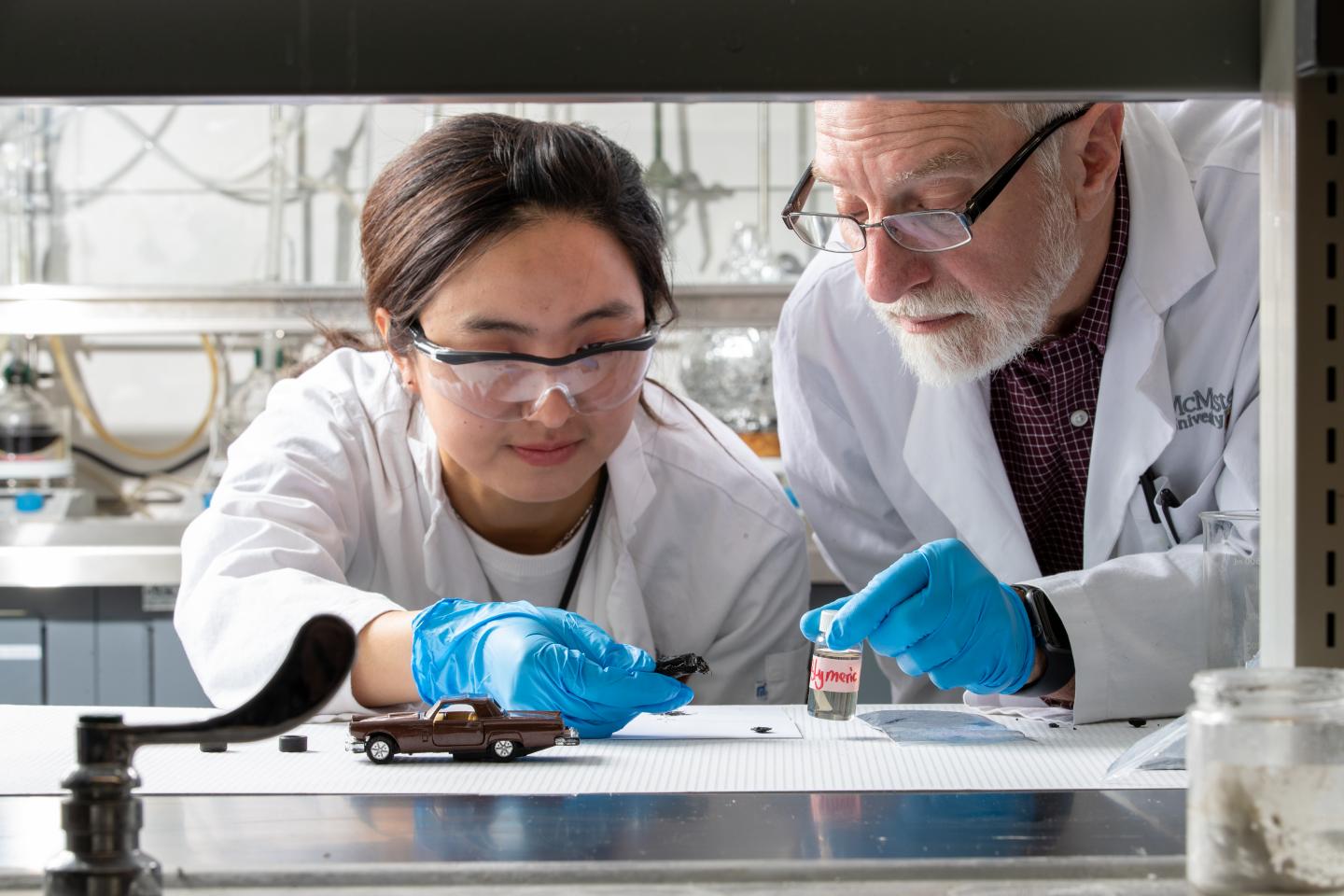
Credit: Georgia Kirkos, McMaster University


A team of chemists at McMaster University has discovered an innovative way to break down and dissolve the rubber used in automobile tires, a process which could lead to new recycling methods that have so far proven to be expensive, difficult and largely inefficient.

The method, outlined in the journal Green Chemistry, addresses the enormous environmental burden posed by tires, approximately 3 billion of which were manufactured and purchased worldwide in 2019. Most of those will end up in massive landfills or storage facilities, ultimately leaching contaminants into the ecosystem.

In 1990, a massive fire continued to burn out-of-control in a pile of 14 million scrap tires near Hagersville, Ontario. It continued for 17 days, spewing toxic smoke into the environment, and drove 4,000 residents from their homes. The fire has been linked to many long-term health issues, including rare cancers among the firefighters who worked on scene for days.

Tires are a typical example of a product prepared for a single use from a non-renewable resource. While some are used as fuel in the cement industry or broken down into crumbs to use as fillers in asphalt, cement or artificial turf, there is no convenient method for recovering the petroleum-based polymers from which they are made so they cannot be easily reused, effectively repurposed, or recycled.

“The chemistry of the tire is very complex and does not lend itself to degradation – for good reason,” says Michael Brook, a professor in the Department of Chemistry & Chemical Biology at McMaster and lead author of the study. “The properties that make tires so durable and stable on the road also make them exceptionally difficult to break down and recycle.”

Charles Goodyear first developed the technique of curing tires in 1850 by combining sulfur with natural rubber, which forms bridges between the natural polymers and transforms the mixture from fluid to rubber.

In the paper, researchers describe a process to efficiently break down the polymeric oils by breaking the sulfur-to-sulfur bond. Brook likens the structure to a piece of fishnet.

“We have found a way to cut all the horizontal lines so instead of having a net, you now have a large number of ropes, which can be isolated and reprocessed much more easily,” he says.

The new method could help to eliminate and prevent the major environmental concerns and dangers posed by stockpiled tires.

While promising, researchers caution that the new method has some limitations because it is expensive for industrial applications.

“We’re working on it, but this is the first major step. This process closes the loop on automotive rubber, allowing old tires to be converted into new products,” says Brook.

###

Media Contact
Michelle Donovan
[email protected]
905-525-9140

Related Journal Article

http://dx.doi.org/10.1039/C9GC03545A

Tags: Chemistry/Physics/Materials SciencesIndustrial Engineering/ChemistryMaterials
Share12Tweet8Share2ShareShareShare2

Related Posts

blank

Breakthrough in Environmental Cleanup: Scientists Develop Solar-Activated Biochar for Faster Remediation

February 7, 2026
blank

Cutting Costs: Making Hydrogen Fuel Cells More Affordable

February 6, 2026

Scientists Develop Hand-Held “Levitating” Time Crystals

February 6, 2026

Observing a Key Green-Energy Catalyst Dissolve Atom by Atom

February 6, 2026
Please login to join discussion

POPULAR NEWS

  • Robotic Ureteral Reconstruction: A Novel Approach

    Robotic Ureteral Reconstruction: A Novel Approach

    82 shares
    Share 33 Tweet 21
  • Digital Privacy: Health Data Control in Incarceration

    63 shares
    Share 25 Tweet 16
  • Study Reveals Lipid Accumulation in ME/CFS Cells

    57 shares
    Share 23 Tweet 14
  • Breakthrough in RNA Research Accelerates Medical Innovations Timeline

    53 shares
    Share 21 Tweet 13

About

We bring you the latest biotechnology news from best research centers and universities around the world. Check our website.

Follow us

Recent News

Evaluating Pediatric Emergency Care Quality in Ethiopia

TPMT Expression Predictions Linked to Azathioprine Side Effects

Improving Dementia Care with Enhanced Activity Kits

Subscribe to Blog via Email

Success! An email was just sent to confirm your subscription. Please find the email now and click 'Confirm' to start subscribing.

Join 73 other subscribers
  • Contact Us

Bioengineer.org © Copyright 2023 All Rights Reserved.

Welcome Back!

Login to your account below

Forgotten Password?

Retrieve your password

Please enter your username or email address to reset your password.

Log In
No Result
View All Result
  • Homepages
    • Home Page 1
    • Home Page 2
  • News
  • National
  • Business
  • Health
  • Lifestyle
  • Science

Bioengineer.org © Copyright 2023 All Rights Reserved.