• HOME
  • NEWS
  • EXPLORE
    • CAREER
      • Companies
      • Jobs
    • EVENTS
    • iGEM
      • News
      • Team
    • PHOTOS
    • VIDEO
    • WIKI
  • BLOG
  • COMMUNITY
    • FACEBOOK
    • INSTAGRAM
    • TWITTER
Saturday, December 27, 2025
BIOENGINEER.ORG
No Result
View All Result
  • Login
  • HOME
  • NEWS
  • EXPLORE
    • CAREER
      • Companies
      • Jobs
        • Lecturer
        • PhD Studentship
        • Postdoc
        • Research Assistant
    • EVENTS
    • iGEM
      • News
      • Team
    • PHOTOS
    • VIDEO
    • WIKI
  • BLOG
  • COMMUNITY
    • FACEBOOK
    • INSTAGRAM
    • TWITTER
  • HOME
  • NEWS
  • EXPLORE
    • CAREER
      • Companies
      • Jobs
        • Lecturer
        • PhD Studentship
        • Postdoc
        • Research Assistant
    • EVENTS
    • iGEM
      • News
      • Team
    • PHOTOS
    • VIDEO
    • WIKI
  • BLOG
  • COMMUNITY
    • FACEBOOK
    • INSTAGRAM
    • TWITTER
No Result
View All Result
Bioengineer.org
No Result
View All Result
Home NEWS Science News Chemistry

Developed a band-aid-like sensor to detect human body conditions in real-time

Bioengineer by Bioengineer
January 8, 2020
in Chemistry
Reading Time: 2 mins read
0
IMAGE
Share on FacebookShare on TwitterShare on LinkedinShare on RedditShare on Telegram

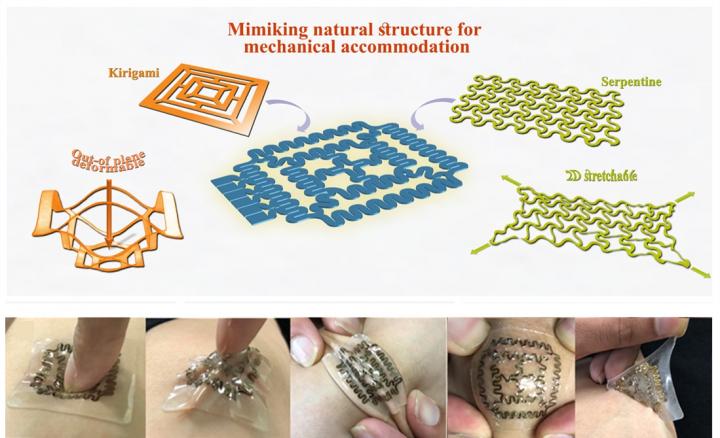
Dramatically improved sensor stability with complex structural design that mimics snake motions, spider webs, and paper craft Expected to be applied in various fields such as bio-diagnosis, smart skin, clothes, and livestock diagnosis
IMAGE

Credit: DGIST

DGIST announced that Professor Hyuk-Jun Kwon in the Department of Information and Communication Engineering developed a ‘patch-based health diagnosis sensor system’ that is easily attached to skin with Professor Sunkook Kim’s research team at Sungkyunkwan University. This sensor is attached to skin as if attaching band-aid and collects various health information in real-time by monitoring biosignals and certain movements, drawing huge expectations for diverse applications.

Research on wearable healthcare devices has been actively conducted with the well-being era. However, product developments have faced many difficulties due to barriers in collecting biometric information such as body movements, sweats, and secretions. Professor Kwon’s team focused on developing sensors that can collect stable biometric data from various situations including intense workouts and emergencies.

As a result, the research team has successfully developed precise structures for daily life using laser and increased the stability of sensor that collects biometric information. Inspired by the crooked movements of snakes and spider webs, Professor Kwon’s team created a stable structure for sensors to operate without damage despite huge body movements. Moreover, the team greatly improved the vertical elasticity of the sensors by applying the zigzag paper craft structure, so that sensors endure intense body movements.

The patch-based sensor developed this time was made of a biometric-friendly waterproof material, thus improving the difficulties in acquiring accurate information due to the skin-attachment problem. In addition, the sensor can also be connected to smartphone using Bluetooth, so biometric data can be saved to a cloud server 24/7. This will enable making timely response to various emergencies such as infants, young children, and elders living alone who are need care as well as soldiers and firefighters who are constantly exposed to dangerous environments.

Professor Kwon said that “The key for this sensor development was securing structural stability and skin adhesion that can endure very intensive physical movements. The sensor is very useful because as long as it is attached to skin like a band-aid, it can collect various biodata information. It is expected to be applied to observe and monitor animal and livestock diseases as well in the future.”

###

This research was published on the online version of IEEE (Transaction on Industrial Electronics), a world-renowned international journal in electrical and electronic engineering.

Media Contact
Hyuk-Jun Kwon
[email protected]
82-537-856-326

Original Source

https://www.dgist.ac.kr/en/html/sub06/060202.html?mode=V&no=8264d7c4033a194c342d3e362287777c

Related Journal Article

http://dx.doi.org/10.1109/TIE.2019.2950842

Tags: BiotechnologyComputer ScienceElectrical Engineering/ElectronicsElectromagneticsTechnology/Engineering/Computer Science
Share12Tweet8Share2ShareShareShare2

Related Posts

Cutting Electrolyte Reduction Boosts High-Energy Battery Performance

Cutting Electrolyte Reduction Boosts High-Energy Battery Performance

December 19, 2025
Microenvironment Shapes Gold-Catalysed CO2 Electroreduction

Microenvironment Shapes Gold-Catalysed CO2 Electroreduction

December 11, 2025

Photoswitchable Olefins Enable Controlled Polymerization

December 11, 2025

Cation Hydration Entropy Controls Chloride Ion Diffusion

December 10, 2025
Please login to join discussion

POPULAR NEWS

  • Robotic Waist Tether for Research Into Metabolic Cost of Walking

    NSF funds machine-learning research at UNO and UNL to study energy requirements of walking in older adults

    71 shares
    Share 28 Tweet 18
  • Nurses’ Views on Online Learning: Effects on Performance

    70 shares
    Share 28 Tweet 18
  • Exploring Audiology Accessibility in Johannesburg, South Africa

    51 shares
    Share 20 Tweet 13
  • Unraveling Levofloxacin’s Impact on Brain Function

    55 shares
    Share 22 Tweet 14

About

We bring you the latest biotechnology news from best research centers and universities around the world. Check our website.

Follow us

Recent News

Pilot Study: Haptic VR Simulation for Nursing Students

Unraveling Bisphenol A’s Stroke Toxicity Mechanisms

CAR-T vs. Bispecific Antibodies: A Treatment Showdown

Subscribe to Blog via Email

Enter your email address to subscribe to this blog and receive notifications of new posts by email.

Join 71 other subscribers
  • Contact Us

Bioengineer.org © Copyright 2023 All Rights Reserved.

Welcome Back!

Login to your account below

Forgotten Password?

Retrieve your password

Please enter your username or email address to reset your password.

Log In
No Result
View All Result
  • Homepages
    • Home Page 1
    • Home Page 2
  • News
  • National
  • Business
  • Health
  • Lifestyle
  • Science

Bioengineer.org © Copyright 2023 All Rights Reserved.