• HOME
  • NEWS
  • EXPLORE
    • CAREER
      • Companies
      • Jobs
    • EVENTS
    • iGEM
      • News
      • Team
    • PHOTOS
    • VIDEO
    • WIKI
  • BLOG
  • COMMUNITY
    • FACEBOOK
    • INSTAGRAM
    • TWITTER
Monday, May 18, 2026
BIOENGINEER.ORG
No Result
View All Result
  • Login
  • HOME
  • NEWS
  • EXPLORE
    • CAREER
      • Companies
      • Jobs
        • Lecturer
        • PhD Studentship
        • Postdoc
        • Research Assistant
    • EVENTS
    • iGEM
      • News
      • Team
    • PHOTOS
    • VIDEO
    • WIKI
  • BLOG
  • COMMUNITY
    • FACEBOOK
    • INSTAGRAM
    • TWITTER
  • HOME
  • NEWS
  • EXPLORE
    • CAREER
      • Companies
      • Jobs
        • Lecturer
        • PhD Studentship
        • Postdoc
        • Research Assistant
    • EVENTS
    • iGEM
      • News
      • Team
    • PHOTOS
    • VIDEO
    • WIKI
  • BLOG
  • COMMUNITY
    • FACEBOOK
    • INSTAGRAM
    • TWITTER
No Result
View All Result
Bioengineer.org
No Result
View All Result
Home NEWS Science News Immunology

Researchers identify key structure of C. difficle bacteria that could lead to future treatments

Bioengineer by Bioengineer
January 3, 2020
in Immunology
Reading Time: 2 mins read
0
IMAGE
Share on FacebookShare on TwitterShare on LinkedinShare on RedditShare on Telegram

Mapping of new cell binding component on bacteria could lead to new structure-based drug-design
IMAGE

Credit: PNAS


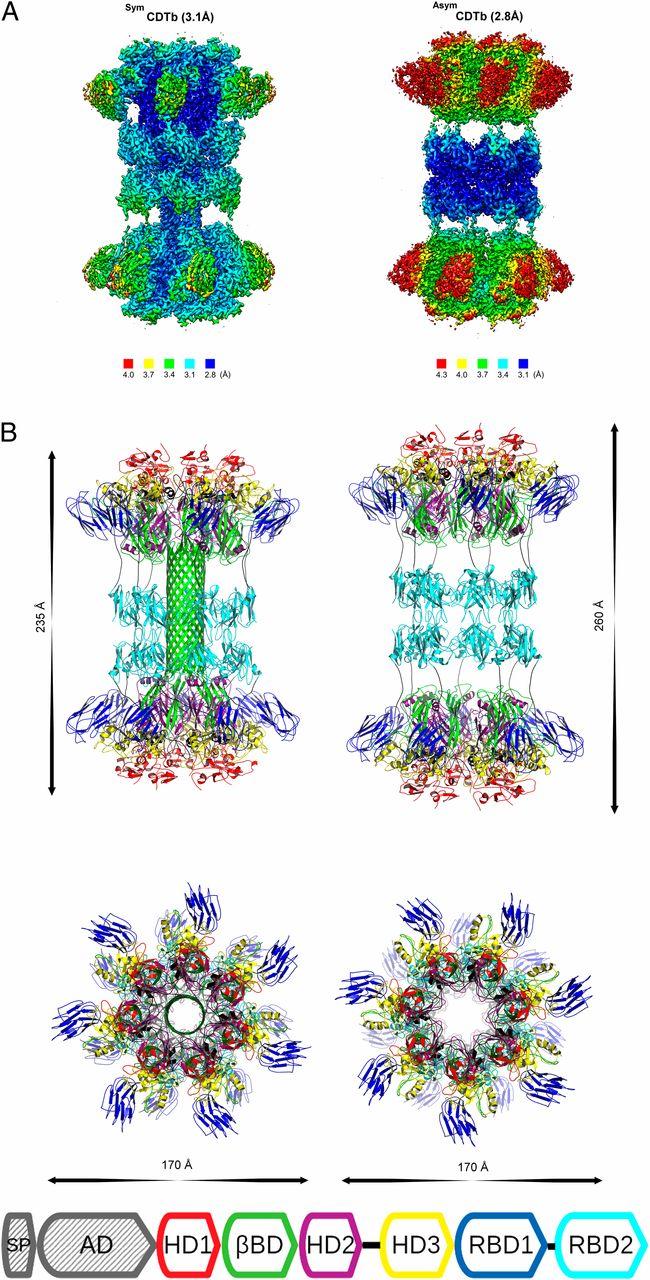
Researchers from the University of Maryland School of Medicine and their colleagues have identified the structure of the most lethal toxin produced by certain strains of Clostridium difficile bacteria, a potentially deadly infection associated with the use of antibiotics. The finding, published today in the Proceedings of the National Academy of Sciences journal, used cryo electron microscopy, X-ray crystallography and other biophysical methods to identify the microscopic structures of the bacteria. The researchers mapped out the delivery and binding components of the toxin, which could pave the way for new drugs to neutralize it.

“We identified two structures that help explain the molecular underpinnings of C. difficile toxicity,” said study co-author David Weber, PhD, a Professor of Biochemistry and Molecular Biology and Director of the Center for Biomolecular Therapeutics at UMSOM. “These structures will be important for targeting this human pathogen using structure-based therapeutic design methods.”

Certain C. difficile infections are notoriously difficult to treat and often arise from antibiotic therapy given to fight other infections, which wipes out the beneficial bacteria that normally keep C. difficile bacteria in check. More than 500,000 cases occur annually in the United States, according to the Centers for Disease Control and Prevention, resulting in an estimated 15,000 deaths, usually from strains that are resistant to antibiotic treatment.

There is currently no drug approved by the Food and Drug Administration that targets the C. difficile toxin (CDT) or “binary toxin”.

The work was done in conjunction with researchers at the City University of New York, City College of New York, the National Institute of Standards and Merck & Co.

With the mapping of the structures of one of the binary toxins, called CDTb, the researchers next aim to answer important new questions regarding the molecular mechanism of the C. difficile toxin, which can also benefit drug discovery. For example, they will investigate how the active binary toxin complex assembles and dissociates, how it binds to a healthy cell in a patient’s gastrointestinal tract and how it enters the cell.

###

This research was funded by the National Institutes of Health, National Science Foundation Division of Chemistry, and the U.S. Department of Health and Human Services.

Media Contact
Deborah Kotz
[email protected]
410-706-4255

Related Journal Article

http://dx.doi.org/10.1073/pnas.1919490117

Tags: Infectious/Emerging DiseasesMedicine/HealthMolecular Biology
Share12Tweet8Share2ShareShareShare2

Related Posts

IMAGE

UMass Amherst grad student awarded fellowship for food allergy research

July 23, 2021
IMAGE

Less-sensitive COVID-19 tests may still achieve optimal results if enough people tested

July 22, 2021

Public trust in CDC, FDA, and Fauci holds steady, survey shows

July 20, 2021

USC study shows male-female differences in immune cell function

July 19, 2021
Please login to join discussion

POPULAR NEWS

  • Research Indicates Potential Connection Between Prenatal Medication Exposure and Elevated Autism Risk

    845 shares
    Share 338 Tweet 211
  • New Study Reveals Plants Can Detect the Sound of Rain

    731 shares
    Share 292 Tweet 182
  • Salmonella Haem Blocks Macrophages, Boosts Infection

    62 shares
    Share 25 Tweet 16
  • Breastmilk Balances E. coli and Beneficial Bacteria in Infant Gut Microbiomes

    58 shares
    Share 23 Tweet 15

About

We bring you the latest biotechnology news from best research centers and universities around the world. Check our website.

Follow us

Recent News

Immune Checkpoint Regulation in Cancer Therapy and Evasion

Antibiotics Ineffective for Wheezing Episodes in Young Children in Emergency Care, Study Finds

Evaluating a Family-Based Healthy Weight Program for Childhood Obesity in Primary Care Clinics Across Louisiana and Tennessee

Subscribe to Blog via Email

Enter your email address to subscribe to this blog and receive notifications of new posts by email.

Join 82 other subscribers
  • Contact Us

Bioengineer.org © Copyright 2023 All Rights Reserved.

Welcome Back!

Login to your account below

Forgotten Password?

Retrieve your password

Please enter your username or email address to reset your password.

Log In
No Result
View All Result
  • Homepages
    • Home Page 1
    • Home Page 2
  • News
  • National
  • Business
  • Health
  • Lifestyle
  • Science

Bioengineer.org © Copyright 2023 All Rights Reserved.