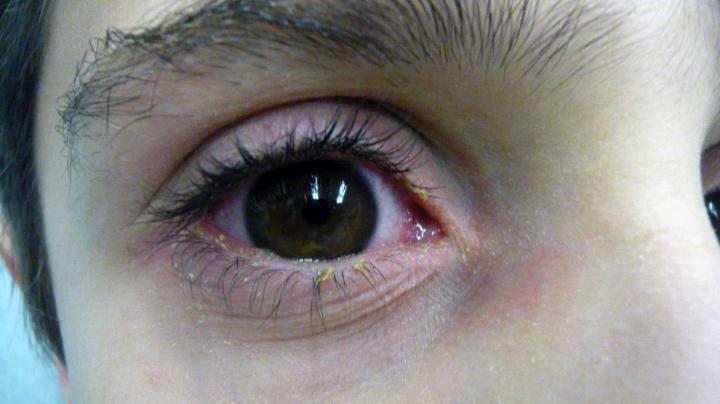
Credit: University Children’s Hospital Zurich
Painful inflammatory lesions of the skin and mucous membranes may occur in children who develop bacterial pneumonia. A research group at the University Children’s Hospital Zurich has recently developed a new diagnostic blood test, which reliably diagnoses bacteria as the causative pathogen at an early stage, allowing more specific treatment and prediction about prognosis.
Rapidly dying mucous membrane cells in the mouth, eye and genital regions, and vesicles and blisters on the skin can be symptoms and signs of drug allergies or infections. The latter can be triggered by the bacterium Mycoplasma pneumoniae, which is a well-known cause of pneumonia in children. M. pneumoniae can also be found outside the lungs and trigger severe, painful skin and mucous membrane lesions.
Early and clear diagnosis of bacterial infections
The connection between a M. pneumoniae infection and inflammation of the skin and mucous membranes is difficult to prove, however: Routine diagnostic tests can detect M. pneumoniae, but do not answer the question of whether it is the cause of the infection or whether the bacteria has colonized only the nasopharyngeal cavity without any consequences.
A research group at the University Children’s Hospital Zurich has therefore developed an ELISpot (Enzyme-Linked Immunospot) blood test, which can detect specific immune cells (B cells) within 24 hours. These immune cells are directed specifically against M. pneumoniae and only become active during an infection. “Early recognizing inflammatory lesions of the skin and mucous membranes as infection-triggered rather than drug-triggered enables more specific treatment, and most importantly, avoids restriction of possibly causative drugs,” says Patrick Meyer Sauteur, Consultant in Pediatric Infectious Diseases and Hospital Epidemiology at the University Children’s Hospital Zurich.
Severe skin and mucous membrane lesions as complication of pneumonia
The new ELISpot blood test has already been used in a childhood pneumonia study at the Children’s Hospital Zurich, in which skin and mucous membrane lesions were the first time prospectively investigated. In one third of 152 children with pneumonia, M. pneumoniae was identified as cause of the infection. Skin and mucous membrane lesions were observed in 23 percent of these pneumonia cases caused by M. pneumoniae – three of the children had severe lesions, predominantly of the mucous membranes. In contrast, only three percent of children who had infections caused by other pathogens experienced skin and mucous membrane lesions.
The reason why infections with M. pneumoniae, in addition to respiratory disease, often lead to skin and mucous membrane lesions is not yet fully understood. The study showed that the immune system was much more activated in children who were infected with M. pneumoniae and had skin and mucosal lesions than in children with only respiratory tract disease due to M. pneumoniae. “This leads to an interesting conclusion: It may be not M. pneumoniae itself that causes the skin and mucous membrane lesions, but the immune system, which reacts to the bacteria,” says Meyer Sauteur.
Immune response attacks not only the bacteria but also skin and mucous membranes
The group at the Children’s Hospital is currently investigating which bacterial components trigger this distinct immune reaction and which structures of the skin and mucous membranes are targeted. Previous studies have shown that the surface of M. pneumoniae can be very similar to structures of various tissues in the body. It is therefore possible that the immune system attacks the human body as it cannot discriminate between bacterial and human tissue structures.
The new ELISpot blood test makes it possible to investigate the specific immune response in blood in detail and to make an exact diagnosis in patients with M. pneumoniae infections. “Our research has a direct impact on treatment management: In patients with M. pneumoniae infections, symptoms may be improved not only through treatment with antibiotics, but also with drugs that modulate the possibly disease-causing immune response,” says the infectious disease specialist.
###
Media Contact
Dr. med. Patrick M. Meyer Sauteur
[email protected]
41-442-667-896
Original Source
https:/
Related Journal Article
http://dx.