An international team of scientists led by researchers from CFM, DIPC, and UPV/EHU, has been able to predict and observe the first topological insulator with intrinsic magnetic properties
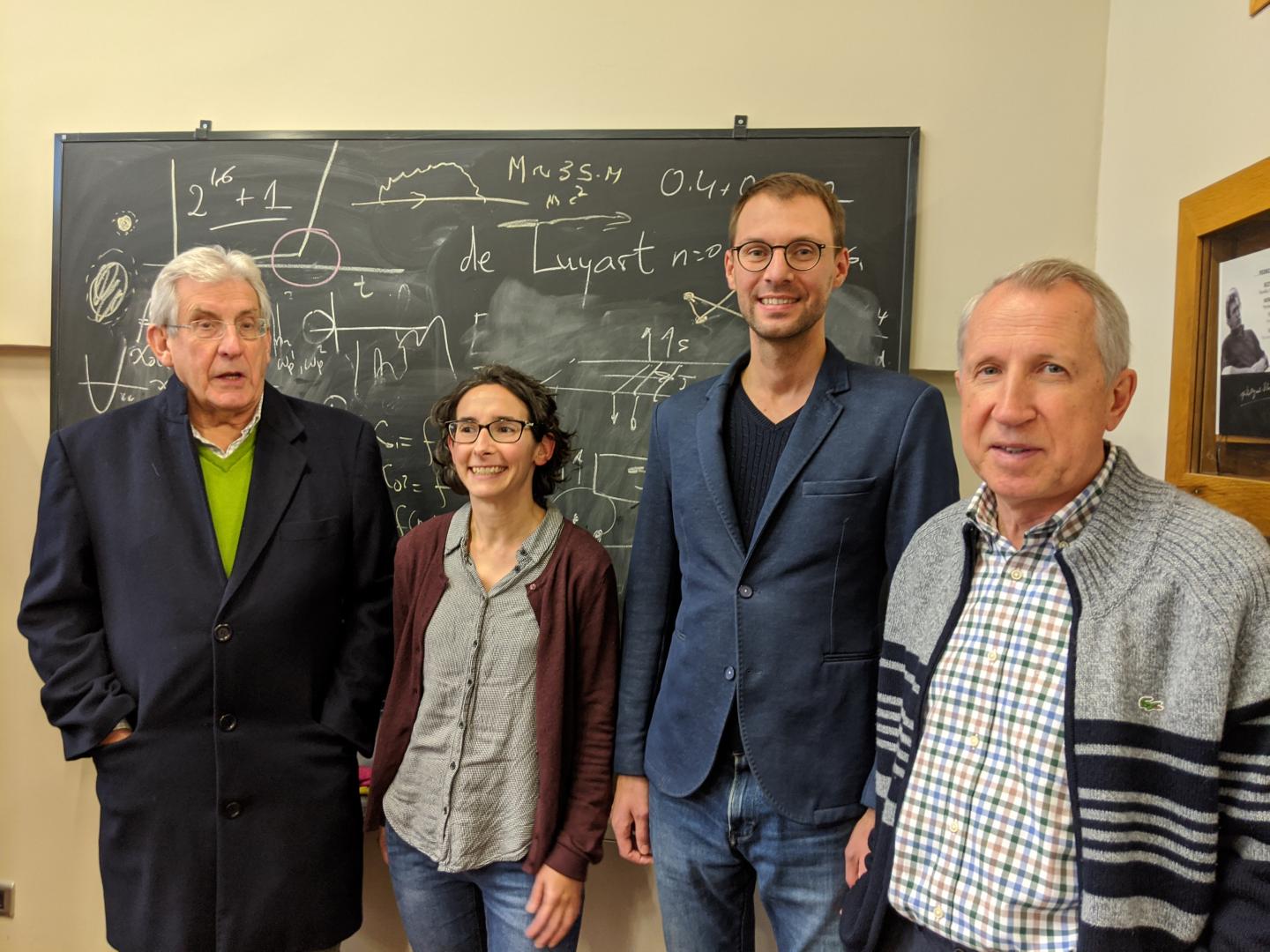
Credit: UPV/EHU
The so-called topological insulators are those materials that are insulators in bulk, i.e. do not allow electric currents in its volume, but are conductors on its surface. Unlike the usual conductors, that is, metals, the electric current circulating in a topological insulator does not suffer any loss of energy. This property opens great possibilities of application in electronics, since it would enable the fabrication of more efficient, faster and low-energy consumption devices; an objective as desirable as necessary in the current scenario of rapid advance of energy demand worldwide, which threatens our environment. For that very reason, the discovery of topological insulators about a decade ago caused a global research boom in the fields of nanotechnology and condensed matter physics.
With technological applications in mind, for example in information technologies, one of the challenges during these years of intense research has been the creation of a magnetic topological insulator. So far, magnetic topological insulators had only been created by the so-called extrinsic route, which consists of doping nonmagnetic topological insulators with magnetic atoms. However, thanks to the efforts of a group of researchers from the Materials Physics Center (CFM, CSIC-UPV/EHU joint centre), Donostia International Physics Center (DIPC) and the University of the Basque Country (UPV/EHU), it is now possible to grow an intrinsic magnetic topological insulator, that is, one that has magnetic properties by its own very nature. The team that includes DIPC researchers Mikhail Otrokov (CFM Ikerbasque Research Fellow), Evgueni Chulkov (UPV/EHU, Euskadi Research Prize 2019), María Blanco Rey (UPV/EHU) and Pedro M. Echenique (UPV/EHU, DIPC President), has predicted theoretically the first intrinsic magnetic topological insulator, with chemical formula MnBi2Te4. The key to the success of this prediction has been the large experience that this group of scientists has in the fields of topological insulators, magnetism and material science in general. The Ikerbasque fellow and leader of this research, Mikhail Otrokov, states that “previous work from different approaches led us to the conclusion that the intrinsic route was the only feasible one nowadays. Then, we directed our efforts to find an intrinsic magnetic topological insulator based on our prior experience. Thanks to that, we knew what crystalline structure and atomic composition such a material should have”.
Donostia (Basque Country, Spain) is not only the place where the theoretical prediction of this first magnetic topological insulator has been carried out, but it has also been the base camp from where its experimental confirmation has been coordinated. This work has involved experts in different areas, from leading research centres in Russia, Azerbaijan, Germany, Austria, Japan, Italy and the USA. The results of this study are being published this week in the prestigious journal ‘Nature‘. Otrokov has explained that for experimental confirmation, the first step was the synthesis of the compound crystals by the chemical synthesis experts. Once synthesized, the samples were subject to a multitude characterization experiments; structural, magnetic, electronic, of transport, of atomic composition, etc.; until the predicted characteristics were observed and verified.
The results of the study, which had already been disseminated through an open-access server and lectures delivered by the authors at international conferences, have been well received by the international scientific community. Currently, MnBi2Te4 and other materials based on it are studied in several research centers, those of the USA and China showing the most intense activity.
” MnBi2Te4, besides being an intrinsic magnetic topological insulator, has turned out to be antiferromagnetic, just as we had calculated”, Blanco tells us. Antiferromagnetism consists of a magnetic order at an atomic scale, such that the material lacks net magnetization. As a result, these materials are much more robust against perturbations by magnets.
This crystal composed of Manganese (Mn), Bismuth (Bi) and Tellurium (Te) has a great potential both at a fundamental and a technological level. It is extremely rich in exotic properties, for example, such as the various Hall effects, including the quantum ones, some of which are used in the calibration of physical constants for its exceptional precision. In addition, MnBi2Te4 can be used to create the so-called Majorana fermions. This is a kind of particle, a quasiparticle to be accurate, that has been considered the cornerstone of quantum computing. Likewise, MnBi2Te4 is the first intrinsic material for which an electromagnetic response very similar to that of an axion is predicted. An axion is a hypothetical particle postulated in the framework of quantum chromodynamics, and it is a good candidate to solve the problem of dark matter. That is why there are a lot of experiments aimed precisely at detecting signals of axion-type behaviour in the family of this compound.
Regarding the practical applications, several devices based on magnetic topological insulators have already been patented. For instance, MnBi2Te4 could be used in chiral interconnect devices, which promise superior performance to the ordinary copper connections currently used in commercially available integrated circuits. Some other applications include optical modulators, magnetic field sensors and memory elements.
The researchers working in Donostia, together with their network of international collaborators, expect to be able to observe in MnBi2Te4 some of the exotic phenomena mentioned above, and discover new intrinsic magnetic topological insulators with even superior properties than those of MnBi2Te4.
###
Publication reference
“Prediction and observation of an antiferromagnetic topological insulator”, M. M. Otrokov, I. I. Klimovskikh, H. Bentmann, D. Estyunin, A. Zeugner, Z. S. Aliev, S. Gaß, A. U. B. Wolter, A. V. Koroleva, A. M. Shikin, M. Blanco-Rey, M. Hoffmann, I. P. Rusinov, A. Yu. Vyazovskaya, S. V. Eremeev, Yu. M. Koroteev, V. M. Kuznetsov, F. Freyse, J. Sánchez-Barriga, I. R. Amiraslanov, M. B. Babanly, N. T. Mamedov, N. A. Abdullayev, V. N. Zverev, A. Alfonsov, V. Kataev, B. Büchner, E. F. Schwier, S. Kumar, A. Kimura, L. Petaccia, G. Di Santo, R. C. Vidal, S. Schatz, K. Kißner, M. Ünzelmann, C. H. Min, Simon Moser, T. R. F. Peixoto, F. Reinert, A. Ernst, P. M. Echenique, A. Isaeva and E. V. Chulkov. Nature (2019). DOI: 10.1038/s41586-019-1840-9
Media Contact
Matxalen Sotillo
[email protected]
Original Source
https:/
Related Journal Article
http://dx.