• HOME
  • NEWS
  • EXPLORE
    • CAREER
      • Companies
      • Jobs
    • EVENTS
    • iGEM
      • News
      • Team
    • PHOTOS
    • VIDEO
    • WIKI
  • BLOG
  • COMMUNITY
    • FACEBOOK
    • INSTAGRAM
    • TWITTER
Monday, August 31, 2026
BIOENGINEER.ORG
No Result
View All Result
  • Login
  • HOME
  • NEWS
  • EXPLORE
    • CAREER
      • Companies
      • Jobs
        • Lecturer
        • PhD Studentship
        • Postdoc
        • Research Assistant
    • EVENTS
    • iGEM
      • News
      • Team
    • PHOTOS
    • VIDEO
    • WIKI
  • BLOG
  • COMMUNITY
    • FACEBOOK
    • INSTAGRAM
    • TWITTER
  • HOME
  • NEWS
  • EXPLORE
    • CAREER
      • Companies
      • Jobs
        • Lecturer
        • PhD Studentship
        • Postdoc
        • Research Assistant
    • EVENTS
    • iGEM
      • News
      • Team
    • PHOTOS
    • VIDEO
    • WIKI
  • BLOG
  • COMMUNITY
    • FACEBOOK
    • INSTAGRAM
    • TWITTER
No Result
View All Result
Bioengineer.org
No Result
View All Result
Home NEWS Science News Biology

A Freiburg research team deciphers how stem cells decide their identity

Bioengineer by Bioengineer
December 3, 2019
in Biology
Reading Time: 2 mins read
0
IMAGE
Share on FacebookShare on TwitterShare on LinkedinShare on RedditShare on Telegram

IMAGE

Credit: Source: Carsten Schwan/ Jelena Tosic


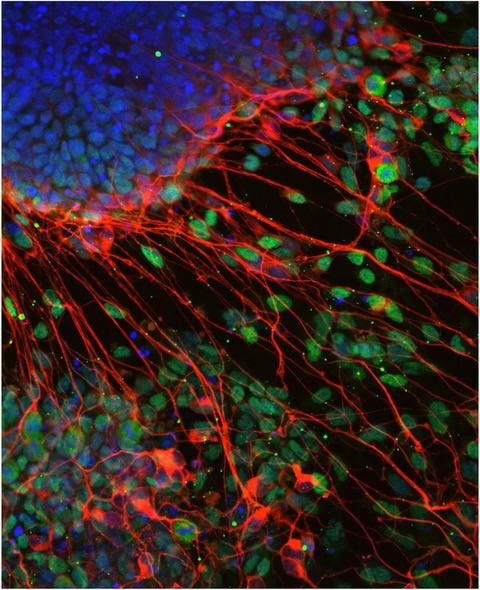
A research team headed by Prof. Dr. Sebastian Arnold and Jelena Tosic from the Faculty of Medicine at the University of Freiburg has now succeeded in deciphering basic molecular control mechanisms by which stem cells decide which embryonic cell types to turn into.
This is achieved at least partially through selective usage of the genes for each different cell type, despite the presence of the identical genetic information in every cell in the body.

The scientists have published their findings in the journal Nature Cell Biology.

The undifferentiated stem cells of the embryo develop either into cells of the nervous system, the so-called neuroectoderm, or into cells of the meso- and endoderm, from which, for example, many different cell types of the internal organs or the muscles develop. For over 25 years it has been known that this decision is regulated by embryonic signaling molecules, such as TGFβ and Wnt signals. So far, however, it has remained unclear exactly how these signals control this first decision of cell differentiation. The study, carried out in the context of Tosic’s doctoral thesis, shows that the embryonic TGFβ and Wnt signals are transmitted by gene-regulating transcription factors of the T-box factor family, namely Eomes and Brachyury. These factors are responsible for “turning on” the differentiation gene programs for all meso- and endoderm cells. At the same time, these T-box factors also act as gene repressors, preventing the formation of neural tissue by suppressing the corresponding gene programs. This involves changes in the structure but not the content of the genetic information in the cell nucleus.

“The results of the study represent a crucial step towards understanding the basic mechanisms of how cells develop their future identity during development,” says Arnold. They also allow further studies on how cell identity is permanently encoded in a cell.

###

Sebastian Arnold works at the Institute for Experimental and Clinical Pharmacology and Toxicology of the University of Freiburg’s Faculty of Medicine. He is also involved in the Collaborative Research Centres 850, 1140, and 994 as well as the Freiburg Cluster of Excellence CIBSS – Centre for Integrated Biological Signalling Studies.

Original publication:

Tosic, J., Kim, G.-J., Pavlovic, M., Schröder, C.M., Mersiowsky, S.-L., Barg, M., Hofherr, A., Probst, S., Köttgen, M., Hein, L., and Arnold, S.J. (2019): Eomes and Brachyury control pluripotency exit and germ layer segregation by changing the chromatin state. In: Nature Cell Biol. DOI: http://dx.doi.org/10.1038/s41556-019-0423-1

Contact:

Research Group for Regenerative Pharmacology

Institute of Experimental & Clinical Pharmacology and Toxicology

University of Freiburg

Media Contact
Sebastian Arnold
[email protected]
49-761-203-96819

Related Journal Article

http://dx.doi.org/10.1038/s41556-019-0423-1

Tags: Cell BiologyMedicine/Health
Share12Tweet8Share2ShareShareShare2

Related Posts

Methylation puts parasites in motion

Methylation puts parasites in motion

August 31, 2026
Desiccation promotes DNA damage and rifampin resistance in Mycobacterium tuberculosis

Desiccation promotes DNA damage and rifampin resistance in Mycobacterium tuberculosis

August 31, 2026

Gastrointestinal Parasitism in Cattle and Water Buffaloes in Pakistan: Prevalence and Associated Risk Factors

August 31, 2026

Development of HPLC–PDA method for steviol glycosides analysis in food matrices

August 31, 2026
Please login to join discussion

POPULAR NEWS

  • β-Sitosterol from Ipomoea carnea Jacq. As a promising anti-inflammatory agent: Evidence from in silico modeling and in vitro validation

    29 shares
    Share 12 Tweet 7
  • Design, fabrication and characterization of a wearable Fiber Bragg grating sensor for cardiorespiratory monitoring using finger plethysmography

    29 shares
    Share 12 Tweet 7
  • KAIST opens the era of industrial-scale microbial foods, proposing growth strategies for the next-generation protein market

    29 shares
    Share 12 Tweet 7
  • Virologist awarded $2 million NIH grant to investigate how virus-infected cells live and die

    29 shares
    Share 12 Tweet 7

About

We bring you the latest biotechnology news from best research centers and universities around the world. Check our website.

Follow us

Recent News

β-Sitosterol from Ipomoea carnea Jacq. As a promising anti-inflammatory agent: Evidence from in silico modeling and in vitro validation

Design, fabrication and characterization of a wearable Fiber Bragg grating sensor for cardiorespiratory monitoring using finger plethysmography

KAIST opens the era of industrial-scale microbial foods, proposing growth strategies for the next-generation protein market

Subscribe to Blog via Email

Enter your email address to subscribe to this blog and receive notifications of new posts by email.

Join 85 other subscribers
  • Contact Us

Bioengineer.org © Copyright 2023 All Rights Reserved.

Welcome Back!

Login to your account below

Forgotten Password?

Retrieve your password

Please enter your username or email address to reset your password.

Log In
No Result
View All Result
  • Homepages
    • Home Page 1
    • Home Page 2
  • News
  • National
  • Business
  • Health
  • Lifestyle
  • Science

Bioengineer.org © Copyright 2023 All Rights Reserved.