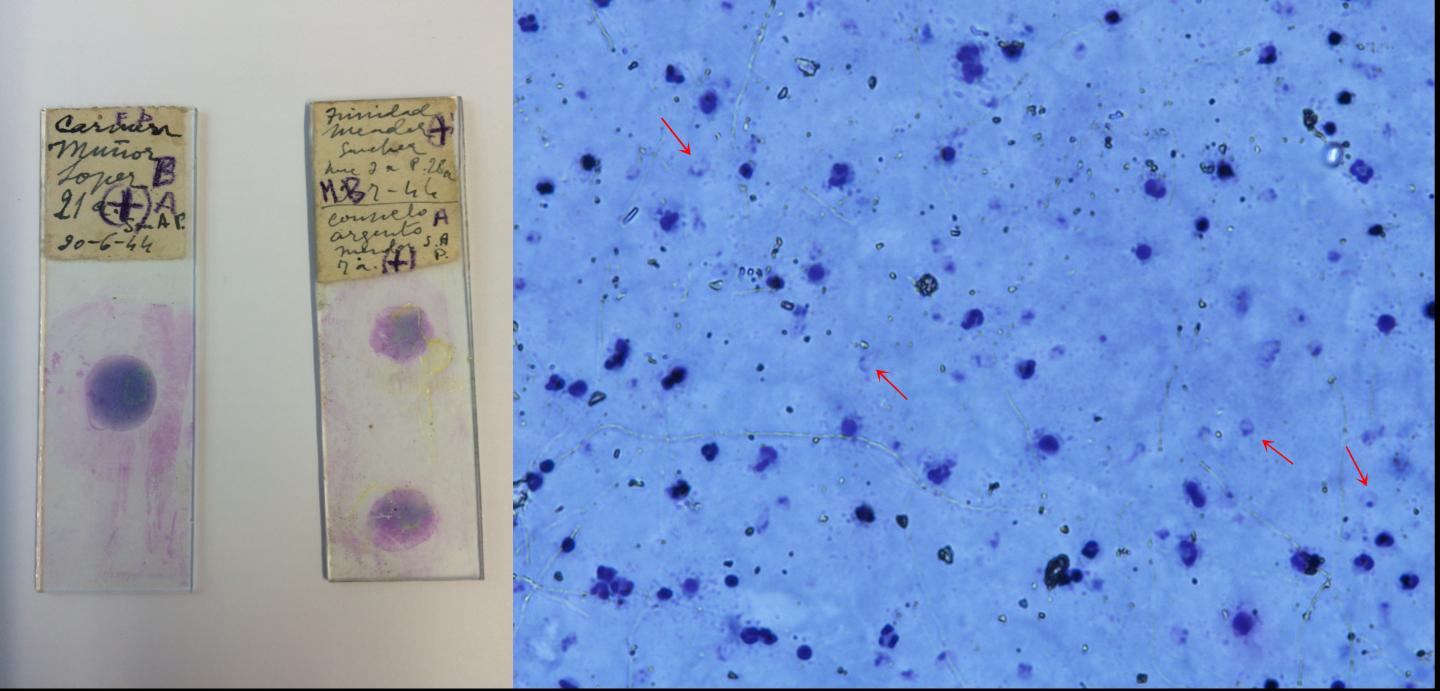
Credit: Institute of Evolutionary Biology (IBE)
DNA from 75-year old eradicated European malaria parasites uncovers the historical spread of one of the two most common forms of the disease, Plasmodium vivax, from Europe to the Americas during the colonial period, finds a new study co-led by UCL.
The research published in Molecular Biology and Evolution reports the genome sequence of a malaria parasite sourced from blood-stained medical microscope slides used in 1944 in Spain, one of the last footholds of malaria in Europe.
Malaria was a major disease throughout Europe since antiquity and was only eradicated in the region in the 20th century.
The international team, led by UCL, the Institute of Evolutionary Biology (IBE), Barcelona, and the University of Copenhagen, analysed microscopy slides from the 1940s that were obtained with permission from the medical collection of Dr Ildefonso Canicio, a Spanish malaria researcher from the early 1900s. The slides were used to diagnose patients suffering from malaria in Spain’s Ebro Delta, where malaria was common until the 1960s.
By comparing the genetic data from the slides to a global dataset of modern P. vivax genomes, the researchers found that the eradicated European malaria parasites were genetically most similar to tertian (P. vivax) malaria strains currently found in the Americas, including Mexico, Brazil and Peru.
“Being able to obtain a full genome of extinct European Plasmodium vivax from these decades old slides allowed us to ask questions as to how malaria may have been affecting us centuries ago,” said co-lead author Dr Lucy van Dorp (UCL Genetics Institute).
“We found a clear relationship with modern Central and South American strains, establishing historic links spreading disease between these continents.”
Analysing a historical sample also enabled the researchers to estimate mutation rates, helping them to infer when the different regional strains of P. vivax malaria diverged from each other. They estimated the last common ancestor between the eradicated European strain and the ones still present in the Americas to the 15th century.
This divergence is in line with European colonists introducing tertian malaria into the Americas and suggests indigenous peoples of the Americas were not infected before their contact with Europeans. There is no reliable evidence of malaria in the Americas before colonial times, but there are historical accounts of tertian malaria in Europe as far back as classical Greece.
“We could date the age of the spread to the Americas to around the 15th century, which clearly points to an introduction of the disease following European contact,” explained co-author Professor Francois Balloux (UCL Genetics Institute).
The researchers were also able to gain new insights into how infectious disease agents can develop resistance to treatments. The team found that the 1940s malaria sample already had some genetic mutations which are known to confer resistance to modern anti-malarial drugs, despite them not having been in use at the time.
The findings suggest drug resistance potential may have already existed in some past malaria strains, possibly due to the historical use of quinine (which has been used to treat malaria as well as other ailments), allowing the parasite to evade modern medications soon after their introduction.
Professor Carles Lalueza-Fox, paleogeneticist at the Institute of Evolutionary Biology (IBE, CSIC-UPF) in Barcelona who co-led the study, said he is excited by the prospect of historical genomes to help us understand malaria: “My initial motivation to study this ancient malaria strain is the fact that my father contracted malaria in 1938, while crossing the Ebro region with the Republican army during the Spanish Civil War.”
“After realising the potential of old medical material to understand modern infectious diseases, I got hooked and we’re currently sourcing more slides from medical and museum collections to understand where malaria emerged first and then spread to other regions of the world.”
###
The research was supported by the “la Caixa” Foundation, FEDER-Ministry of Science, Innovation and Universities (Spain), the European Research Council, the Medical Research Council (MRC, UK), and the Biotechnology and Biological Sciences Research Council (BBSRC, UK).
Media Contact
Chris Lane
[email protected]
44-207-679-9222
Related Journal Article
http://dx.