• HOME
  • NEWS
  • EXPLORE
    • CAREER
      • Companies
      • Jobs
    • EVENTS
    • iGEM
      • News
      • Team
    • PHOTOS
    • VIDEO
    • WIKI
  • BLOG
  • COMMUNITY
    • FACEBOOK
    • INSTAGRAM
    • TWITTER
Saturday, February 7, 2026
BIOENGINEER.ORG
No Result
View All Result
  • Login
  • HOME
  • NEWS
  • EXPLORE
    • CAREER
      • Companies
      • Jobs
        • Lecturer
        • PhD Studentship
        • Postdoc
        • Research Assistant
    • EVENTS
    • iGEM
      • News
      • Team
    • PHOTOS
    • VIDEO
    • WIKI
  • BLOG
  • COMMUNITY
    • FACEBOOK
    • INSTAGRAM
    • TWITTER
  • HOME
  • NEWS
  • EXPLORE
    • CAREER
      • Companies
      • Jobs
        • Lecturer
        • PhD Studentship
        • Postdoc
        • Research Assistant
    • EVENTS
    • iGEM
      • News
      • Team
    • PHOTOS
    • VIDEO
    • WIKI
  • BLOG
  • COMMUNITY
    • FACEBOOK
    • INSTAGRAM
    • TWITTER
No Result
View All Result
Bioengineer.org
No Result
View All Result
Home NEWS Science News

Solving the thermoelectric ‘trade-off’ conundrum with metallic carbon nanotubes

Bioengineer by Bioengineer
December 2, 2019
in Science News
Reading Time: 2 mins read
0
IMAGE
Share on FacebookShare on TwitterShare on LinkedinShare on RedditShare on Telegram

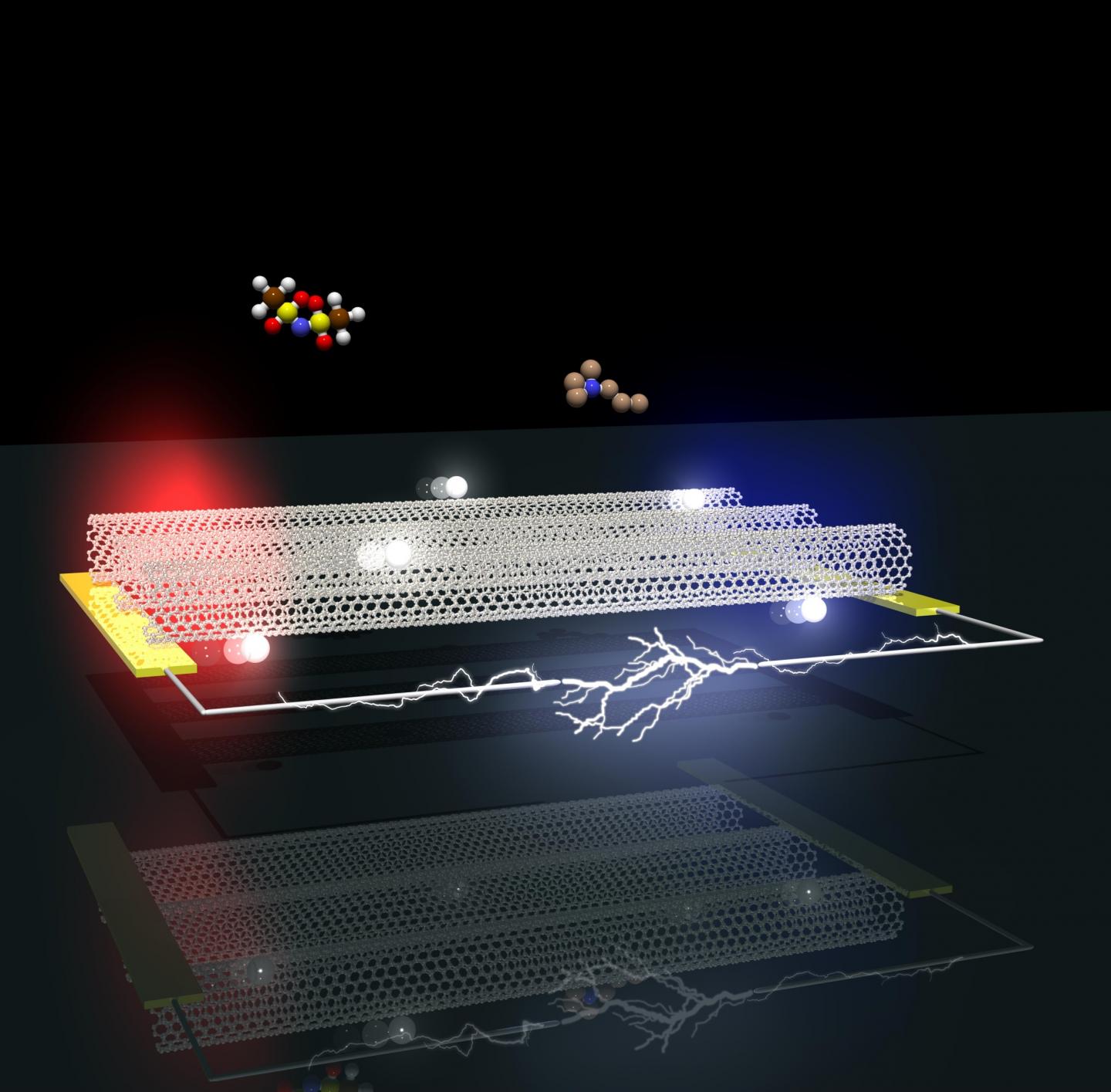
Strategy to bypass trade-off between thermoelectric voltage and conductivity
IMAGE

Credit: Tokyo Metropolitan University


Tokyo, Japan – Scientists from Tokyo Metropolitan University have used aligned “metallic” carbon nanotubes to create a device which converts heat to electrical energy (a thermoelectric device) with a higher power output than pure semiconducting carbon nanotubes (CNTs) in random networks. The new device bypasses the troublesome trade-off in semiconductors between conductivity and electrical voltage, significantly outperforming its counterpart. High power thermoelectric devices may pave the way for more efficient use of waste heat, like wearable electronics.

Thermoelectric devices can directly convert heat to electricity. When we think about the amount of wasted heat in our environment like in air conditioning exhausts, vehicle engines or even body heat, it would be revolutionary if we could somehow scavenge this energy back from our surroundings and put it to good use. This goes some way to powering the thought behind wearable electronics and photonics, devices which could be worn on the skin and powered by body heat. Limited applications are already available in the form of body heat powered lights and smartwatches.

The power extracted from a thermoelectric device when a temperature gradient is formed is affected by the conductivity of the device and the Seebeck coefficient, a number indicating how much electrical voltage is generated with a certain difference in temperature. The problem is that there is a trade-off between the Seebeck coefficient and conductivity: the Seebeck coefficient drops when the device is made more conductive. To generate more power, we ideally want to improve both.

Semiconducting materials are generally considered superior candidates for high-performance thermoelectric devices. However, a team led by Prof. Kazuhiro Yanagi of Tokyo Metropolitan University met an unlikely hero in the form of “metallic” CNTs. Unlike purely semiconducting CNTs, they found that they could simultaneously enhance both the conductivity and Seebeck coefficient of metallic CNTs, breaking the trade-off between these two key quantities. The team went on to show that these unique characteristics arose from the one-dimensional metallic electronic structure of the material. Furthermore, they were able to align the orientation of the metallic CNTs, achieving an output which was nearly five times that of films of randomly oriented pure semiconducting CNTs.

Not only will high-performance thermoelectric elements let us use body heat to power our smartphones, the potential biomedical applications will ensure that they play an important role in everyday applications in the future.

###

This work was supported by the JSPS KAKENHI Program through Grant Numbers JP17H06124, JP17H01069, and JP18H01816, and the JST CREST Program through Grant Number JPMJCR17I5.

Media Contact
Go Totsukawa
[email protected]
81-426-772-728

Original Source

https://pubs.acs.org/doi/10.1021/acs.nanolett.9b03022

Related Journal Article

http://dx.doi.org/10.1021/acs.nanolett.9b03022

Tags: Chemistry/Physics/Materials SciencesElectrical Engineering/ElectronicsIndustrial Engineering/ChemistryMaterialsNanotechnology/MicromachinesSuperconductors/SemiconductorsTechnology/Engineering/Computer Science
Share12Tweet8Share2ShareShareShare2

Related Posts

Decoding Prostate Cancer Origins via snFLARE-seq, mxFRIZNGRND

February 7, 2026

Digital Health Perspectives from Baltic Sea Experts

February 7, 2026

Florida Cane Toad: Complex Spread and Selective Evolution

February 7, 2026

Exploring Decision-Making in Dementia Caregivers’ Mobility

February 7, 2026
Please login to join discussion

POPULAR NEWS

  • Robotic Ureteral Reconstruction: A Novel Approach

    Robotic Ureteral Reconstruction: A Novel Approach

    82 shares
    Share 33 Tweet 21
  • Digital Privacy: Health Data Control in Incarceration

    63 shares
    Share 25 Tweet 16
  • Study Reveals Lipid Accumulation in ME/CFS Cells

    57 shares
    Share 23 Tweet 14
  • Breakthrough in RNA Research Accelerates Medical Innovations Timeline

    53 shares
    Share 21 Tweet 13

About

We bring you the latest biotechnology news from best research centers and universities around the world. Check our website.

Follow us

Recent News

Decoding Prostate Cancer Origins via snFLARE-seq, mxFRIZNGRND

Digital Health Perspectives from Baltic Sea Experts

Florida Cane Toad: Complex Spread and Selective Evolution

Subscribe to Blog via Email

Enter your email address to subscribe to this blog and receive notifications of new posts by email.

Join 73 other subscribers
  • Contact Us

Bioengineer.org © Copyright 2023 All Rights Reserved.

Welcome Back!

Login to your account below

Forgotten Password?

Retrieve your password

Please enter your username or email address to reset your password.

Log In
No Result
View All Result
  • Homepages
    • Home Page 1
    • Home Page 2
  • News
  • National
  • Business
  • Health
  • Lifestyle
  • Science

Bioengineer.org © Copyright 2023 All Rights Reserved.