• HOME
  • NEWS
  • EXPLORE
    • CAREER
      • Companies
      • Jobs
    • EVENTS
    • iGEM
      • News
      • Team
    • PHOTOS
    • VIDEO
    • WIKI
  • BLOG
  • COMMUNITY
    • FACEBOOK
    • INSTAGRAM
    • TWITTER
Thursday, March 26, 2026
BIOENGINEER.ORG
No Result
View All Result
  • Login
  • HOME
  • NEWS
  • EXPLORE
    • CAREER
      • Companies
      • Jobs
        • Lecturer
        • PhD Studentship
        • Postdoc
        • Research Assistant
    • EVENTS
    • iGEM
      • News
      • Team
    • PHOTOS
    • VIDEO
    • WIKI
  • BLOG
  • COMMUNITY
    • FACEBOOK
    • INSTAGRAM
    • TWITTER
  • HOME
  • NEWS
  • EXPLORE
    • CAREER
      • Companies
      • Jobs
        • Lecturer
        • PhD Studentship
        • Postdoc
        • Research Assistant
    • EVENTS
    • iGEM
      • News
      • Team
    • PHOTOS
    • VIDEO
    • WIKI
  • BLOG
  • COMMUNITY
    • FACEBOOK
    • INSTAGRAM
    • TWITTER
No Result
View All Result
Bioengineer.org
No Result
View All Result
Home NEWS Science News

The impact of molecular rotation on a peculiar isotope effect on water hydrogen bonds

Bioengineer by Bioengineer
December 2, 2019
in Science News
Reading Time: 2 mins read
0
IMAGE
Share on FacebookShare on TwitterShare on LinkedinShare on RedditShare on Telegram

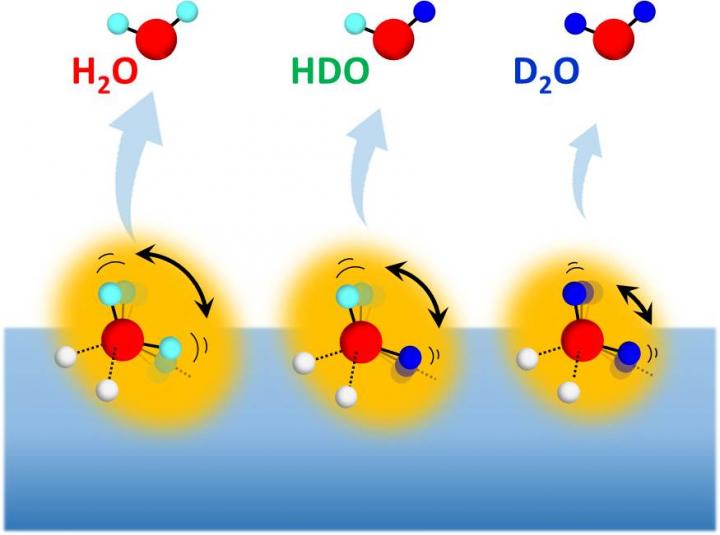
Unveiling two deuteration effects on hydrogen-bond breaking process of water isotopomers
IMAGE

Credit: NINS/IMS


The physicochemical and biological properties of hydrogen-bonded systems are significantly affected by nuclear quantum effects including zero-point energies of vibrational modes, proton delocalization, and tunneling effect. These originate from the extremely low nuclear mass of hydrogen; thus, hydrogen-bonded systems show remarkable isotope effects upon deuteration. In the 1930s, Ubbelohde first proposed that deuteration elongates and weakens hydrogen bonds in many hydrogen-bonded systems. Ever since, such an isotope effect has been widely confirmed and is nowadays well known as the “Ubbelohde effect.” In contrast, deuterating water molecules in liquid water and ice elongates but strengthens hydrogen bonds. Despite intensive experimental and theoretical studies in more than three-quarters of a century, the molecular-level origin of this peculiar isotope effect on water hydrogen bonds has been unclear.

Very recently, researchers led by Toshiki Sugimoto, Associate Professor at the Institute for Molecular Science, have tackled the longstanding mystery: how do more expanded D2O aggregates form stronger hydrogen bonds than H2O aggregates, in contrast to the hydrogen-bonded systems composed of bulky constituent molecules? By means of isotope selective measurements on sublimation of isotope-mixed ice with various H/D isotopic compositions, the researchers have made a new discovery to unravel the mystery; the isotope effect on the strength of hydrogen bonds are governed by two deuteration effects: (1) the bond-strengthening effect derived from zero-point energy of hindered rotational motion, and (2) the bond-weakening (and elongating) effect derived from quantum anharmonic coupling between inter- and intramolecular modes.

The most important concept is that the deuteration effect (1) derived from rotational motion plays crucial roles in the bond breaking process of extremely small and light molecules. In the case of water aggregates, huge isotopic difference in the zero-point energy of hindered rotation brings out a peculiar nature of the bond strengthening effect (1) overwhelming over the bond-weakening effect (2), leading to the unique isotope effect: deuterated water molecules form longer but stronger hydrogen bonds than hydrogenated water molecules. In contrast, in the case of other typical hydrogen-bonded systems composed of larger and heavier constituent molecules, such as oxalic acid dihydrate, benzoic acid, succinic acid, and cyclohexane/Rh(111), the isotopic differences in the zero-point energy of hindered rotation are negligibly small. Therefore, only the bond-weakening effect (2) is predominant in the isotope effect on their binding energy, resulting in the longer and weaker hydrogen bonds in deuterated systems than hydrogenated systems. Thus, the isotopic differences in the strength of hydrogen bonds are determined by a delicate balance between the competing two deuteration effects (1) and (2), while those in hydrogen-bond length, i.e. geometrical isotope effect, are basically dominated by the deuteration effect (2). “These results and concepts provide a new basis for our fundamental understanding of the highly quantum water hydrogen bonds,” says Sugimoto.

###

Media Contact
Toshiki Sugimoto
[email protected]
81-564-557-287

Related Journal Article

http://dx.doi.org/10.1103/PhysRevMaterials.3.112001

Tags: AstrophysicsAtomic/Molecular/Particle PhysicsBiomechanics/BiophysicsChemistry/Physics/Materials SciencesGeophysicsMaterialsMolecular PhysicsNanotechnology/Micromachines
Share12Tweet8Share2ShareShareShare2

Related Posts

Starburst Winds Drain Supernova Energy Quickly

Starburst Winds Drain Supernova Energy Quickly

March 26, 2026
Decoding the Phosphorus Puzzle: How Microplastics and Hydrochar Transform Nutrient Dynamics in Rice Paddies

Decoding the Phosphorus Puzzle: How Microplastics and Hydrochar Transform Nutrient Dynamics in Rice Paddies

March 26, 2026

Microtubules Found to Actively Ensure Accurate Chromosome Distribution During Cell Division

March 25, 2026

Aversive Learning Hijacks Brain Sugar Sensor

March 25, 2026
Please login to join discussion

POPULAR NEWS

  • blank

    Revolutionary AI Model Enhances Precision in Detecting Food Contamination

    96 shares
    Share 38 Tweet 24
  • Imagine a Social Media Feed That Challenges Your Views Instead of Reinforcing Them

    1003 shares
    Share 397 Tweet 248
  • Uncovering Functions of Cavernous Malformation Proteins in Organoids

    54 shares
    Share 22 Tweet 14
  • Promising Outcomes from First Clinical Trials of Gene Regulation in Epilepsy

    51 shares
    Share 20 Tweet 13

About

We bring you the latest biotechnology news from best research centers and universities around the world. Check our website.

Follow us

Recent News

In-Sensor Cryptography Links Physical Process to Digital Identity

Can Psychosocial Factors Influence Cancer Risk?

Depression Factors in Elderly: Pre vs. Post-COVID Analysis

Subscribe to Blog via Email

Success! An email was just sent to confirm your subscription. Please find the email now and click 'Confirm' to start subscribing.

Join 78 other subscribers
  • Contact Us

Bioengineer.org © Copyright 2023 All Rights Reserved.

Welcome Back!

Login to your account below

Forgotten Password?

Retrieve your password

Please enter your username or email address to reset your password.

Log In
No Result
View All Result
  • Homepages
    • Home Page 1
    • Home Page 2
  • News
  • National
  • Business
  • Health
  • Lifestyle
  • Science

Bioengineer.org © Copyright 2023 All Rights Reserved.