• HOME
  • NEWS
  • EXPLORE
    • CAREER
      • Companies
      • Jobs
    • EVENTS
    • iGEM
      • News
      • Team
    • PHOTOS
    • VIDEO
    • WIKI
  • BLOG
  • COMMUNITY
    • FACEBOOK
    • INSTAGRAM
    • TWITTER
Monday, December 29, 2025
BIOENGINEER.ORG
No Result
View All Result
  • Login
  • HOME
  • NEWS
  • EXPLORE
    • CAREER
      • Companies
      • Jobs
        • Lecturer
        • PhD Studentship
        • Postdoc
        • Research Assistant
    • EVENTS
    • iGEM
      • News
      • Team
    • PHOTOS
    • VIDEO
    • WIKI
  • BLOG
  • COMMUNITY
    • FACEBOOK
    • INSTAGRAM
    • TWITTER
  • HOME
  • NEWS
  • EXPLORE
    • CAREER
      • Companies
      • Jobs
        • Lecturer
        • PhD Studentship
        • Postdoc
        • Research Assistant
    • EVENTS
    • iGEM
      • News
      • Team
    • PHOTOS
    • VIDEO
    • WIKI
  • BLOG
  • COMMUNITY
    • FACEBOOK
    • INSTAGRAM
    • TWITTER
No Result
View All Result
Bioengineer.org
No Result
View All Result
Home NEWS Science News

Detecting mental and physical stress via smartphone

Bioengineer by Bioengineer
November 21, 2019
in Science News
Reading Time: 2 mins read
0
IMAGE
Share on FacebookShare on TwitterShare on LinkedinShare on RedditShare on Telegram

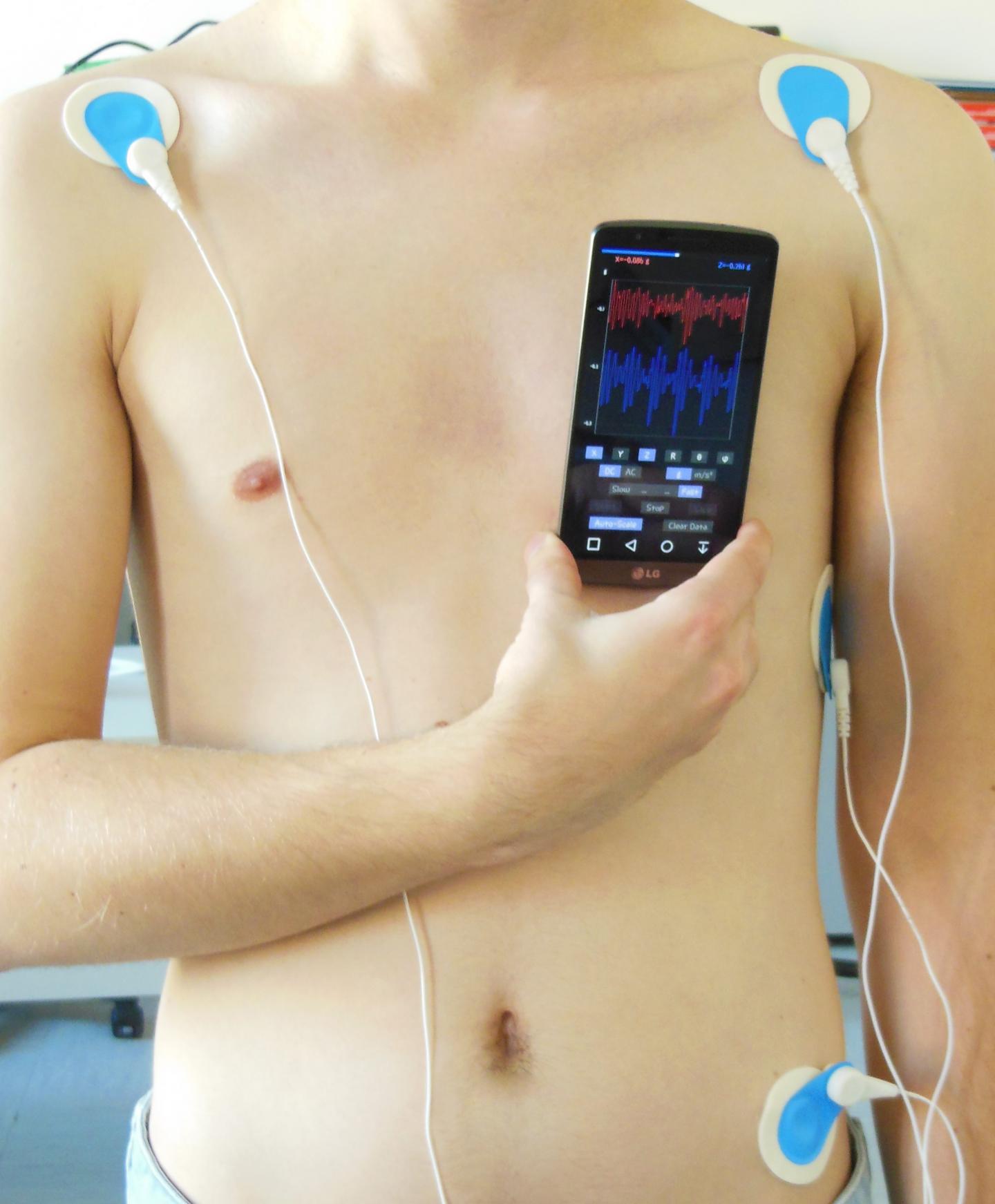
A study by Politecnico di Milano published in Sensors
IMAGE

Credit: Politecnico di Milano


Can we use our smartphones without any other peripherals or wearables to accurately extract vital parameters, such as heart beat rate and stress level?

The team led by Professor Enrico Caiani of the Department of Electronics, Information and Bioengineering at Politecnico di Milano has shown that it is possible to do so, using the accelerometers inside a smartphone.

In fact, they can be used to acquire a signal associated with mechanical – cardiac activity, generated by heart’s vibrations at every beat, which can be felt by simply placing the telephone on particular parts of the body.

In this study we focussed on positioning of the smartphone on the abdomen, at the belly-button, as part of an application scenario that looks at brief daily acquisition lasting 30 seconds, in a prone position, before getting out of bed in the morning. By suitably processing this signal, measurements can be acquired of the heart beat rate and status of activation of the sympathetic-vagal balance, associated with the stress level. By means of an experimental protocol, which calls for acquisition for each subject in base conditions and during a stressed state induced by mental calculation, it is possible to check the capacity of the indicators measured by the smartphone to capture the increase in stress, on the one hand, and, on the other hand, to determine the best correspondence of the results with the same observations made using an electrocardiogram taken at the same time.

This study, carried out in collaboration with the team led by Professor Gianfranco Parati of the I.R.C.C.S. Istituto Auxologico Italiano, in the Department of Cardiovascular, Metabolic, and Neurological Sciences at Ospedale San Luca in Milan, was recently published in Sensors, the leading open access, peer-reviewed international magazine, on science and technology for sensors and biosensors.

This result opens new horizons and possibilities for using the smartphone as an instrument readily available, for simple self-monitoring of one’s health.

###

Media Contact
Cristina Perini
[email protected]
022-399-2509

Related Journal Article

http://dx.doi.org/10.3390/s19173729

Tags: BiotechnologyDiagnosticsHealth Care Systems/ServicesMedicine/Health
Share12Tweet8Share2ShareShareShare2

Related Posts

Plasma Protein Profiling Detects Cancer in Symptomatic Patients

December 29, 2025

ChatGPT Excels in Forensic Pathology Exam Insights

December 29, 2025

HiSTaR: Mapping Spatial Domains with Hierarchical Transcriptomics

December 29, 2025

Evaluating Economic Strategies for Maternal-Neonatal Sepsis Solutions

December 29, 2025
Please login to join discussion

POPULAR NEWS

  • Robotic Waist Tether for Research Into Metabolic Cost of Walking

    NSF funds machine-learning research at UNO and UNL to study energy requirements of walking in older adults

    71 shares
    Share 28 Tweet 18
  • Exploring Audiology Accessibility in Johannesburg, South Africa

    51 shares
    Share 20 Tweet 13
  • Nurses’ Views on Online Learning: Effects on Performance

    70 shares
    Share 28 Tweet 18
  • SARS-CoV-2 Subvariants Affect Outcomes in Elderly Hip Fractures

    44 shares
    Share 18 Tweet 11

About

We bring you the latest biotechnology news from best research centers and universities around the world. Check our website.

Follow us

Recent News

Plasma Protein Profiling Detects Cancer in Symptomatic Patients

ChatGPT Excels in Forensic Pathology Exam Insights

HiSTaR: Mapping Spatial Domains with Hierarchical Transcriptomics

Subscribe to Blog via Email

Enter your email address to subscribe to this blog and receive notifications of new posts by email.

Join 71 other subscribers
  • Contact Us

Bioengineer.org © Copyright 2023 All Rights Reserved.

Welcome Back!

Login to your account below

Forgotten Password?

Retrieve your password

Please enter your username or email address to reset your password.

Log In
No Result
View All Result
  • Homepages
    • Home Page 1
    • Home Page 2
  • News
  • National
  • Business
  • Health
  • Lifestyle
  • Science

Bioengineer.org © Copyright 2023 All Rights Reserved.