• HOME
  • NEWS
  • EXPLORE
    • CAREER
      • Companies
      • Jobs
    • EVENTS
    • iGEM
      • News
      • Team
    • PHOTOS
    • VIDEO
    • WIKI
  • BLOG
  • COMMUNITY
    • FACEBOOK
    • INSTAGRAM
    • TWITTER
Tuesday, December 2, 2025
BIOENGINEER.ORG
No Result
View All Result
  • Login
  • HOME
  • NEWS
  • EXPLORE
    • CAREER
      • Companies
      • Jobs
        • Lecturer
        • PhD Studentship
        • Postdoc
        • Research Assistant
    • EVENTS
    • iGEM
      • News
      • Team
    • PHOTOS
    • VIDEO
    • WIKI
  • BLOG
  • COMMUNITY
    • FACEBOOK
    • INSTAGRAM
    • TWITTER
  • HOME
  • NEWS
  • EXPLORE
    • CAREER
      • Companies
      • Jobs
        • Lecturer
        • PhD Studentship
        • Postdoc
        • Research Assistant
    • EVENTS
    • iGEM
      • News
      • Team
    • PHOTOS
    • VIDEO
    • WIKI
  • BLOG
  • COMMUNITY
    • FACEBOOK
    • INSTAGRAM
    • TWITTER
No Result
View All Result
Bioengineer.org
No Result
View All Result
Home NEWS Science News Chemistry

New hybrid device can both capture and store solar energy

Bioengineer by Bioengineer
November 20, 2019
in Chemistry
Reading Time: 3 mins read
0
IMAGE
Share on FacebookShare on TwitterShare on LinkedinShare on RedditShare on Telegram

Device offers a new avenue for capitalizing on abundant solar energy
IMAGE

Credit: University of Houston


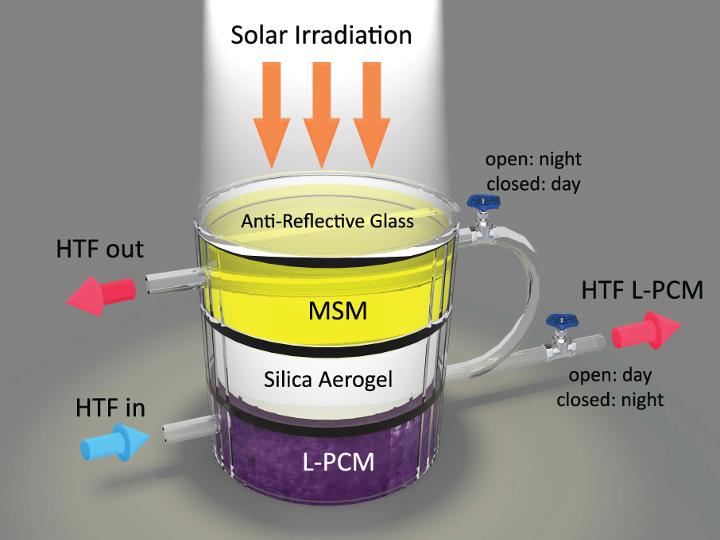
Researchers from the University of Houston have reported a new device that can both efficiently capture solar energy and store it until it is needed, offering promise for applications ranging from power generation to distillation and desalination.

Unlike solar panels and solar cells, which rely on photovoltaic technology for the direct generation of electricity, the hybrid device captures heat from the sun and stores it as thermal energy. It addresses some of the issues that have stalled wider-scale adoption of solar power, suggesting an avenue for using solar energy around-the-clock, despite limited sunlight hours, cloudy days and other constraints.

The work, described in a paper published Wednesday in Joule, combines molecular energy storage and latent heat storage to produce an integrated harvesting and storage device for potential 24/7 operation. The researchers report a harvesting efficiency of 73% at small-scale operation and as high as 90% at large-scale operation.

Up to 80% of stored energy was recovered at night, and the researchers said daytime recovery was even higher.

Hadi Ghasemi, Bill D. Cook Associate Professor of Mechanical Engineering at UH and a corresponding author for the paper, said the high efficiency harvest is due, in part, to the ability of the device to capture the full spectrum of sunlight, harvesting it for immediate use and converting the excess into molecular energy storage.

The device was synthesized using norbornadiene-quadricyclane as the molecular storage material, an organic compound that the researchers said demonstrates high specific energy and exceptional heat release while remaining stable over extended storage times. Ghasemi said the same concept could be applied using different materials, allowing performance – including operating temperatures and efficiency – to be optimized.

T. Randall Lee, Cullen Distinguished University Chair professor of chemistry and a corresponding author, said the device offers improved efficiency in several ways: The solar energy is stored in molecular form rather than as heat, which dissipates over time, and the integrated system also reduces thermal losses because there is no need to transport the stored energy through piping lines.

“During the day, the solar thermal energy can be harvested at temperatures as high as 120 degrees centigrade (about 248 Fahrenheit),” said Lee, who also is a principle investigator for the Texas Center for Superconductivity at UH. “At night, when there is low or no solar irradiation, the stored energy is harvested by the molecular storage material, which can convert it from a lower energy molecule to a higher energy molecule.”

That allows the stored energy to produce thermal energy at a higher temperature at night than during the day – boosting the amount of energy available even when the sun is not shining, he said.

###

In addition to Ghasemi and Lee, researchers involved with the work include first author Varun Kashyap, Siwakorn Sakunkaewkasem, Parham Jafari, Masoumeh Nazari, Bahareh Eslami, Sina Nazifi, Peyman Irajizad and Maria D. Marquez, all with UH.

Media Contact
Jeannie Kever
[email protected]
713-743-0778

Original Source

https://uh.edu/news-events/stories/2019/november-2019/11202019ghasemi-lee-solar-harvesting.php

Tags: Chemistry/Physics/Materials SciencesClimate ChangeEnergy SourcesEnergy/Fuel (non-petroleum)Materials
Share12Tweet8Share2ShareShareShare2

Related Posts

Neighboring Groups Speed Up Polymer Self-Deconstruction

Neighboring Groups Speed Up Polymer Self-Deconstruction

November 28, 2025
blank

Activating Alcohols as Sulfonium Salts for Photocatalysis

November 26, 2025

Carbonate Ions Drive Water Ordering in CO₂ Reduction

November 25, 2025

Isolable Germa-Isonitrile with N≡Ge Triple Bond

November 24, 2025
Please login to join discussion

POPULAR NEWS

  • New Research Unveils the Pathway for CEOs to Achieve Social Media Stardom

    New Research Unveils the Pathway for CEOs to Achieve Social Media Stardom

    203 shares
    Share 81 Tweet 51
  • Scientists Uncover Chameleon’s Telephone-Cord-Like Optic Nerves, A Feature Missed by Aristotle and Newton

    120 shares
    Share 48 Tweet 30
  • Neurological Impacts of COVID and MIS-C in Children

    106 shares
    Share 42 Tweet 27
  • MoCK2 Kinase Shapes Mitochondrial Dynamics in Rice Fungal Pathogen

    67 shares
    Share 27 Tweet 17

About

We bring you the latest biotechnology news from best research centers and universities around the world. Check our website.

Follow us

Recent News

Enhancing Recommendations with Contrastive Learning and Knowledge Graphs

New Genetic Insights on Cowpea Flowering and Growth

Navigating Challenges in China’s Advanced Nurse Training

Subscribe to Blog via Email

Enter your email address to subscribe to this blog and receive notifications of new posts by email.

Join 69 other subscribers
  • Contact Us

Bioengineer.org © Copyright 2023 All Rights Reserved.

Welcome Back!

Login to your account below

Forgotten Password?

Retrieve your password

Please enter your username or email address to reset your password.

Log In
No Result
View All Result
  • Homepages
    • Home Page 1
    • Home Page 2
  • News
  • National
  • Business
  • Health
  • Lifestyle
  • Science

Bioengineer.org © Copyright 2023 All Rights Reserved.