• HOME
  • NEWS
  • EXPLORE
    • CAREER
      • Companies
      • Jobs
    • EVENTS
    • iGEM
      • News
      • Team
    • PHOTOS
    • VIDEO
    • WIKI
  • BLOG
  • COMMUNITY
    • FACEBOOK
    • INSTAGRAM
    • TWITTER
Saturday, December 20, 2025
BIOENGINEER.ORG
No Result
View All Result
  • Login
  • HOME
  • NEWS
  • EXPLORE
    • CAREER
      • Companies
      • Jobs
        • Lecturer
        • PhD Studentship
        • Postdoc
        • Research Assistant
    • EVENTS
    • iGEM
      • News
      • Team
    • PHOTOS
    • VIDEO
    • WIKI
  • BLOG
  • COMMUNITY
    • FACEBOOK
    • INSTAGRAM
    • TWITTER
  • HOME
  • NEWS
  • EXPLORE
    • CAREER
      • Companies
      • Jobs
        • Lecturer
        • PhD Studentship
        • Postdoc
        • Research Assistant
    • EVENTS
    • iGEM
      • News
      • Team
    • PHOTOS
    • VIDEO
    • WIKI
  • BLOG
  • COMMUNITY
    • FACEBOOK
    • INSTAGRAM
    • TWITTER
No Result
View All Result
Bioengineer.org
No Result
View All Result
Home NEWS Science News Biology

Chitin-binding proteins override host plant’s resistance to fungal infection

Bioengineer by Bioengineer
November 13, 2019
in Biology
Reading Time: 2 mins read
0
IMAGE
Share on FacebookShare on TwitterShare on LinkedinShare on RedditShare on Telegram

IMAGE

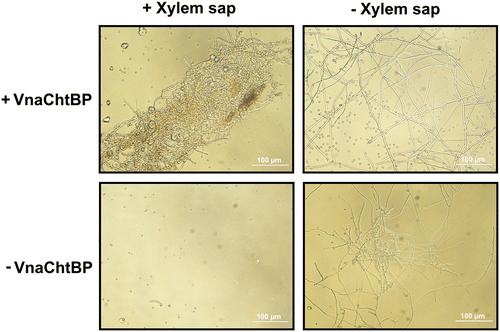
Credit: Helena Volk, Kristina Marton, Marko Flajšman, et al.


An insoluble complex carbohydrate, chitin makes up fungal walls and plays a significant role in the interaction between fungal pathogens and their plant hosts. Plant cells harbor immune receptors that perceive chitin and work to stop fungal infection. However, fungal plant pathogens then release chitin-binding proteins that perturb the chitin-triggered immunity.

A recent Molecular Plant-Microbe Interactions article studies one of these chitin-binding proteins from a soilborne fungus (Verticillium nonalfalfae) that causes vascular wilt in plants. This fungus binds a particular protein (VnaChtBP) to chitin in order to abolish the host plant’s chitin-triggered burst of reactive oxygen species and shield the fungus from being digested by the plant.

The scientists used 3D homology modelling, molecular docking, CD measurements, and a Y2H assay to determine, for the first time, the probable molecular mechanism of chitin-binding to carbohydrate-binding module family 18 (CBM18)-containing fungal effectors. In addition, this research highlights that, apart from the well-studied Avr4 (CBM14) and LysM (CBM50) fungal effectors, which can interfere with plant chitin perception and activation of immune responses, other structurally unrelated fungal effectors with CBM18 domains have evolved with similar function, suggesting a convergent evolution.

Learn more by reading “Chitin-Binding Protein of Verticillium nonalfalfae Disguises Fungus from Plant Chitinases and Suppresses Chitin-Triggered Host Immunity,” which describes the characterization of this protein and determines the probable molecular mechanism of CBM18 chitin-binding fungal effectors.

###

Molecular Plant-Microbe Interactions (MPMI) publishes fundamental and advanced applied research on the genetics, genomics, molecular biology, biochemistry, and biophysics of pathological, symbiotic, and associative interactions of microbes, insects, nematodes, or parasitic plants with plants.

Follow us on Twitter @MPMIjournal and visit https://apsjournals.apsnet.org/journal/mpmi to learn more.

Media Contact
Ashley Bergman Carlin
[email protected]
651-994-3832

Related Journal Article

http://dx.doi.org/10.1094/MPMI-03-19-0079-R

Tags: Agricultural Production/EconomicsBioinformaticsBiologyBiotechnologyCell BiologyGeology/SoilMolecular BiologyMycologyPlant Sciences
Share13Tweet8Share2ShareShareShare2

Related Posts

Targeted Knock-In of Mouse Y Chromosomal Genes

Targeted Knock-In of Mouse Y Chromosomal Genes

December 20, 2025
Choosing Models: Linking Cat Intake to Socioeconomics

Choosing Models: Linking Cat Intake to Socioeconomics

December 19, 2025

Unraveling Proanthocyanidin Gene LAR’s Evolutionary Journey

December 19, 2025

Streptococcus Protein Triggers PBP1a for Cell Division

December 19, 2025
Please login to join discussion

POPULAR NEWS

  • Nurses’ Views on Online Learning: Effects on Performance

    Nurses’ Views on Online Learning: Effects on Performance

    70 shares
    Share 28 Tweet 18
  • NSF funds machine-learning research at UNO and UNL to study energy requirements of walking in older adults

    70 shares
    Share 28 Tweet 18
  • Unraveling Levofloxacin’s Impact on Brain Function

    53 shares
    Share 21 Tweet 13
  • Exploring Audiology Accessibility in Johannesburg, South Africa

    51 shares
    Share 20 Tweet 13

About

We bring you the latest biotechnology news from best research centers and universities around the world. Check our website.

Follow us

Recent News

Assessing the K-NHSPSC: Korean Patient Safety Culture Insights

Spot Urine CA 19-9: New Insights in Pediatric Hydronephrosis

Discharge Choices for Elderly Surgical Patients Explored

Subscribe to Blog via Email

Enter your email address to subscribe to this blog and receive notifications of new posts by email.

Join 70 other subscribers
  • Contact Us

Bioengineer.org © Copyright 2023 All Rights Reserved.

Welcome Back!

Login to your account below

Forgotten Password?

Retrieve your password

Please enter your username or email address to reset your password.

Log In
No Result
View All Result
  • Homepages
    • Home Page 1
    • Home Page 2
  • News
  • National
  • Business
  • Health
  • Lifestyle
  • Science

Bioengineer.org © Copyright 2023 All Rights Reserved.