• HOME
  • NEWS
  • EXPLORE
    • CAREER
      • Companies
      • Jobs
    • EVENTS
    • iGEM
      • News
      • Team
    • PHOTOS
    • VIDEO
    • WIKI
  • BLOG
  • COMMUNITY
    • FACEBOOK
    • INSTAGRAM
    • TWITTER
Tuesday, June 30, 2026
BIOENGINEER.ORG
No Result
View All Result
  • Login
  • HOME
  • NEWS
  • EXPLORE
    • CAREER
      • Companies
      • Jobs
        • Lecturer
        • PhD Studentship
        • Postdoc
        • Research Assistant
    • EVENTS
    • iGEM
      • News
      • Team
    • PHOTOS
    • VIDEO
    • WIKI
  • BLOG
  • COMMUNITY
    • FACEBOOK
    • INSTAGRAM
    • TWITTER
  • HOME
  • NEWS
  • EXPLORE
    • CAREER
      • Companies
      • Jobs
        • Lecturer
        • PhD Studentship
        • Postdoc
        • Research Assistant
    • EVENTS
    • iGEM
      • News
      • Team
    • PHOTOS
    • VIDEO
    • WIKI
  • BLOG
  • COMMUNITY
    • FACEBOOK
    • INSTAGRAM
    • TWITTER
No Result
View All Result
Bioengineer.org
No Result
View All Result
Home NEWS Science News Chemistry

Printed metal conductors may be next-generation electronic displays

Bioengineer by Bioengineer
November 13, 2019
in Chemistry
Reading Time: 2 mins read
0
IMAGE
Share on FacebookShare on TwitterShare on LinkedinShare on RedditShare on Telegram

$1m grant from DOE funds Pitt researcher and electroninks project using metal ink for OLEDs
IMAGE

Credit: Swanson School of Engineering


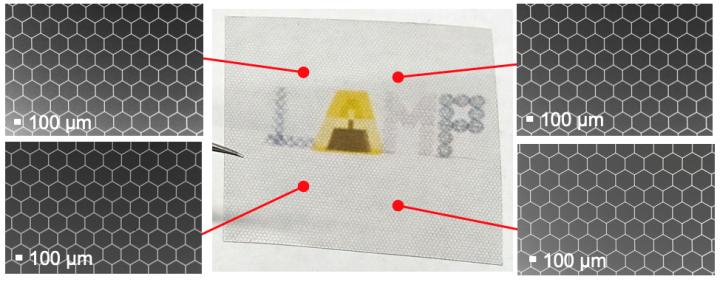
PITTSBURGH (Nov. 13, 2019) — Each year, consumers ask more of electronic displays, wanting them bigger, brighter, and even flexible. Displays from smartwatches to 4K TVs currently consist of organic light-emitting diodes (OLEDs) which use indium tin oxide (ITO) as a transparent electrode. However, ITO has its limitations: it is expensive; doesn’t perform well enough for larger areas; and can crack with repeated touching or swiping.

However, a $1 million award from the Department of Energy’s (DOE) Office of Energy Efficiency and Renewable Energy Small Business Innovation Research (SBIR) program will fund collaborative research to replace ITO with metal “microgrid” conductors to improve OLED performance. The research will be led by Paul Leu, PhD, associate professor of industrial engineering at the University of Pittsburgh’s Swanson School of Engineering, and Electroninks, a technology company in Austin, Texas.

Leu first came across the Electronink’s metal ink in its circuit drawing kit called Circuit Scribe. The device includes a pen that uses conductive silver ink to allow users to create working lights with circuits drawn on paper. Leu, whose lab works with transparent electrodes, saw the product and understood that the company’s particle-free, metal ink might be able to address some of the limitations with ITO.

“Electronink’s metal ink can cure at low temperatures, be printed into patterns, and has conductivity comparable to bulk metal,” says Leu. “By using a new metal patterning technique that prints the metal grid directly on glass or plastic, we can create ‘microgrid’ conductors that can outperform ITO at a lower manufacturing cost.”

“We are excited to continue this collaboration with Prof. Leu, and appreciate the DOE recognizing the milestones to date and continued support of our collective effort,” says Melbs LeMieux, President and Cofounder at Electroninks. “Prof. Leu’s team has helped to greatly accelerate the metal microgrid process technology for OLED lighting from concept to demonstration, and now we are working with our industrial partners towards commercialization.”

Leu and Electroninks began the project in 2018, working for a year in a proof-of-concept phase to show that their metal inks could work as a replacement for ITO.

“The first phase of the project was successful,” says Ziyu Zhou, lead graduate student on the project. “We were able to achieve high performance, with transparency over 90 percent and sheet resistance under 1 ohm per square.”

###

The DOE grant funds Phase II, in which Leu’s lab and Electroninks will continue to investigate and develop the technology, process, and implementation to commercial products with its industrial partners. They will be developing and evaluating the technology for a variety of applications such as displays, lighting, touch sensors, and electromagnetic interference shielding.

Media Contact
Maggie Pavlick
[email protected]
412-383-0449

Original Source

https://www.engineering.pitt.edu/News/2019/Leu-Electroninks-Metal-Ink-Microgrid/

Tags: Chemistry/Physics/Materials SciencesElectrical Engineering/ElectronicsIndustrial Engineering/ChemistryMaterialsResearch/DevelopmentSuperconductors/Semiconductors
Share12Tweet8Share2ShareShareShare2

Related Posts

Biochar-Based Materials Offer Promising Solution for Sustainable Uranium Recovery in Nuclear Energy — Chemistry

Biochar-Based Materials Offer Promising Solution for Sustainable Uranium Recovery in Nuclear Energy

June 30, 2026
From Cells to Boundaries: Unveiling the Origins of Biological Order — Chemistry

From Cells to Boundaries: Unveiling the Origins of Biological Order

June 30, 2026

AI and Physics Collaborate to Design Advanced Hydrogen Storage Materials

June 25, 2026

International Team Including Dresden Scientists Develops Novel Designer Proteins for Advanced Study of Living Tissue

June 25, 2026
Please login to join discussion

POPULAR NEWS

  • Saying Goodbye to PGY-6: Pediatric Fellowship Realities

    103 shares
    Share 41 Tweet 26
  • Detection of EDCs in Breast Milk and Infant Urine Up to Six Months Highlights Early Exposure Risks

    77 shares
    Share 31 Tweet 19
  • New Drug Candidate Developed at McMaster Shows Potential for Treating Brain Cancer

    58 shares
    Share 23 Tweet 15
  • KTU Researchers Explore Ultrasound’s Role in Enhancing Blood Flow Beyond Diagnostics

    53 shares
    Share 21 Tweet 13

About

We bring you the latest biotechnology news from best research centers and universities around the world. Check our website.

Follow us

Recent News

Indiana University Biologists Discover Molecular Mechanism Driving Spread of Antibiotic Resistance Genes in Bacteria

Biochar-Based Materials Offer Promising Solution for Sustainable Uranium Recovery in Nuclear Energy

Experimental Treatment Shows Promise in Improving Outcomes for ARDS Patients

Subscribe to Blog via Email

Enter your email address to subscribe to this blog and receive notifications of new posts by email.

Join 82 other subscribers
  • Contact Us

Bioengineer.org © Copyright 2023 All Rights Reserved.

Welcome Back!

Login to your account below

Forgotten Password?

Retrieve your password

Please enter your username or email address to reset your password.

Log In
No Result
View All Result
  • Homepages
    • Home Page 1
    • Home Page 2
  • News
  • National
  • Business
  • Health
  • Lifestyle
  • Science

Bioengineer.org © Copyright 2023 All Rights Reserved.