• HOME
  • NEWS
  • EXPLORE
    • CAREER
      • Companies
      • Jobs
    • EVENTS
    • iGEM
      • News
      • Team
    • PHOTOS
    • VIDEO
    • WIKI
  • BLOG
  • COMMUNITY
    • FACEBOOK
    • INSTAGRAM
    • TWITTER
Sunday, August 23, 2026
BIOENGINEER.ORG
No Result
View All Result
  • Login
  • HOME
  • NEWS
  • EXPLORE
    • CAREER
      • Companies
      • Jobs
        • Lecturer
        • PhD Studentship
        • Postdoc
        • Research Assistant
    • EVENTS
    • iGEM
      • News
      • Team
    • PHOTOS
    • VIDEO
    • WIKI
  • BLOG
  • COMMUNITY
    • FACEBOOK
    • INSTAGRAM
    • TWITTER
  • HOME
  • NEWS
  • EXPLORE
    • CAREER
      • Companies
      • Jobs
        • Lecturer
        • PhD Studentship
        • Postdoc
        • Research Assistant
    • EVENTS
    • iGEM
      • News
      • Team
    • PHOTOS
    • VIDEO
    • WIKI
  • BLOG
  • COMMUNITY
    • FACEBOOK
    • INSTAGRAM
    • TWITTER
No Result
View All Result
Bioengineer.org
No Result
View All Result
Home NEWS Science News Health

Forget the Chardonay, pass me the grape stems! Anti-tumor activity in prostate cancer cells

Bioengineer by Bioengineer
November 13, 2019
in Health
Reading Time: 2 mins read
0
IMAGE
Share on FacebookShare on TwitterShare on LinkedinShare on RedditShare on Telegram

IMAGE

Credit: Hidefumi Makabe & Hiroshi Fujii, Institute for Biomedical Sciences, Shinshu University, Japan


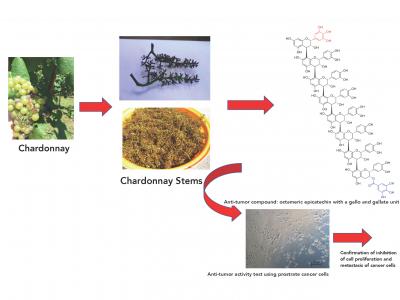
Grape stems are discarded en masse during the production of wine. We love and produce a lot of wine in Nagano prefecture, and have been hoping to find a positive use for the previously discarded grape stems. Scientists at Shinshu University studied compounds within grape stem extracts and found significant anti-cancer activity on tumor cells.

In this study, compounds from grape stems were isolated, characterized and evaluated for their anti-tumor activities. One of the compounds in particular was found to have induced cell cycle arrest, apoptosis and suppressed the invasive activity of the cancerous prostrate cells. The compound also significantly suppressed the expression of the cancer-promoting gene FABP5.

Studies need to be carried out to determine if the compound interacts with potent receptors in cancer cells, and promise is observed regarding its anti-metastasis properties. Further research is needed in vivo to determine if grape stems with food function can help deter cancer.

###

This study was partially supported by Chinomori Foundation of Shinshu University. This study was a joint research project with local wine producer St Cousair who generously provided the grape stems for the study and the Interdisciplinary Cluster for Cutting Edge Research, Institute for Biomedical Sciences, Shinshu University.

Mr. Hideyuki Karasawa of Nagano Prefecture General Industrial Technical Center is thanked for help obtaining ESI-TOFMS data.

Keywords: oligomeric proanthocyanidin, vitis vinifera, flavan-3-ol, high-performance liquid chromatography, FABP5, PC3, EGCG, ESI-TOFMS, anti-cancer

The results of this research has been published in the journal Scientific Reports.

Link to http://www.stcousair.co.jp

Link to https://www.shinshu-u.ac.jp/institution/ibs/english/

Media Contact
Hitomi Thompson
[email protected]
81-263-373-529

Related Journal Article

http://dx.doi.org/10.1038/s41598-019-48603-5

Tags: Biomedical/Environmental/Chemical EngineeringBiotechnologycancerEcology/EnvironmentFood/Food ScienceMedicine/HealthPharmaceutical ChemistryPharmaceutical Science
Share12Tweet8Share2ShareShareShare2

Related Posts

Blocking glucosylceramide production kills cancer cells via lysosomal dysfunction, not ceramide buildup

August 23, 2026

ZCCHC4 boosts replication-dependent histone mRNA translation by interacting with eIF3

August 23, 2026

Tirzepatide Versus GLP-1 Agonists for Stroke Risk in Atrial Fibrillation and Diabetes

August 22, 2026

Real-world study examines psychotic complications of subcutaneous foslevodopa/foscarbidopa infusions in 198 patients

August 22, 2026
Please login to join discussion

POPULAR NEWS

  • Blocking glucosylceramide production kills cancer cells via lysosomal dysfunction, not ceramide buildup

    29 shares
    Share 12 Tweet 7
  • ZCCHC4 boosts replication-dependent histone mRNA translation by interacting with eIF3

    29 shares
    Share 12 Tweet 7
  • KAIST Surface Defects Boost Droplet Formation, Removal, and Heat Transfer by 5.5-Fold

    29 shares
    Share 12 Tweet 7
  • Dual-oxygen pancreatic cancer organoids mirror basal-classical diversity, spatial transcriptomics confirms

    29 shares
    Share 12 Tweet 7

About

We bring you the latest biotechnology news from best research centers and universities around the world. Check our website.

Follow us

Recent News

Blocking glucosylceramide production kills cancer cells via lysosomal dysfunction, not ceramide buildup

ZCCHC4 boosts replication-dependent histone mRNA translation by interacting with eIF3

KAIST Surface Defects Boost Droplet Formation, Removal, and Heat Transfer by 5.5-Fold

Subscribe to Blog via Email

Success! An email was just sent to confirm your subscription. Please find the email now and click 'Confirm' to start subscribing.

Join 85 other subscribers
  • Contact Us

Bioengineer.org © Copyright 2023 All Rights Reserved.

Welcome Back!

Login to your account below

Forgotten Password?

Retrieve your password

Please enter your username or email address to reset your password.

Log In
No Result
View All Result
  • Homepages
    • Home Page 1
    • Home Page 2
  • News
  • National
  • Business
  • Health
  • Lifestyle
  • Science

Bioengineer.org © Copyright 2023 All Rights Reserved.