• HOME
  • NEWS
  • EXPLORE
    • CAREER
      • Companies
      • Jobs
    • EVENTS
    • iGEM
      • News
      • Team
    • PHOTOS
    • VIDEO
    • WIKI
  • BLOG
  • COMMUNITY
    • FACEBOOK
    • INSTAGRAM
    • TWITTER
Saturday, December 20, 2025
BIOENGINEER.ORG
No Result
View All Result
  • Login
  • HOME
  • NEWS
  • EXPLORE
    • CAREER
      • Companies
      • Jobs
        • Lecturer
        • PhD Studentship
        • Postdoc
        • Research Assistant
    • EVENTS
    • iGEM
      • News
      • Team
    • PHOTOS
    • VIDEO
    • WIKI
  • BLOG
  • COMMUNITY
    • FACEBOOK
    • INSTAGRAM
    • TWITTER
  • HOME
  • NEWS
  • EXPLORE
    • CAREER
      • Companies
      • Jobs
        • Lecturer
        • PhD Studentship
        • Postdoc
        • Research Assistant
    • EVENTS
    • iGEM
      • News
      • Team
    • PHOTOS
    • VIDEO
    • WIKI
  • BLOG
  • COMMUNITY
    • FACEBOOK
    • INSTAGRAM
    • TWITTER
No Result
View All Result
Bioengineer.org
No Result
View All Result
Home NEWS Science News

Non-volatile control of magnetic anisotropy through change of electric polarization

Bioengineer by Bioengineer
November 11, 2019
in Science News
Reading Time: 2 mins read
0
IMAGE
Share on FacebookShare on TwitterShare on LinkedinShare on RedditShare on Telegram

Researchers from Kanazawa University use electrical polarization to control magnetic properties aiming for advanced memory applications
IMAGE

Credit: Kanazawa University


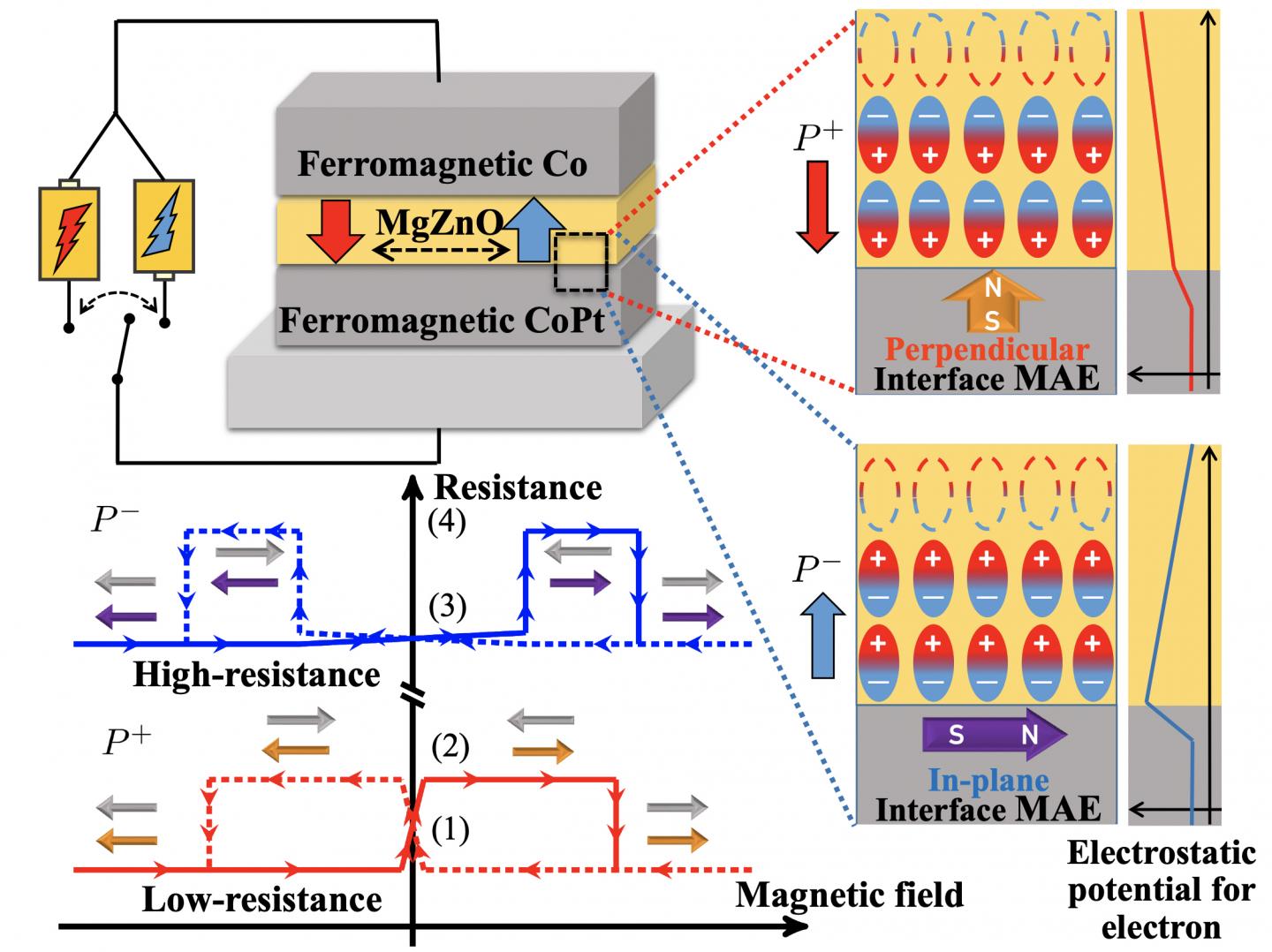
Kanazawa, Japan–The ability to control the magnetic properties of a material using electricity is important for the development of computer technology, particularly nonvolatile memory, which is memory that requires no constant electrical supply to maintain a set state. That is, electrical control of the magnetic states of a material may allow us to realize the attractive energy-efficient concept of nonvolatile magnetic memory that is switched between different states using electricity. Recently, Japanese researchers from Kanazawa University found that the magnetic properties of one metal layer could be controlled by applying electricity to an overlying metal oxide layer.

The research team investigated the change in the magnetic properties of a layer of cobalt-platinum alloy (CoPt) induced by the electrical polarization of an overlying zinc oxide (ZnO) layer. Computational simulations showed that switching the electrical polarization of the ZnO layer had a large effect on the chemical potential at the interface between ZnO and CoPt, which in turn led to a considerable change in the magnetic behavior of the CoPt layer. The change of the magnetic behavior of the CoPt layer was nonvolatile; i.e., the layer remained in the set state until the electrical polarization of the ZnO layer was changed.

“The large effect of the electrical polarization of ZnO on the magnetic properties of CoPt could be explained by the polarization of ZnO providing control over the interactions of the atomic orbitals of CoPt,” says author Masao Obata.

To confirm the promising results obtained from their simulations, the researchers fabricated a stacked structure called a tunnel junction containing Mg doped ZnO and CoPt layers. The magnetic properties and switching behavior of the tunnel junction were investigated. The results revealed that the tunnel junction showed substantially different magnetic behavior depending on the electrical polarization state of the ZnO layer, providing qualitative agreement between the simulation results and theoretical findings.

“The ZnO/CoPt system demonstrates that it is possible to achieve nonvolatile electrical control of the magnetic properties of materials,” explains co-author Tatsuki Oda. “Such a concept is important for the development of advanced energy-efficient nonvolatile magnetic memory.”

The nonvolatile control of the magnetic behavior of CoPt by the electrical polarization of ZnO represents an attractive concept to realize new nonvolatile memory applications to further advance information processing.

###

Media Contact
Tomoya Sato
[email protected]
81-762-645-076

Original Source

https://doi.org/10.1103/PhysRevB.100.054423

Related Journal Article

http://dx.doi.org/10.1103/PhysRevB.100.054423

Tags: Chemistry/Physics/Materials SciencesElectrical Engineering/ElectronicsElectromagneticsMaterialsNanotechnology/MicromachinesResearch/DevelopmentTheory/Design
Share12Tweet8Share2ShareShareShare2

Related Posts

Body Trust and Approval Affect Women’s Sexual Health

December 20, 2025

Assessing the K-NHSPSC: Korean Patient Safety Culture Insights

December 20, 2025

Spot Urine CA 19-9: New Insights in Pediatric Hydronephrosis

December 20, 2025

Discharge Choices for Elderly Surgical Patients Explored

December 20, 2025
Please login to join discussion

POPULAR NEWS

  • Nurses’ Views on Online Learning: Effects on Performance

    Nurses’ Views on Online Learning: Effects on Performance

    70 shares
    Share 28 Tweet 18
  • NSF funds machine-learning research at UNO and UNL to study energy requirements of walking in older adults

    71 shares
    Share 28 Tweet 18
  • Unraveling Levofloxacin’s Impact on Brain Function

    53 shares
    Share 21 Tweet 13
  • Exploring Audiology Accessibility in Johannesburg, South Africa

    51 shares
    Share 20 Tweet 13

About

We bring you the latest biotechnology news from best research centers and universities around the world. Check our website.

Follow us

Recent News

Body Trust and Approval Affect Women’s Sexual Health

Assessing the K-NHSPSC: Korean Patient Safety Culture Insights

Spot Urine CA 19-9: New Insights in Pediatric Hydronephrosis

Subscribe to Blog via Email

Enter your email address to subscribe to this blog and receive notifications of new posts by email.

Join 70 other subscribers
  • Contact Us

Bioengineer.org © Copyright 2023 All Rights Reserved.

Welcome Back!

Login to your account below

Forgotten Password?

Retrieve your password

Please enter your username or email address to reset your password.

Log In
No Result
View All Result
  • Homepages
    • Home Page 1
    • Home Page 2
  • News
  • National
  • Business
  • Health
  • Lifestyle
  • Science

Bioengineer.org © Copyright 2023 All Rights Reserved.