• HOME
  • NEWS
  • EXPLORE
    • CAREER
      • Companies
      • Jobs
    • EVENTS
    • iGEM
      • News
      • Team
    • PHOTOS
    • VIDEO
    • WIKI
  • BLOG
  • COMMUNITY
    • FACEBOOK
    • INSTAGRAM
    • TWITTER
Saturday, February 7, 2026
BIOENGINEER.ORG
No Result
View All Result
  • Login
  • HOME
  • NEWS
  • EXPLORE
    • CAREER
      • Companies
      • Jobs
        • Lecturer
        • PhD Studentship
        • Postdoc
        • Research Assistant
    • EVENTS
    • iGEM
      • News
      • Team
    • PHOTOS
    • VIDEO
    • WIKI
  • BLOG
  • COMMUNITY
    • FACEBOOK
    • INSTAGRAM
    • TWITTER
  • HOME
  • NEWS
  • EXPLORE
    • CAREER
      • Companies
      • Jobs
        • Lecturer
        • PhD Studentship
        • Postdoc
        • Research Assistant
    • EVENTS
    • iGEM
      • News
      • Team
    • PHOTOS
    • VIDEO
    • WIKI
  • BLOG
  • COMMUNITY
    • FACEBOOK
    • INSTAGRAM
    • TWITTER
No Result
View All Result
Bioengineer.org
No Result
View All Result
Home NEWS Science News Biology

Brain enlightens the origin of human hand’s skill

Bioengineer by Bioengineer
November 11, 2019
in Biology
Reading Time: 3 mins read
0
IMAGE
Share on FacebookShare on TwitterShare on LinkedinShare on RedditShare on Telegram

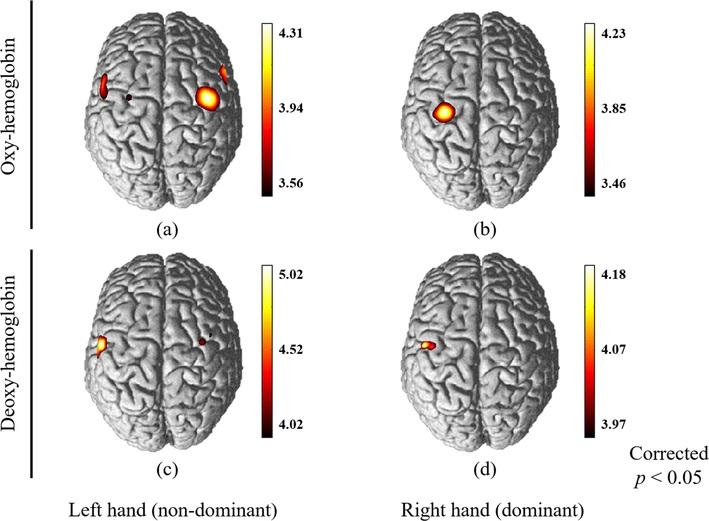
Using non-dominant hand activates both sides of your brain
IMAGE

Credit: DGIST


DGIST announced that Dr. Jinung An, Principal Research Scientist in Convergence Research Institute, found clues to explain the origin of ‘human hand motor skill.’

According to the Dr. An, We, humans, who have evolved from Homo habilis (‘handy man’), have developed art, science, and technology. This is due to the ability to manipulate hands, one of the innate talents that human has as well as language. Nevertheless, scientific exploration of the origin of the human hand’s skill to manipulate is still ongoing. He and his colleagues (Dr. Seung Hyun Lee and Mr. Sang Hyeon Jin) began to explore the human brain’s motor pathway with a lamp called fNIRS to find it.

Fifteen right-handed men performed sophisticated and complex hand movements (pinch grasping almonds with steel chopsticks and moving them precisely into the target) alternately between right and left hands. Simultaneously, they observed by fNIRS how the motor pathways of the cerebral cortex differ from one another.

They discovered that dominant right hand manipulation turned on contralateral cortical motor pathway accurately. Non-dominant left hand manipulation, on the other hand, activated contralateral cortical motor pathway with the help of ipsilateral cortical motor pathway. This results significantly suggested that when manipulating with non-dominant left-hand, brain regions corresponding to the inborn dominant right hand functioned to help learn motor manipulation.

Dr. An talked. In the early 20th century, Claude Lévi-Strauss declared that human is a ‘Locuteur (Speaker)’ rather than a man’s maker of machines. He emphasized language as a natural heritage of humankind. In contrast, Henri Bergson earlier defined human intelligence as the “faculty to create artificial objects, in particular tools to make tools, and to indefinitely variate its makings” in his great book, “Creative Evolution, 1907.” Influenced by his philosophical idea, Max Frisch published a novel “Homo Faber (Man the Maker)” tells that human beings are able to control their fate and their environment as a result of the use of tools.

Dr. An strongly insisted that both language and ability to use tools are inherent talents of human beings, and we can develop new motor artificial intelligence by simulating human ability to use tools just as we have developed the artificial intelligence of natural language processing by simulating the structure of human language.

###

This research was supported by the National Research Foundation for the ‘Development of noninvasive central-peripheral nerves complex stimulus and control technology based on brain activated real-time for facilitating next generation cerebral nerves (2018R1A2B2008013)’ as well as the ‘Development of BCI-based brain cognitive computing technology that recognizes human intention using deep learning (2017-0-00451)’ supported by the Institute for Information and Communications Technology Promotion (IITP). The research was published on the online version of Scientific Reports on October 1st.

Media Contact
Jinung An
[email protected]
82-537-854-610

Original Source

https://www.dgist.ac.kr/en/html/sub06/060202.html?mode=V&no=59e393e5c1e4c7e1119e8006225cc0ff&GotoPage=1

Related Journal Article

http://dx.doi.org/10.1038/s41598-019-50644-9

Tags: BiotechnologyMechanical EngineeringRobotry/Artificial IntelligenceTechnology/Engineering/Computer Science
Share12Tweet8Share2ShareShareShare2

Related Posts

Florida Cane Toad: Complex Spread and Selective Evolution

Florida Cane Toad: Complex Spread and Selective Evolution

February 7, 2026
New Study Uncovers Mechanism Behind Burn Pit Particulate Matter–Induced Lung Inflammation

New Study Uncovers Mechanism Behind Burn Pit Particulate Matter–Induced Lung Inflammation

February 6, 2026

DeepBlastoid: Advancing Automated and Efficient Evaluation of Human Blastoids with Deep Learning

February 6, 2026

Navigating the Gut: The Role of Formic Acid in the Microbiome

February 6, 2026
Please login to join discussion

POPULAR NEWS

  • Robotic Ureteral Reconstruction: A Novel Approach

    Robotic Ureteral Reconstruction: A Novel Approach

    82 shares
    Share 33 Tweet 21
  • Digital Privacy: Health Data Control in Incarceration

    63 shares
    Share 25 Tweet 16
  • Study Reveals Lipid Accumulation in ME/CFS Cells

    57 shares
    Share 23 Tweet 14
  • Breakthrough in RNA Research Accelerates Medical Innovations Timeline

    53 shares
    Share 21 Tweet 13

About

We bring you the latest biotechnology news from best research centers and universities around the world. Check our website.

Follow us

Recent News

Boosting Remote Healthcare: Stepped-Wedge Trial Insights

Barriers and Boosters of Seniors’ Physical Activity in Karachi

Evaluating Pediatric Emergency Care Quality in Ethiopia

Subscribe to Blog via Email

Enter your email address to subscribe to this blog and receive notifications of new posts by email.

Join 73 other subscribers
  • Contact Us

Bioengineer.org © Copyright 2023 All Rights Reserved.

Welcome Back!

Login to your account below

Forgotten Password?

Retrieve your password

Please enter your username or email address to reset your password.

Log In
No Result
View All Result
  • Homepages
    • Home Page 1
    • Home Page 2
  • News
  • National
  • Business
  • Health
  • Lifestyle
  • Science

Bioengineer.org © Copyright 2023 All Rights Reserved.