• HOME
  • NEWS
  • EXPLORE
    • CAREER
      • Companies
      • Jobs
    • EVENTS
    • iGEM
      • News
      • Team
    • PHOTOS
    • VIDEO
    • WIKI
  • BLOG
  • COMMUNITY
    • FACEBOOK
    • INSTAGRAM
    • TWITTER
Saturday, February 7, 2026
BIOENGINEER.ORG
No Result
View All Result
  • Login
  • HOME
  • NEWS
  • EXPLORE
    • CAREER
      • Companies
      • Jobs
        • Lecturer
        • PhD Studentship
        • Postdoc
        • Research Assistant
    • EVENTS
    • iGEM
      • News
      • Team
    • PHOTOS
    • VIDEO
    • WIKI
  • BLOG
  • COMMUNITY
    • FACEBOOK
    • INSTAGRAM
    • TWITTER
  • HOME
  • NEWS
  • EXPLORE
    • CAREER
      • Companies
      • Jobs
        • Lecturer
        • PhD Studentship
        • Postdoc
        • Research Assistant
    • EVENTS
    • iGEM
      • News
      • Team
    • PHOTOS
    • VIDEO
    • WIKI
  • BLOG
  • COMMUNITY
    • FACEBOOK
    • INSTAGRAM
    • TWITTER
No Result
View All Result
Bioengineer.org
No Result
View All Result
Home NEWS Science News

NASA-NOAA satellite finds super typhoon Halong finally weakening

Bioengineer by Bioengineer
November 6, 2019
in Science News
Reading Time: 2 mins read
0
IMAGE
Share on FacebookShare on TwitterShare on LinkedinShare on RedditShare on Telegram

IMAGE

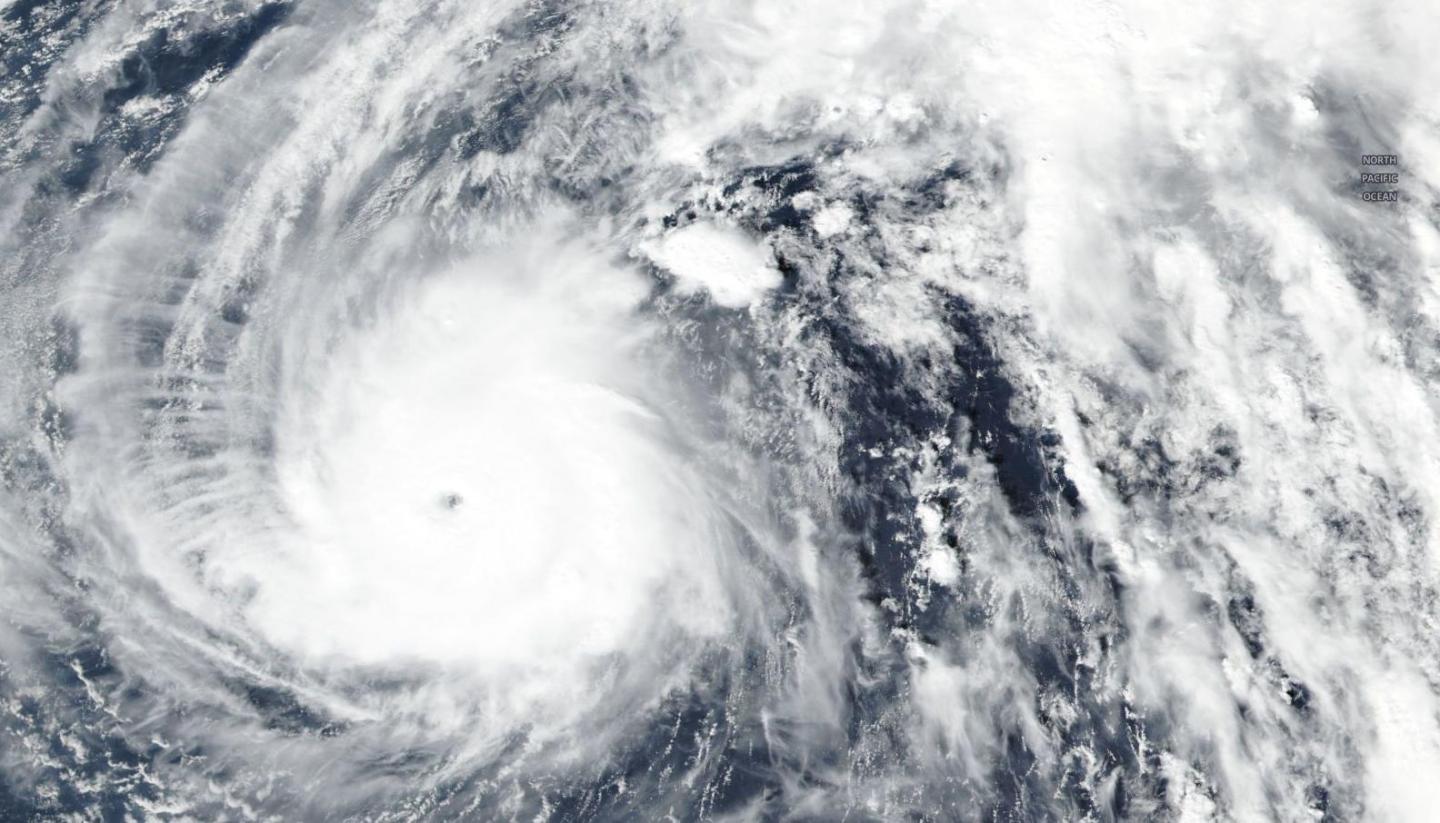
Credit: Credit: NASA Worldview, Earth Observing System Data and Information System (EOSDIS) / NOAA


Super Typhoon Halong has finally peaked in intensity and is now on a weakening trend. NASA-NOAA’s Suomi NPP satellite passed over the Northwestern Pacific Ocean and provided a look at the storm.

On Nov. 5, Halong was a powerful Category 5 hurricane on the Saffir-Simpson Hurricane Wind Scale. When the Suomi NPP satellite passed overhead on Nov. 6 the Visible Infrared Imaging Radiometer Suite (VIIRS) instrument aboard provided a visible image of the storm, after it had weakened slightly to a Category 4 storm. The VIIRS imagery showed bands of thunderstorms wrapping into the 10 nautical-mile wide eye.

At 10 a.m. EDT (1500 UTC) on Nov. 6 (or 1 a.m. CHST on Nov. 7) the National Weather Service in Tiyan, Guam noted the eye of Super Typhoon Halong was located near latitude 22.0 degrees north and longitude 150.8 degrees rast. That puts the center of Halong about 255 miles southwest of Minamitorishima, 420 miles northeast of Pagan, 580 miles northeast of Saipan, and 710 miles northeast of Guam.

Halong was moving north-northeast at 6 mph. Halong is expected to maintain this north-northeast heading through Thursday, Nov. 7, with a gradual increase in forward speed. By Saturday, Nov. 9, Halong is forecast to move toward the east-northeast at a faster pace.

Maximum sustained winds have decreased to 155 mph. A Category 4 hurricane contains sustained winds between 130 and 156 mph (113 and 136 knots/209 and 251 kph). Typhoon force winds extend outward from the eye up to 35 miles and tropical storm force winds extend outward up to 145 miles southeast of the center and up to 105 miles elsewhere.

Halong is forecast to weaken further today with a steady weakening trend expected to commence Friday, Nov. 8. On Nov. 8 upper-level winds are forecast to begin to affect the typhoon as Halong moves over cooler sea surface temperatures. Both of those factors are expected to help the storm transition into an extra-tropical cyclone.

Hurricanes are the most powerful weather event on Earth. NASA’s expertise in space and scientific exploration contributes to essential services provided to the American people by other federal agencies, such as hurricane weather forecasting.

###

For updated forecasts, Visit: https://www.weather.gov/gum/Cyclones

By Rob Gutro 

NASA’s Goddard Space Flight Center

Media Contact
Rob Gutro
[email protected]

Original Source

https://blogs.nasa.gov/hurricanes/2019/11/06/halong-northwestern-pacific-ocean-3/

Tags: Atmospheric ChemistryAtmospheric ScienceClimate ChangeClimate ScienceEarth ScienceMeteorologyTechnology/Engineering/Computer ScienceTemperature-Dependent PhenomenaWeather/Storms
Share13Tweet8Share2ShareShareShare2

Related Posts

Digital Health Perspectives from Baltic Sea Experts

February 7, 2026
Florida Cane Toad: Complex Spread and Selective Evolution

Florida Cane Toad: Complex Spread and Selective Evolution

February 7, 2026

Exploring Decision-Making in Dementia Caregivers’ Mobility

February 7, 2026

Succinate Receptor 1 Limits Blood Cell Formation, Leukemia

February 7, 2026
Please login to join discussion

POPULAR NEWS

  • Robotic Ureteral Reconstruction: A Novel Approach

    Robotic Ureteral Reconstruction: A Novel Approach

    82 shares
    Share 33 Tweet 21
  • Digital Privacy: Health Data Control in Incarceration

    63 shares
    Share 25 Tweet 16
  • Study Reveals Lipid Accumulation in ME/CFS Cells

    57 shares
    Share 23 Tweet 14
  • Breakthrough in RNA Research Accelerates Medical Innovations Timeline

    53 shares
    Share 21 Tweet 13

About

We bring you the latest biotechnology news from best research centers and universities around the world. Check our website.

Follow us

Recent News

Digital Health Perspectives from Baltic Sea Experts

Florida Cane Toad: Complex Spread and Selective Evolution

Exploring Decision-Making in Dementia Caregivers’ Mobility

Subscribe to Blog via Email

Enter your email address to subscribe to this blog and receive notifications of new posts by email.

Join 73 other subscribers
  • Contact Us

Bioengineer.org © Copyright 2023 All Rights Reserved.

Welcome Back!

Login to your account below

Forgotten Password?

Retrieve your password

Please enter your username or email address to reset your password.

Log In
No Result
View All Result
  • Homepages
    • Home Page 1
    • Home Page 2
  • News
  • National
  • Business
  • Health
  • Lifestyle
  • Science

Bioengineer.org © Copyright 2023 All Rights Reserved.