• HOME
  • NEWS
  • EXPLORE
    • CAREER
      • Companies
      • Jobs
    • EVENTS
    • iGEM
      • News
      • Team
    • PHOTOS
    • VIDEO
    • WIKI
  • BLOG
  • COMMUNITY
    • FACEBOOK
    • INSTAGRAM
    • TWITTER
Monday, October 5, 2026
BIOENGINEER.ORG
No Result
View All Result
  • Login
  • HOME
  • NEWS
  • EXPLORE
    • CAREER
      • Companies
      • Jobs
        • Lecturer
        • PhD Studentship
        • Postdoc
        • Research Assistant
    • EVENTS
    • iGEM
      • News
      • Team
    • PHOTOS
    • VIDEO
    • WIKI
  • BLOG
  • COMMUNITY
    • FACEBOOK
    • INSTAGRAM
    • TWITTER
  • HOME
  • NEWS
  • EXPLORE
    • CAREER
      • Companies
      • Jobs
        • Lecturer
        • PhD Studentship
        • Postdoc
        • Research Assistant
    • EVENTS
    • iGEM
      • News
      • Team
    • PHOTOS
    • VIDEO
    • WIKI
  • BLOG
  • COMMUNITY
    • FACEBOOK
    • INSTAGRAM
    • TWITTER
No Result
View All Result
Bioengineer.org
No Result
View All Result
Home NEWS Science News

NASA finds small area of heavy rain left in Tropical Cyclone Kyarr

Bioengineer by Bioengineer
October 31, 2019
in Science News
Reading Time: 2 mins read
0
IMAGE
Share on FacebookShare on TwitterShare on LinkedinShare on RedditShare on Telegram

IMAGE

Credit: Credit: NASA/JAXA/NRL


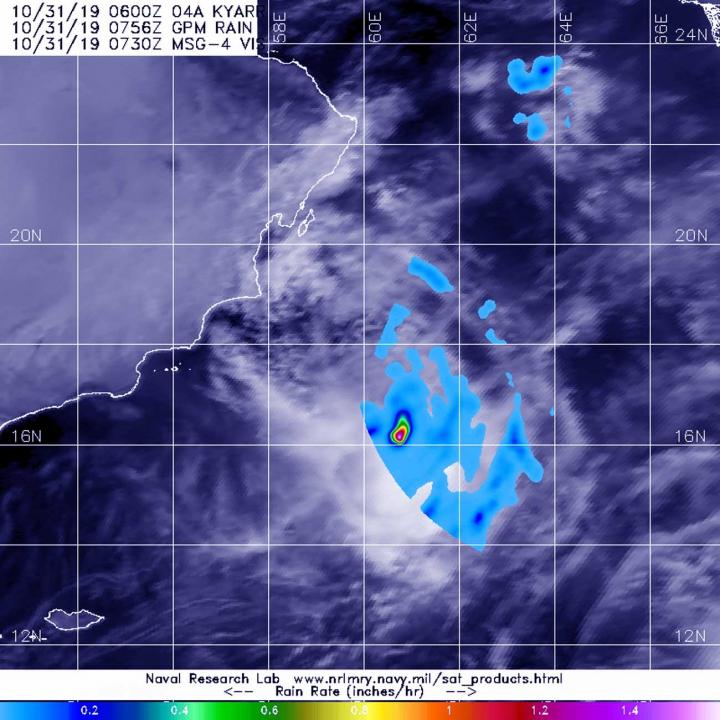
Tropical Cyclone Kyarr appears to be winding down as it moves through the Arabian Sea and NASA provided forecasters with an analysis of rainfall rates occurring in the weakening storm.

NASA has the unique capability of peering under the clouds in storms and measuring the rate in which rain is falling. Global Precipitation Measurement mission or GPM core passed over Kyarr from its orbit in space and measured rainfall rates throughout the storm.

The GPM’s core satellite passed over Tropical Cyclone Kyarr in the Arabian Sea, Northern Indian Ocean on Oct. 31 at 3:56 a.m. EDT (0756 UTC) and found the heaviest rainfall occurring in a very small area around the center of circulation where rain was falling at 1.6 inches (40 mm) per hour. Most of the rain falling throughout the rest of the system was occurring at a rate of over 25 mm (about 1 inch) per hour Forecasters incorporate the rainfall data into their forecasts.

At 5 a.m. EDT (0900 UTC) on Oct. 31, the Joint Typhoon Warning Center or JTWC noted that Kyarr was located near latitude 17.7 degrees north and longitude 59.9. degrees east, about 174 miles south-southeast of Masirah Island, Oman. Kyarr was moving to the southwest and had maximum sustained winds 35 knots (40 mph/65 kph).

Kyarr is moving southwest and is weakening rapidly. The storm is expected to dissipate before reaching Socotra Island.

Hurricanes are the most powerful weather event on Earth. NASA’s expertise in space and scientific exploration contributes to essential services provided to the American people by other federal agencies, such as hurricane weather forecasting.

Both the Japan Aerospace Exploration Agency, JAXA and NASA manage GPM.

###

Media Contact
Rob Gutro
[email protected]

Original Source

https://blogs.nasa.gov/hurricanes/2019/10/31/kyarr-northern-indian-ocean-5/

Tags: Atmospheric ChemistryAtmospheric ScienceClimate ChangeClimate ScienceEarth ScienceMeteorologyTechnology/Engineering/Computer ScienceTemperature-Dependent PhenomenaWeather/Storms
Share13Tweet8Share2ShareShareShare2

Related Posts

Blockchain Meets the Road: A Lightweight Security Shield for the Internet of Vehicles

Blockchain Meets the Road: A Lightweight Security Shield for the Internet of Vehicles

October 5, 2026
New AI Framework Slashes Labeling Costs in Shifting, Imbalanced Data Streams

New AI Framework Slashes Labeling Costs in Shifting, Imbalanced Data Streams

October 5, 2026

AI Turns Cheap RGB Drone Photos Into Multispectral Crop Scans

October 5, 2026

AI Reads Ultrasound Signals to Predict Which Carotid Plaques May Trigger Stroke

October 5, 2026
Please login to join discussion

POPULAR NEWS

  • Alloys That Shrink Their Own Grains: New PIX Mechanism Refines Metals With Heat Alone

    Alloys That Shrink Their Own Grains: New PIX Mechanism Refines Metals With Heat Alone

    29 shares
    Share 12 Tweet 7
  • Endurance Exercise Reshapes the Liver in Males and Females Through Distinct Molecular Routes

    29 shares
    Share 12 Tweet 7
  • Single Transcription Factor PU.1 Rapidly Converts Fibroblasts into Macrophage-Lineage Cells

    29 shares
    Share 12 Tweet 7
  • New Scale Measures How Ready Nurse Educators Really Are for the AI Era

    29 shares
    Share 12 Tweet 7

About

We bring you the latest biotechnology news from best research centers and universities around the world. Check our website.

Follow us

Recent News

Alloys That Shrink Their Own Grains: New PIX Mechanism Refines Metals With Heat Alone

Endurance Exercise Reshapes the Liver in Males and Females Through Distinct Molecular Routes

Single Transcription Factor PU.1 Rapidly Converts Fibroblasts into Macrophage-Lineage Cells

Subscribe to Blog via Email

Success! An email was just sent to confirm your subscription. Please find the email now and click 'Confirm' to start subscribing.

Join 85 other subscribers
  • Contact Us

Bioengineer.org © Copyright 2023 All Rights Reserved.

Welcome Back!

Login to your account below

Forgotten Password?

Retrieve your password

Please enter your username or email address to reset your password.

Log In
No Result
View All Result
  • Homepages
    • Home Page 1
    • Home Page 2
  • News
  • National
  • Business
  • Health
  • Lifestyle
  • Science

Bioengineer.org © Copyright 2023 All Rights Reserved.