• HOME
  • NEWS
  • EXPLORE
    • CAREER
      • Companies
      • Jobs
    • EVENTS
    • iGEM
      • News
      • Team
    • PHOTOS
    • VIDEO
    • WIKI
  • BLOG
  • COMMUNITY
    • FACEBOOK
    • INSTAGRAM
    • TWITTER
Tuesday, August 18, 2026
BIOENGINEER.ORG
No Result
View All Result
  • Login
  • HOME
  • NEWS
  • EXPLORE
    • CAREER
      • Companies
      • Jobs
        • Lecturer
        • PhD Studentship
        • Postdoc
        • Research Assistant
    • EVENTS
    • iGEM
      • News
      • Team
    • PHOTOS
    • VIDEO
    • WIKI
  • BLOG
  • COMMUNITY
    • FACEBOOK
    • INSTAGRAM
    • TWITTER
  • HOME
  • NEWS
  • EXPLORE
    • CAREER
      • Companies
      • Jobs
        • Lecturer
        • PhD Studentship
        • Postdoc
        • Research Assistant
    • EVENTS
    • iGEM
      • News
      • Team
    • PHOTOS
    • VIDEO
    • WIKI
  • BLOG
  • COMMUNITY
    • FACEBOOK
    • INSTAGRAM
    • TWITTER
No Result
View All Result
Bioengineer.org
No Result
View All Result
Home NEWS Science News Chemistry

Lithuanian scientists’ research may contribute to a better diagnosis of cancer

Bioengineer by Bioengineer
October 28, 2019
in Chemistry
Reading Time: 2 mins read
0
IMAGE
Share on FacebookShare on TwitterShare on LinkedinShare on RedditShare on Telegram

The method discovered by Kaunas University of Technology, Lithuania researchers together with colleagues from other countries opens up an opportunity to develop biological sensors that are extremely sensitive and can detect even single molecules.
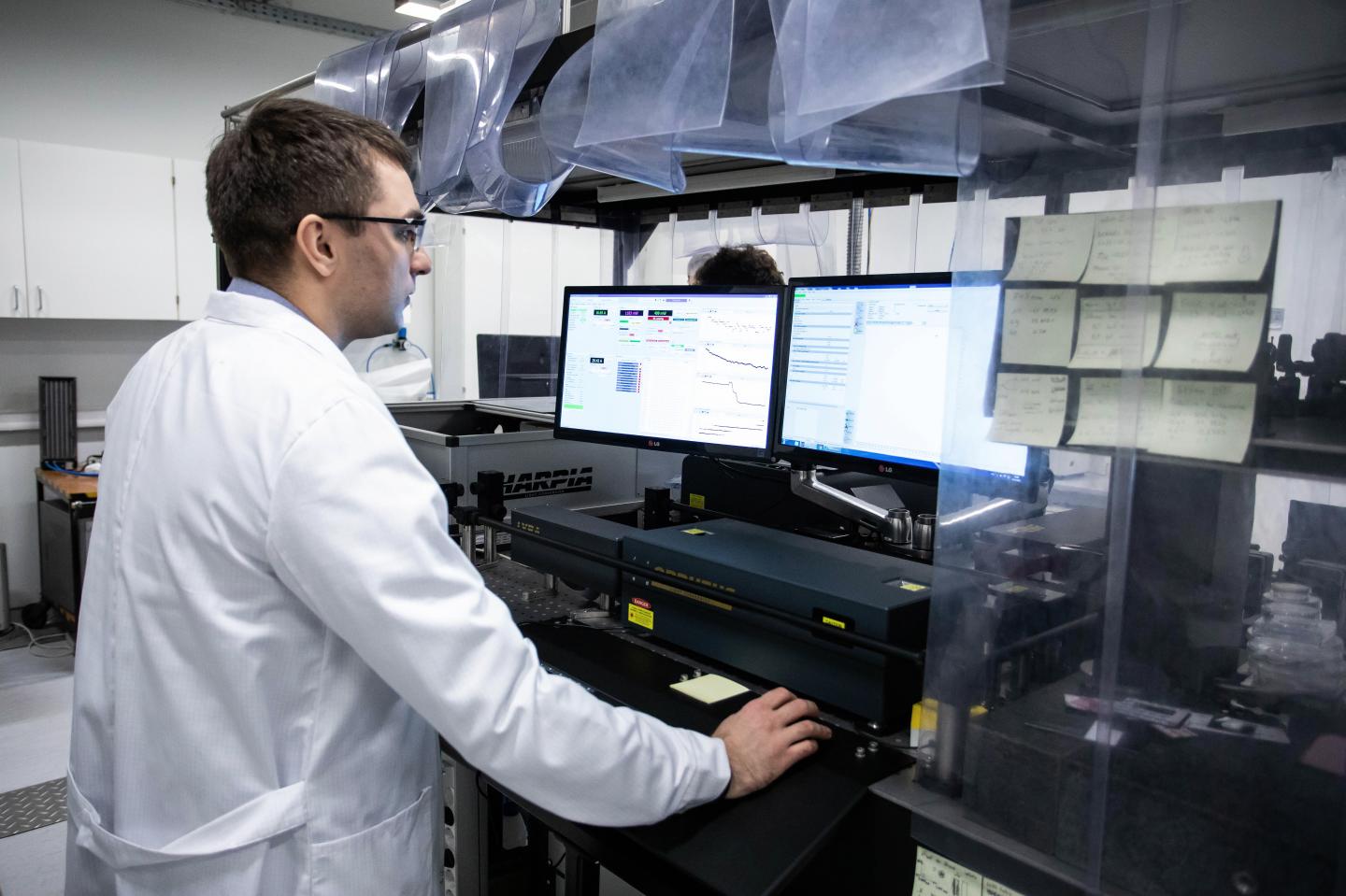
IMAGE

Credit: Juste Suminaite/KTU


A team of researchers from the Institute of Materials Science at Kaunas University of Technology (KTU), Lithuania together with colleagues from Japan and Latvia came up with a method that forces over 300 million metal nanoparticles to self-assemble into regular structures, which enhance their interaction with light by orders of magnitude. This work might be beneficial in developing ultra-small lasers that can contribute to the diagnostics of many illnesses, including oncological ones.

At the KTU Institute of Materials Science, researchers are studying materials at the level of atoms and molecules to find ways to efficiently re-arrange the characteristics of various surfaces used in the field of photonics and medicine. In the most recent study, KTU scientists Professor Sigitas Tamulevicius, Professor Tomas Tamulevicius and PhD student Mindaugas Juodenas delved into the world of smallest metal particles and their interaction with light.

“These metal nanoparticles are very small – so small that a thousand of them could fit across a human hair”, said Juodenas.

Such particles can resonantly interact with light, which is an interesting and useful phenomenon by itself. If, however, they constitute a larger, periodic structure, their collective interaction with light not only becomes orders of magnitude stronger but can also be controlled. This opens a plethora of possibilities for the development of ultra-small photonic devices, such as nanolasers.

“We came up with a method that forces over 300 million metal nanoparticles to self-assemble in a regular fashion. This makes them interact with light more efficiently. What are the benefits? This is an opportunity to develop biological sensors that are extremely sensitive and can detect even single molecules. Diagnostics of various illnesses would thus become possible at a very early stage”, explained Juodenas, one of the co-authors of the research.

KTU researchers’ achievement could also benefit the new cancer treatment method – photothermal treatment – that is currently being developed worldwide. Photothermal treatment means that heat produced through nanoparticles’ resonant interaction with light is applied to a very small area in order to kill cancer cells without affecting other tissues in the body. This requires laser technology, and a device featuring the nanoparticle arrays proposed by KTU researchers might allow for the development of implantable nanolasers, which would help to redirect light into harmful cells more efficiently.

###

Media Contact
Aldona Tuur
[email protected]
370-612-55857

Original Source

https://en.ktu.edu/news/ktu-scientists-research-can-serve-as-a-breakthrough-in-cancer-treatment-and-diagnostics/

Tags: Atomic/Molecular/Particle PhysicscancerChemistry/Physics/Materials SciencesDiagnosticsHealth Care Systems/ServicesMaterialsNanotechnology/MicromachinesOpticsParticle Physics
Share14Tweet9Share2ShareShareShare2

Related Posts

Switchable smart gel could enable next-generation drug delivery and sensing technologies

Switchable smart gel could enable next-generation drug delivery and sensing technologies

August 18, 2026
How Curvature Shapes the World Around Us

How Curvature Shapes the World Around Us

August 18, 2026

TUM develops single-photon sources to advance quantum communication

August 18, 2026

Scientists visualize nanoscale forces, confirming electric fields at the air–water interface

August 18, 2026
Please login to join discussion

POPULAR NEWS

  • New platform enables long-lasting, air-stable persistent luminescence in amorphous organic materials

    29 shares
    Share 12 Tweet 7
  • Switchable smart gel could enable next-generation drug delivery and sensing technologies

    29 shares
    Share 12 Tweet 7
  • Cannabis Use Associated With Earlier Psychosis Onset

    29 shares
    Share 12 Tweet 7
  • Posterior Transosseous S1 Pedicle Approach Reaches Superior Hypogastric Plexus

    29 shares
    Share 12 Tweet 7

About

We bring you the latest biotechnology news from best research centers and universities around the world. Check our website.

Follow us

Recent News

New platform enables long-lasting, air-stable persistent luminescence in amorphous organic materials

Switchable smart gel could enable next-generation drug delivery and sensing technologies

Cannabis Use Associated With Earlier Psychosis Onset

Subscribe to Blog via Email

Enter your email address to subscribe to this blog and receive notifications of new posts by email.

Join 85 other subscribers
  • Contact Us

Bioengineer.org © Copyright 2023 All Rights Reserved.

Welcome Back!

Login to your account below

Forgotten Password?

Retrieve your password

Please enter your username or email address to reset your password.

Log In
No Result
View All Result
  • Homepages
    • Home Page 1
    • Home Page 2
  • News
  • National
  • Business
  • Health
  • Lifestyle
  • Science

Bioengineer.org © Copyright 2023 All Rights Reserved.