• HOME
  • NEWS
  • EXPLORE
    • CAREER
      • Companies
      • Jobs
    • EVENTS
    • iGEM
      • News
      • Team
    • PHOTOS
    • VIDEO
    • WIKI
  • BLOG
  • COMMUNITY
    • FACEBOOK
    • INSTAGRAM
    • TWITTER
Saturday, February 7, 2026
BIOENGINEER.ORG
No Result
View All Result
  • Login
  • HOME
  • NEWS
  • EXPLORE
    • CAREER
      • Companies
      • Jobs
        • Lecturer
        • PhD Studentship
        • Postdoc
        • Research Assistant
    • EVENTS
    • iGEM
      • News
      • Team
    • PHOTOS
    • VIDEO
    • WIKI
  • BLOG
  • COMMUNITY
    • FACEBOOK
    • INSTAGRAM
    • TWITTER
  • HOME
  • NEWS
  • EXPLORE
    • CAREER
      • Companies
      • Jobs
        • Lecturer
        • PhD Studentship
        • Postdoc
        • Research Assistant
    • EVENTS
    • iGEM
      • News
      • Team
    • PHOTOS
    • VIDEO
    • WIKI
  • BLOG
  • COMMUNITY
    • FACEBOOK
    • INSTAGRAM
    • TWITTER
No Result
View All Result
Bioengineer.org
No Result
View All Result
Home NEWS Science News Health

New way to wrap liquid drops could improve drug delivery

Bioengineer by Bioengineer
October 22, 2019
in Health
Reading Time: 2 mins read
0
IMAGE
Share on FacebookShare on TwitterShare on LinkedinShare on RedditShare on Telegram

IMAGE

Credit: BRIAN CALDWELL


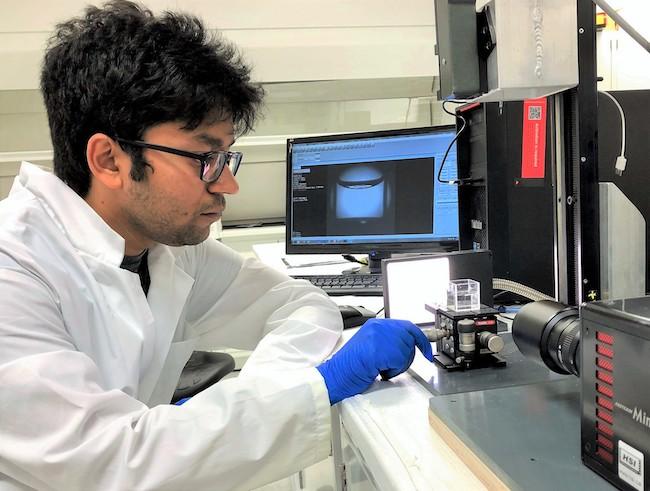
Researchers have developed a faster, cheaper way to coat liquid medication, an invention that could improve how drugs are delivered in the body.

The new encapsulation technology, developed by engineers at the University of Waterloo, uses gravity and other natural forces to wrap drops as they fall through a thin layer of liquid shell floating on a base liquid.

Once hardened, or cured, by exposure to ultraviolet light, the shell houses and protects the liquid core inside.

“It is a very simple technique that requires almost no energy – and it is extremely rapid,” said Sushanta Mitra, executive director of the Waterloo Institute for Nanotechnology. “Encapsulation takes place in milliseconds.”

When the liquid core is required – after reaching a particular area of the body for targeted drug delivery, for instance – the shell is designed to dissolve and release its contents.

Mitra said the system’s simplicity enables much more economical production of capsules than current methods, which include machines that wrap drops with thin gel sheets and complex microfluidic processes.

“We envision a very simple, rapid, mass-production system using syringes,” said Mitra, a professor of mechanical and mechatronics engineering who is cross-appointed in chemical engineering and physics and astronomy. “With a one-shot approach, you could produce thousands of these encapsulations.”

Other advantages of the technology include the ability to coat drops with multiple layers, greater flexibility in terms of drop volume and shell materials, and the production of stronger, more stable capsules.

In addition to the targeted delivery of pharmaceuticals and vitamins, potential uses for the liquid-liquid wrapping method include the production of tiny capsules to add flavours to cola drinks as they’re being consumed and prolonging the shelf life of cosmetic creams containing collagen.

Mitra supervised the research involving engineering graduate students Sirshendu Misra and Kumari Trinavee, and postdoctoral fellow Naga Siva Kumar Gunda.

###

A paper on their work, Encapsulation with an interfacial liquid layer: Robust and efficient liquid-liquid wrapping, appears in the Journal of Colloid and Interface Science.

Media Contact
Chris Wilson-Smith
[email protected]
226-338-6564

Related Journal Article

http://dx.doi.org/10.1016/j.jcis.2019.09.099

Tags: BiochemistryBiomedical/Environmental/Chemical EngineeringBiotechnologyMedicine/HealthNanotechnology/MicromachinesPharmaceutical ChemistryPharmaceutical SciencePharmaceutical SciencesPharmaceutical/Combinatorial Chemistry
Share12Tweet8Share2ShareShareShare2

Related Posts

Evaluating Pediatric Emergency Care Quality in Ethiopia

February 7, 2026

TPMT Expression Predictions Linked to Azathioprine Side Effects

February 7, 2026

Improving Dementia Care with Enhanced Activity Kits

February 7, 2026

Decoding Prostate Cancer Origins via snFLARE-seq, mxFRIZNGRND

February 7, 2026
Please login to join discussion

POPULAR NEWS

  • Robotic Ureteral Reconstruction: A Novel Approach

    Robotic Ureteral Reconstruction: A Novel Approach

    82 shares
    Share 33 Tweet 21
  • Digital Privacy: Health Data Control in Incarceration

    63 shares
    Share 25 Tweet 16
  • Study Reveals Lipid Accumulation in ME/CFS Cells

    57 shares
    Share 23 Tweet 14
  • Breakthrough in RNA Research Accelerates Medical Innovations Timeline

    53 shares
    Share 21 Tweet 13

About

We bring you the latest biotechnology news from best research centers and universities around the world. Check our website.

Follow us

Recent News

Evaluating Pediatric Emergency Care Quality in Ethiopia

TPMT Expression Predictions Linked to Azathioprine Side Effects

Improving Dementia Care with Enhanced Activity Kits

Subscribe to Blog via Email

Enter your email address to subscribe to this blog and receive notifications of new posts by email.

Join 73 other subscribers
  • Contact Us

Bioengineer.org © Copyright 2023 All Rights Reserved.

Welcome Back!

Login to your account below

Forgotten Password?

Retrieve your password

Please enter your username or email address to reset your password.

Log In
No Result
View All Result
  • Homepages
    • Home Page 1
    • Home Page 2
  • News
  • National
  • Business
  • Health
  • Lifestyle
  • Science

Bioengineer.org © Copyright 2023 All Rights Reserved.