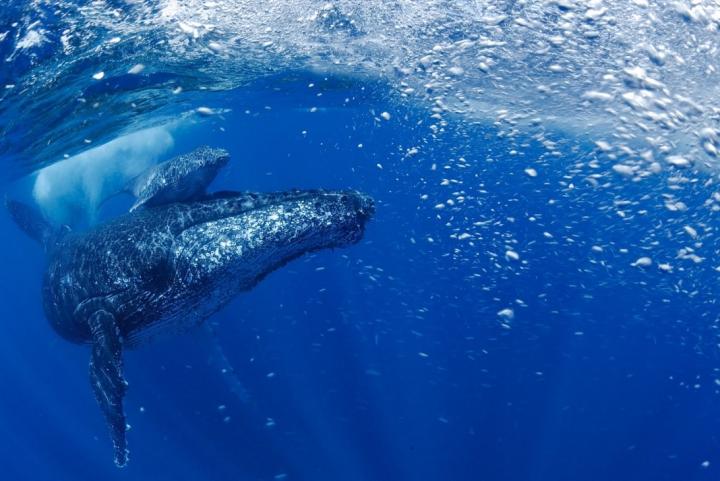
Credit: L. Candisani/Courtesy Insituto Aqualie
A population of humpback whales in the South Atlantic has rebounded from the brink of extinction.
Intense pressure from the whaling industry in the 20th century saw the western South Atlantic population of humpbacks diminish to only 450 whales. It is estimated that 25,000 whales were caught over approximately 12 years in the early 1900s.
Protections were put in place in the 1960s as scientists noticed worldwide that populations were declining. In the mid-1980s, the International Whaling Commission issued a moratorium on all commercial whaling, offering further safeguards for the struggling population.
A new study co-authored by Grant Adams, John Best and André Punt from the University of Washington’s School of Aquatic and Fishery Sciences shows the western South Atlantic humpback (Megaptera novaeangliae) population has grown to 25,000. Researchers believe this new estimate is now close to pre-whaling numbers.
The findings were published Oct. 16 in the journal Royal Society Open Science.
“We were surprised to learn that the population was recovering more quickly than past studies had suggested,” said Best, a UW doctoral student.
The study follows a previous assessment conducted by the International Whaling Commission between 2006 and 2015. Those findings indicated the population had only recovered to about 30% of its pre-exploitation numbers. Since that assessment was completed, new data has come to light, providing more accurate information on catches — including struck-and-lost rates — and genetics and life-history.
“Accounting for pre-modern whaling and struck-and-lost rates where whales were shot or harpooned but escaped and later died, made us realize the population was more productive than we previously believed,” said Adams, a UW doctoral student who helped construct the new model.
By incorporating detailed records from the whaling industry at the outset of commercial exploitation, researchers have a good idea of the size of the original population. Current population estimates are made from a combination of air- and ship-based surveys, along with advanced modeling techniques.
The model built for this study provides scientists with a more comprehensive look at the recovery and current status of the humpback population. The authors anticipate it can be used to determine population recovery in other species in more detail as well.
“We believe that transparency in science is important,” said Adams. “The software we wrote for this project is available to the public and anyone can reproduce our findings.”
Lead author Alex Zerbini of the NOAA Alaska Fisheries Science Center’s Marine Mammal Laboratory stressed the importance of incorporating complete and accurate information when conducting these assessments, and providing population assessments without biases. These findings come as good news, he said, providing an example of how an endangered species can come back from near extinction.
“Wildlife populations can recover from exploitation if proper management is applied,” Zerbini said.
The study also looks at how the revival of South Atlantic humpbacks may have ecosystem-wide impacts. Whales compete with other predators, like penguins and seals, for krill as their primary food source. Krill populations may further be impacted by warming waters due to climate change, compressing their range closer to the poles.
“Long-term monitoring of populations is needed to understand how environmental changes affect animal populations,” said Zerbini.
###
Other co-authors are Phillip Clapham of Alaska Fisheries Science Center and Jennifer Jackson of the British Antarctic Survey.
This research was funded by the Pew Bertarelli Ocean Legacy Project, the U.S. National Marine Fisheries Service-National Oceanic and Atmospheric Administration, the British Antarctic Survey and the University of Washington.
Posted with images: https:/
FROM: Michelle Ma
For more information, contact Zerbini at [email protected], Best at [email protected] and Adams at [email protected].
Media Contact
Michelle Ma
[email protected]
206-543-2580
Original Source
https:/
Related Journal Article
http://dx.