• HOME
  • NEWS
  • EXPLORE
    • CAREER
      • Companies
      • Jobs
    • EVENTS
    • iGEM
      • News
      • Team
    • PHOTOS
    • VIDEO
    • WIKI
  • BLOG
  • COMMUNITY
    • FACEBOOK
    • INSTAGRAM
    • TWITTER
Saturday, February 7, 2026
BIOENGINEER.ORG
No Result
View All Result
  • Login
  • HOME
  • NEWS
  • EXPLORE
    • CAREER
      • Companies
      • Jobs
        • Lecturer
        • PhD Studentship
        • Postdoc
        • Research Assistant
    • EVENTS
    • iGEM
      • News
      • Team
    • PHOTOS
    • VIDEO
    • WIKI
  • BLOG
  • COMMUNITY
    • FACEBOOK
    • INSTAGRAM
    • TWITTER
  • HOME
  • NEWS
  • EXPLORE
    • CAREER
      • Companies
      • Jobs
        • Lecturer
        • PhD Studentship
        • Postdoc
        • Research Assistant
    • EVENTS
    • iGEM
      • News
      • Team
    • PHOTOS
    • VIDEO
    • WIKI
  • BLOG
  • COMMUNITY
    • FACEBOOK
    • INSTAGRAM
    • TWITTER
No Result
View All Result
Bioengineer.org
No Result
View All Result
Home NEWS Science News Health

Insects share the same signaling pathway to form their 3-dimensional body

Bioengineer by Bioengineer
October 21, 2019
in Health
Reading Time: 2 mins read
0
IMAGE
Share on FacebookShare on TwitterShare on LinkedinShare on RedditShare on Telegram

IMAGE

Credit: Siegfried Roth

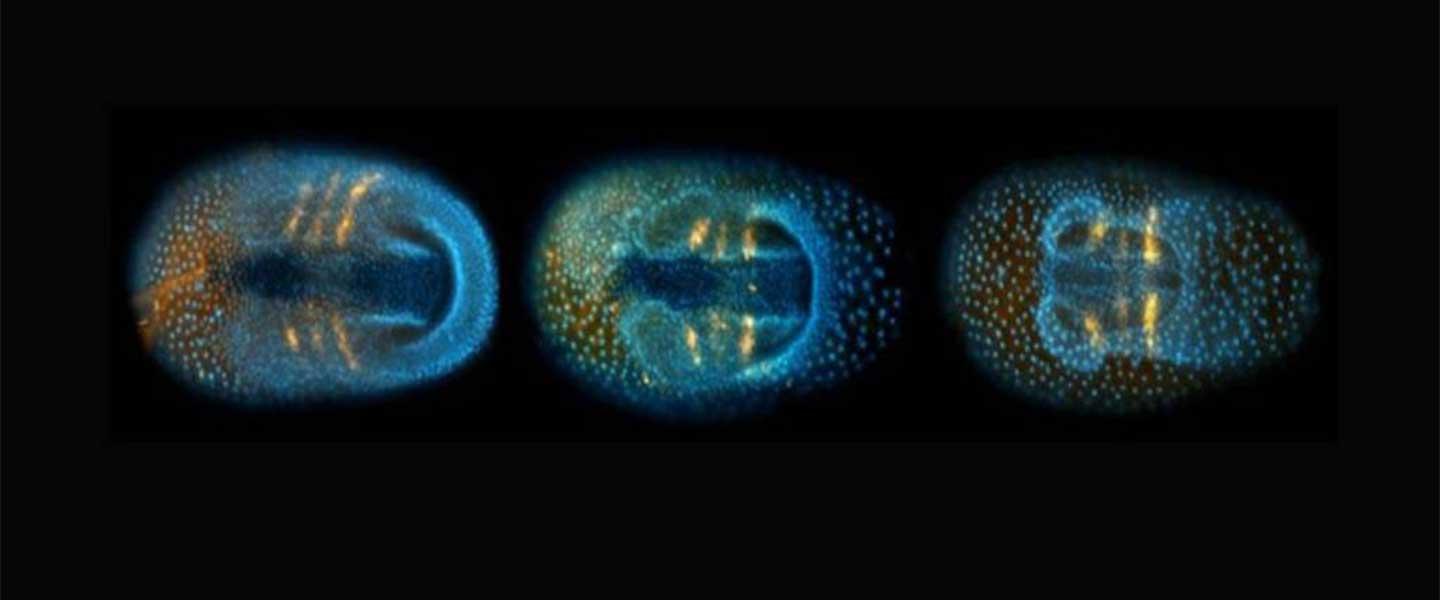
A signalling pathway controlling morphogenesis, the formation of the three-dimensional body shape in the fruit fly Drosophila, also has pivotal functions for early embryonic development in other insects like beetles, crickets and bugs. In these insects, the pathway is even required for the formation of the primary cell layer of the embryo. The discovery of this early function in phylogenetically distant insects suggests that the Fog (folded gastrulation) pathway fulfils a central developmental function in all insects and thus belongs to the archetypical repertoire of insect embryo formation. This is the outcome of a study Professor Siegfried Roth and his team conducted at the Institute of Zoology of the University of Cologne entitled ‘Fog signaling has diverse roles in epithelial morphogenesis in insects’, which has been published in the journal eLife.

For their discovery of developmental genes in Drosophila, Christiane Nüsslein-Volhard, Eric Wieschaus and Edward B. Lewis were awarded the Nobel Prize in Physiology or Medicine in 1995. Some of these developmental genes have been conserved in the entire animal kingdom – from flies to humans. Others are specific to the fast mode of development of Drosophila embryos. So far, scientists believed the Fog pathway to be such a Drosophila-specific component.

The group of the Cologne-based zoologist Roth has now shown that Fog is not exclusive to Drosophila embryos. With the help of molecular methods and life imaging, the team showed that the pathway also has functions not known from Drosophila. In beetle embryos, it contributes to the migration of germ cells, the formation of extraembryonic membranes (serosa and amnion) and the formation of the first epithelial layer of the embryo. Since the latter function has also been observed in species from phylogenetically older insect lineages (bugs and crickets), it may well represent the ancestral function of the pathway.

‘Our findings contribute to a better understanding of where the characteristics of Drosophila development described in all biology textbooks come from and how these developmental processes have evolved. The comparisons with other insects show that the pathway has lost functions in the evolutionary lineage leading to Drosophila,’ says Professor Roth. ‘The Fog pathway is likely to have a very old role during early morphogenesis in insects and may have acquired multiple functions during the formation and folding of cell layers.’

###

This study was initiated in the frame of Collaborative Research Centre 680 ‘The Molecular Basis of Evolutionary Innovations,’ which was funded by the German Research Foundation (DFG) and ran from 2006 to 2017 at the University of Cologne.

Media Contact
Siegfried Roth
[email protected]
49-221-470-2491

Related Journal Article

http://dx.doi.org/10.7554/eLife.47346.001

Tags: BiologyEvolutionPhysiologyZoology/Veterinary Science
Share12Tweet8Share2ShareShareShare2

Related Posts

TPMT Expression Predictions Linked to Azathioprine Side Effects

February 7, 2026

Improving Dementia Care with Enhanced Activity Kits

February 7, 2026

Decoding Prostate Cancer Origins via snFLARE-seq, mxFRIZNGRND

February 7, 2026

Digital Health Perspectives from Baltic Sea Experts

February 7, 2026
Please login to join discussion

POPULAR NEWS

  • Robotic Ureteral Reconstruction: A Novel Approach

    Robotic Ureteral Reconstruction: A Novel Approach

    82 shares
    Share 33 Tweet 21
  • Digital Privacy: Health Data Control in Incarceration

    63 shares
    Share 25 Tweet 16
  • Study Reveals Lipid Accumulation in ME/CFS Cells

    57 shares
    Share 23 Tweet 14
  • Breakthrough in RNA Research Accelerates Medical Innovations Timeline

    53 shares
    Share 21 Tweet 13

About

We bring you the latest biotechnology news from best research centers and universities around the world. Check our website.

Follow us

Recent News

TPMT Expression Predictions Linked to Azathioprine Side Effects

Improving Dementia Care with Enhanced Activity Kits

Decoding Prostate Cancer Origins via snFLARE-seq, mxFRIZNGRND

Subscribe to Blog via Email

Enter your email address to subscribe to this blog and receive notifications of new posts by email.

Join 73 other subscribers
  • Contact Us

Bioengineer.org © Copyright 2023 All Rights Reserved.

Welcome Back!

Login to your account below

Forgotten Password?

Retrieve your password

Please enter your username or email address to reset your password.

Log In
No Result
View All Result
  • Homepages
    • Home Page 1
    • Home Page 2
  • News
  • National
  • Business
  • Health
  • Lifestyle
  • Science

Bioengineer.org © Copyright 2023 All Rights Reserved.