Understanding fast ions, critical to heating plasmas, could help turn a liability into an asset
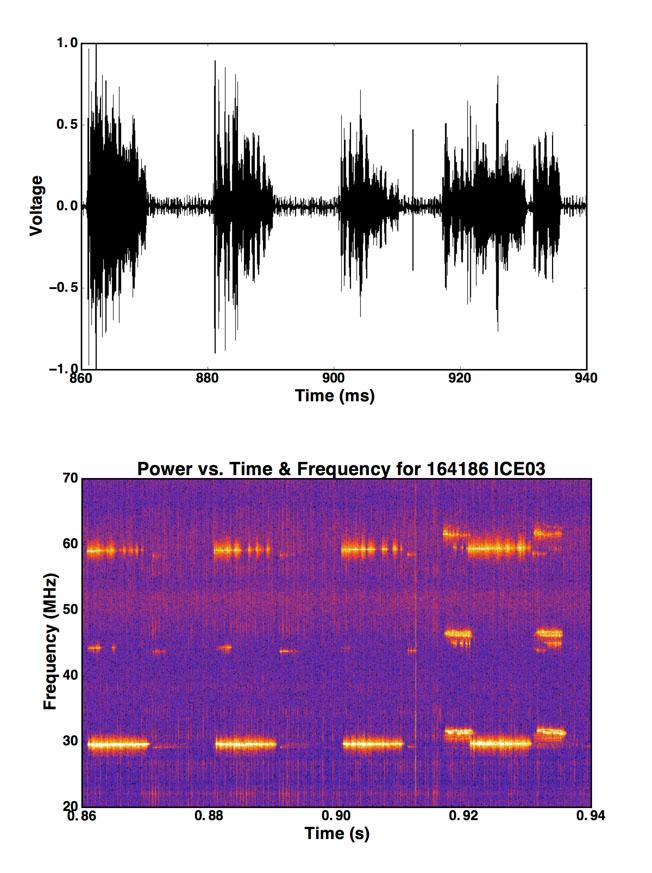
Credit: DIII-D National Fusion Facility.
Fort Lauderdale, Fla.–To create a practical fusion energy reactor, researchers need to control particles known as fast ions. These speedy ions, which are electrically charged hydrogen atoms, provide much of the self-heating ability of the reactor as they collide with other ions. But they can also quickly escape the powerful magnetic fields used to confine them and overheat the walls of the containment vessel, causing damage.
A team at the DIII-D National Fusion Facility recently took a different approach to studying these difficult-to-measure particles. The research showed promising results that have not only yielded insights into the physics of the particles themselves, but they may also lead to new and reliable ways to monitor and manage how well fast ions are contained in future reactors.
“This is really an exciting time to be working on these types of challenges in fusion energy,” said DIII-D researcher Kathreen Thome. “The global fusion community is picking up pace on the road to energy output, and every bit of additional insight we can generate into these problems moves us closer to that destination.”
Part of the research challenge in measuring the fast ions lies in the harsh environment at the heart of a tokamak, a type of fusion reactor. Delicate sensors used in today’s research tokamaks would simply be destroyed in future fusion reactors, which will have much higher power. The DIII-D team used a rugged magnetic sensor and high-performance computing to capture and interpret a small wiggle created in the device’s magnetic field by these fast particles. This magnetic field fluctuation (Figure 1) provides information on the properties and behavior of the speedy ions and how they interact with plasma waves.
The next step for the fusion community will be to use the data generated to expand the capabilities of computer models that interpret the behavior of fast ions based on these wiggles. Once models are made more effective, they could be coupled with the rugged magnetic sensors in future high-power reactors to provide real-time control of the conditions that affect fast ions. If that feedback loop can be established, the fast ions could not only be kept from damaging the tokamak walls, they could be used to heat the plasma more efficiently.
###
This research is supported by the U.S. Department of Energy under Award Number DE-FC02-04ER54698.
For additional information see also:
Thome et al., 2019, Nucl. Fusion. Central Ion Cyclotron Emission in the DIII-D Tokamak, https:/
Abstract:
High-Frequency Energetic-Ion Modes in the DIII-D Tokamak
3:00 PM-5:00 PM, Thursday, October 24, 2019
Room: Floridian Ballroom CD
http://meetings.
Contact:
Dr. Kathreen E Thome, General Atomics, [email protected]
About APS/DPP:
The 61st Annual Meeting of the American Physical Society’s Division of Plasma Physics will take place from October 21-25, 2019 in Fort Lauderdale, Florida. All technical sessions will be located at the Fort Lauderdale/Broward County Convention Center, where over 1,900 papers will be presented by scientists from over 20 countries around the world.
The American Physical Society (APS) is a nonprofit membership organization working to advance and diffuse the knowledge of physics through its outstanding research journals, scientific meetings, and education, outreach, advocacy, and international activities. APS represents over 55,000 members, including physicists in academia, national laboratories, and industry in the United States and throughout the world.
Media Contact
Saralyn Stewart
[email protected]
512-694-2320