Old museum specimens are giving researchers fresh insights into endangered species
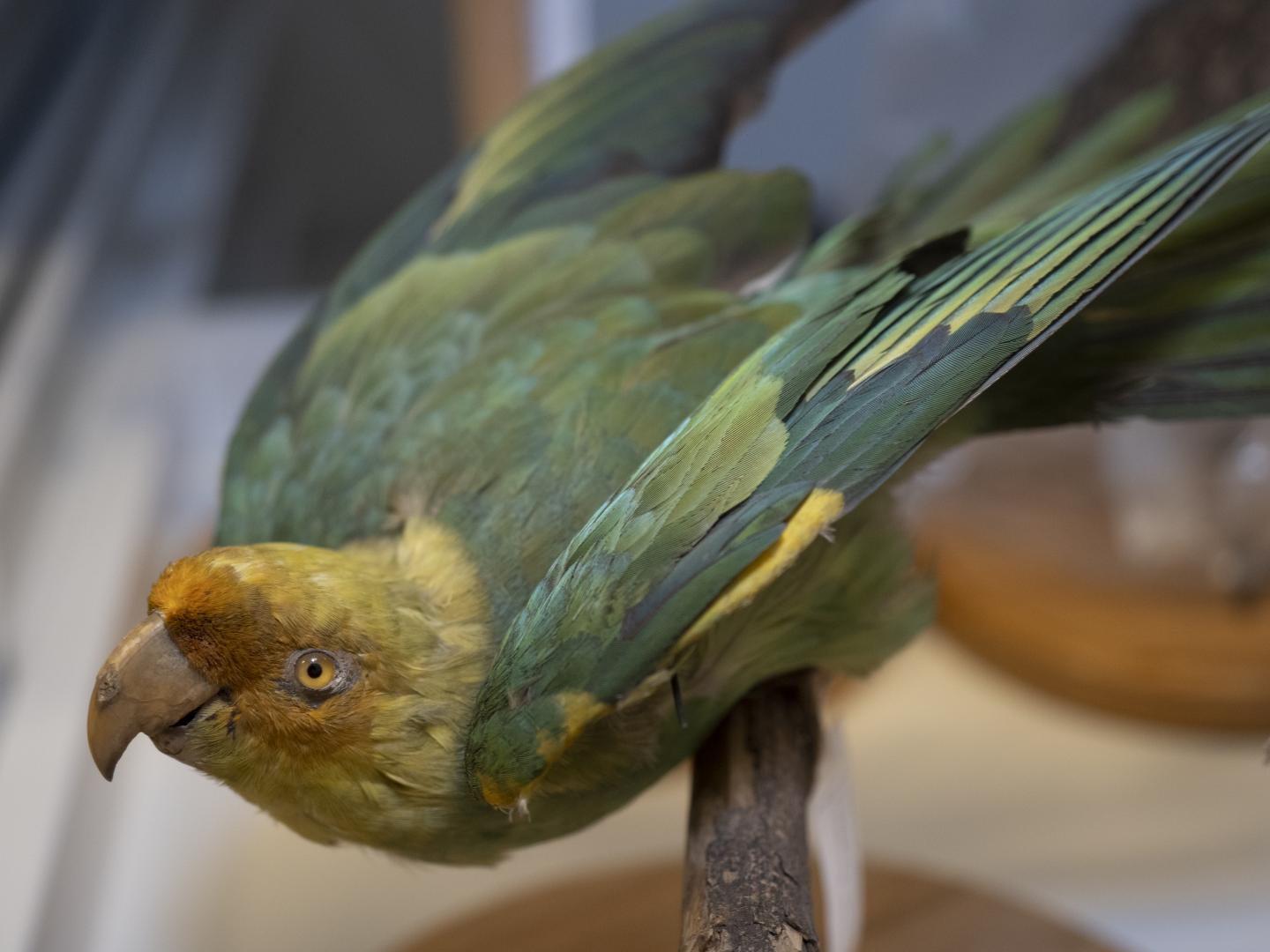
Credit: Jay Yocis/UC Creative Services
Scientists who are trying to save species at the brink of extinction are finding help in an unexpected place.
Heather Farrington, curator of zoology for the Cincinnati Museum Center, is using DNA from specimens collected more than 100 years ago to help understand the evolution and stresses faced by today’s animals.
Farrington runs the museum’s new state-of-the-art genetics laboratory, which helps researchers study populations of animals over time.
Researchers increasingly are embracing the power of ancient DNA from old museum specimens to answer questions about climate change, habitat loss and other stresses on surviving populations. Ancient DNA has been used to explain the diversity of livestock in Africa and the first domestication of wild horses in Asia.
Farrington earned her doctorate in biological sciences from the University of Cincinnati, where she charted the family trees of Galapagos finches and used the latest DNA tools to gain fresh insights about the birds from century-old museum specimens.
The museum’s genetics lab works with researchers and government agencies on a variety of projects that require DNA analysis, from conserving wildlife to improving our understanding of the natural world.
Recently, the lab helped with a conservation project on the Allegheny woodrat, a small rock-loving rodent that is in decline across much of its historic range from Indiana to New Jersey. In Ohio it’s found in only one place, the Richard and Lucille Durrell Edge of Appalachia Preserve, a mix of mature forest and limestone cliffs along the Ohio River.
The museum’s lab analysis found that Ohio’s woodrats are maintaining their genetic diversity so far despite their geographic isolation.
The lab also has studied the genetics of Ohio’s crayfish and a beautiful yellow-and-black songbird called a hooded warbler.
The museum’s DNA lab has glass walls on two sides so the public can watch scientists at work. Next door, visitors also can watch museum staff and volunteers prepare fossils from a public gallery at the paleontology lab.
Farrington’s colleague, museum collections manager Emily Imhoff, explained how the sensitive equipment works.
The lab keeps DNA samples in refrigerators, including one set to a chilly minus-112 degrees Fahrenheit. Scientists can identify the concentration of DNA, amplify the sample and sequence it to understand the lineage and relationships of species.
“We definitely feel our work is useful when we take on projects with other researchers,” Imhoff said. “Heather and I are both passionate about our work.”
Farrington was looking for a graduate program in aquatic ecology that could satisfy her growing curiosity about genetics. UC biology professor Kenneth Petren, who served as dean of UC’s McMicken College of Arts and Sciences, reached out to recruit her to UC.
“He said, ‘Well, I do genetics, but I don’t do fish. I work on Darwin’s finches,'” Farrington said.
At UC, Petren has conducted two decades of research on descendants of birds that shaped Charles Darwin’s understanding of evolution through natural selection in the Galapagos Islands of Ecuador.
“I thought, ‘Oh, my gosh, I can’t say no to Darwin’s finches,'” Farrington said.
Farrington, Petren and UC biology professor Lucinda Lawson authored a study of finch populations that was published recently in the journal Conservation Genetics. Moreover, at UC Farrington also realized what a valuable resource museum collections are for genetic research. For her dissertation, she examined museum specimens gathered more than 100 years ago to understand how Galapagos finch populations have changed over time.
Farrington developed many of the important lab techniques she uses at the museum while conducting research at UC, Petren said.
“While at UC, Heather worked very hard to pioneer the use of museum specimens for population genetics analysis,” Petren said. “Our lab was a leader in this field because of Heather’s efforts.
“She used the techniques she developed to address issues of conservation in several different species of Galapagos finches,” Petren said. “She went on to become a leader in the field of environmental DNA in her role working for the U.S. Department of Defense, which was interested in monitoring rare species or to provide early warnings of problematic invasive species like the Asian carp.”
Farrington said her experience while researching museum specimens for her dissertation at UC convinced her of how valuable these resources can be for future study.
“That is really what got me into museum work and the amazing things you can learn from museum specimens,” Farrington said.
###
Media Contact
Michael Miller
[email protected]
513-556-6757
Original Source
https:/
Related Journal Article
http://dx.