• HOME
  • NEWS
  • EXPLORE
    • CAREER
      • Companies
      • Jobs
    • EVENTS
    • iGEM
      • News
      • Team
    • PHOTOS
    • VIDEO
    • WIKI
  • BLOG
  • COMMUNITY
    • FACEBOOK
    • INSTAGRAM
    • TWITTER
Saturday, February 7, 2026
BIOENGINEER.ORG
No Result
View All Result
  • Login
  • HOME
  • NEWS
  • EXPLORE
    • CAREER
      • Companies
      • Jobs
        • Lecturer
        • PhD Studentship
        • Postdoc
        • Research Assistant
    • EVENTS
    • iGEM
      • News
      • Team
    • PHOTOS
    • VIDEO
    • WIKI
  • BLOG
  • COMMUNITY
    • FACEBOOK
    • INSTAGRAM
    • TWITTER
  • HOME
  • NEWS
  • EXPLORE
    • CAREER
      • Companies
      • Jobs
        • Lecturer
        • PhD Studentship
        • Postdoc
        • Research Assistant
    • EVENTS
    • iGEM
      • News
      • Team
    • PHOTOS
    • VIDEO
    • WIKI
  • BLOG
  • COMMUNITY
    • FACEBOOK
    • INSTAGRAM
    • TWITTER
No Result
View All Result
Bioengineer.org
No Result
View All Result
Home NEWS Science News Health

Digital breast tomosynthesis increases cancer detection over full-field mammography

Bioengineer by Bioengineer
October 16, 2019
in Health
Reading Time: 2 mins read
0
IMAGE
Share on FacebookShare on TwitterShare on LinkedinShare on RedditShare on Telegram

American Journal of Roentgenology research comparing digital breast tomosynthesis and full-field digital mammography finds that DBT results in ‘significantly increased cancer detection rates’–irrespective of tumor type, size, or grade of cancer
IMAGE

Credit: American Journal of Roentgenology (AJR)


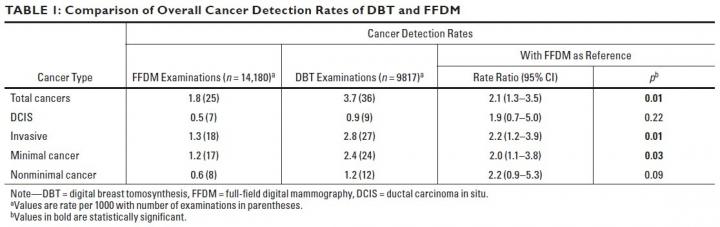
Leesburg, VA, October 16, 2019–An ahead-of-print article forthcoming in the March 2020 issue of the American Journal of Roentgenology (AJR) comparing cancer detection rates (CDR) for screening digital breast tomosynthesis (DBT) versus full-field digital mammography (FFDM) found that DBT results in “significantly increased CDR”–irrespective of tumor type, size, or grade of cancer.

Reviewing consecutive screening examinations performed between October 2012 and September 2014 at a large academic breast imaging practice, Pragya A. Dang and researchers at Brigham and Women’s Hospital in Boston detected 61 cancers in the matched cohort of DBT (n = 9817) and FFDM (n = 14,180) examinations.

CDR measured higher with DBT than with FFDM for invasive cancers (2.8 vs 1.3, p = 0.01), minimal cancers (2.4 vs 1.2, p = 0.03), estrogen receptor-positive invasive cancers (2.6 vs 1.1, p = 0.01), and node-negative invasive cancers (2.3 vs 1.1, p = 0.02.), respectively.

However, the ratio of screen-detected invasive cancers to ductal carcinoma in situ on DBT (3.0) was not significantly different from that on FFDM (2.6) (p = 0.79).

Where CDR were not statistically significant for DBT and FFDM, Dang noted: “We were likely underpowered to show a significant difference because of the smaller number of cancers in these subgroups. For instance, CDR of moderately and poorly differentiated invasive cancers, and for all cancer sizes detected with DBT, was nearly twice that of FFDM, even though it was not statistically significant.”

As Dang concluded, “our results suggest that integrating DBT into clinical practice may detect overall more cancers than does FFDM, for all tumor sub-types, grades, sizes, and nodal statuses.”

###

Founded in 1900, the American Roentgen Ray Society (ARRS) is the first and oldest radiology society in the North America, dedicated to the advancement of medicine through the profession of radiology and its allied sciences. An international forum for progress since the discovery of the x-ray, ARRS maintains its mission of improving health through a community committed to advancing knowledge and skills with an annual scientific meeting, monthly publication of the peer-reviewed American Journal of Roentgenology (AJR), quarterly issues of InPractice magazine, AJR Live Webinars and Podcasts, topical symposia, print and online educational materials, as well as awarding scholarships via The Roentgen FundĀ®.

Media Contact
Logan K. Young
[email protected]
703-858-4332

Original Source

https://arrs.org/ARRSLIVE/Pressroom/PressReleases/breast-tomosynthesis-increases-cancer-detection-over-digital-mammography.aspx

Related Journal Article

http://dx.doi.org/10.2214/AJR.18.21060

Tags: Breast CancercancerDiagnosticsGynecologyHealth Care Systems/ServicesMedicine/HealthPublic Health
Share12Tweet8Share2ShareShareShare2

Related Posts

Evaluating Pediatric Emergency Care Quality in Ethiopia

February 7, 2026

TPMT Expression Predictions Linked to Azathioprine Side Effects

February 7, 2026

Improving Dementia Care with Enhanced Activity Kits

February 7, 2026

Decoding Prostate Cancer Origins via snFLARE-seq, mxFRIZNGRND

February 7, 2026
Please login to join discussion

POPULAR NEWS

  • Robotic Ureteral Reconstruction: A Novel Approach

    Robotic Ureteral Reconstruction: A Novel Approach

    82 shares
    Share 33 Tweet 21
  • Digital Privacy: Health Data Control in Incarceration

    63 shares
    Share 25 Tweet 16
  • Study Reveals Lipid Accumulation in ME/CFS Cells

    57 shares
    Share 23 Tweet 14
  • Breakthrough in RNA Research Accelerates Medical Innovations Timeline

    53 shares
    Share 21 Tweet 13

About

We bring you the latest biotechnology news from best research centers and universities around the world. Check our website.

Follow us

Recent News

Evaluating Pediatric Emergency Care Quality in Ethiopia

TPMT Expression Predictions Linked to Azathioprine Side Effects

Improving Dementia Care with Enhanced Activity Kits

Subscribe to Blog via Email

Enter your email address to subscribe to this blog and receive notifications of new posts by email.

Join 73 other subscribers
  • Contact Us

Bioengineer.org Ā© Copyright 2023 All Rights Reserved.

Welcome Back!

Login to your account below

Forgotten Password?

Retrieve your password

Please enter your username or email address to reset your password.

Log In
No Result
View All Result
  • Homepages
    • Home Page 1
    • Home Page 2
  • News
  • National
  • Business
  • Health
  • Lifestyle
  • Science

Bioengineer.org Ā© Copyright 2023 All Rights Reserved.