• HOME
  • NEWS
  • EXPLORE
    • CAREER
      • Companies
      • Jobs
    • EVENTS
    • iGEM
      • News
      • Team
    • PHOTOS
    • VIDEO
    • WIKI
  • BLOG
  • COMMUNITY
    • FACEBOOK
    • INSTAGRAM
    • TWITTER
Saturday, September 26, 2026
BIOENGINEER.ORG
No Result
View All Result
  • Login
  • HOME
  • NEWS
  • EXPLORE
    • CAREER
      • Companies
      • Jobs
        • Lecturer
        • PhD Studentship
        • Postdoc
        • Research Assistant
    • EVENTS
    • iGEM
      • News
      • Team
    • PHOTOS
    • VIDEO
    • WIKI
  • BLOG
  • COMMUNITY
    • FACEBOOK
    • INSTAGRAM
    • TWITTER
  • HOME
  • NEWS
  • EXPLORE
    • CAREER
      • Companies
      • Jobs
        • Lecturer
        • PhD Studentship
        • Postdoc
        • Research Assistant
    • EVENTS
    • iGEM
      • News
      • Team
    • PHOTOS
    • VIDEO
    • WIKI
  • BLOG
  • COMMUNITY
    • FACEBOOK
    • INSTAGRAM
    • TWITTER
No Result
View All Result
Bioengineer.org
No Result
View All Result
Home NEWS Science News Biology

Achieving a safe and just future for the ocean economy

Bioengineer by Bioengineer
October 15, 2019
in Biology
Reading Time: 3 mins read
0
IMAGE
Share on FacebookShare on TwitterShare on LinkedinShare on RedditShare on Telegram

IMAGE

Credit: © 2019 The People Seas Initiative


The economic potential of the oceans is expected to double from US$1.5 trillion in 2010 to US$3 trillion by 2030. Yet managing this growth should be undertaken in a safe and just manner caution a team of international researchers.

In a climate of environmental change and financial uncertainty, much attention has been given to the growth of the “Blue Economy” – a term which refers to the sustainable use of ocean and marine resources for economic growth, jobs, and improved livelihoods. Ocean resources are viewed as lucrative areas for increased investment, including in fisheries, aquaculture, bio-prospecting, renewable energy, oil and gas, and other businesses. Ensuring that socially equitable and sustainable development occurs should be the mandate of governments and industry, maintain an international group of researchers, led by UBC’s Nathan Bennett and Rashid Sumaila.

“Coastal countries and small island developing states have the most at stake when it comes to increased economic activities in local waters,” said Nathan Bennett, research faculty member in UBC’s Institute for the Oceans and Fisheries and lead author on the paper. “It is important that this not be like a Gold Rush scenario, where unbridled ocean development produces substantial harms for both the marine environment and the wellbeing of the populations who dependent on it. In this paper, we provide solutions to proactively address the potential harms produced by ocean development.”

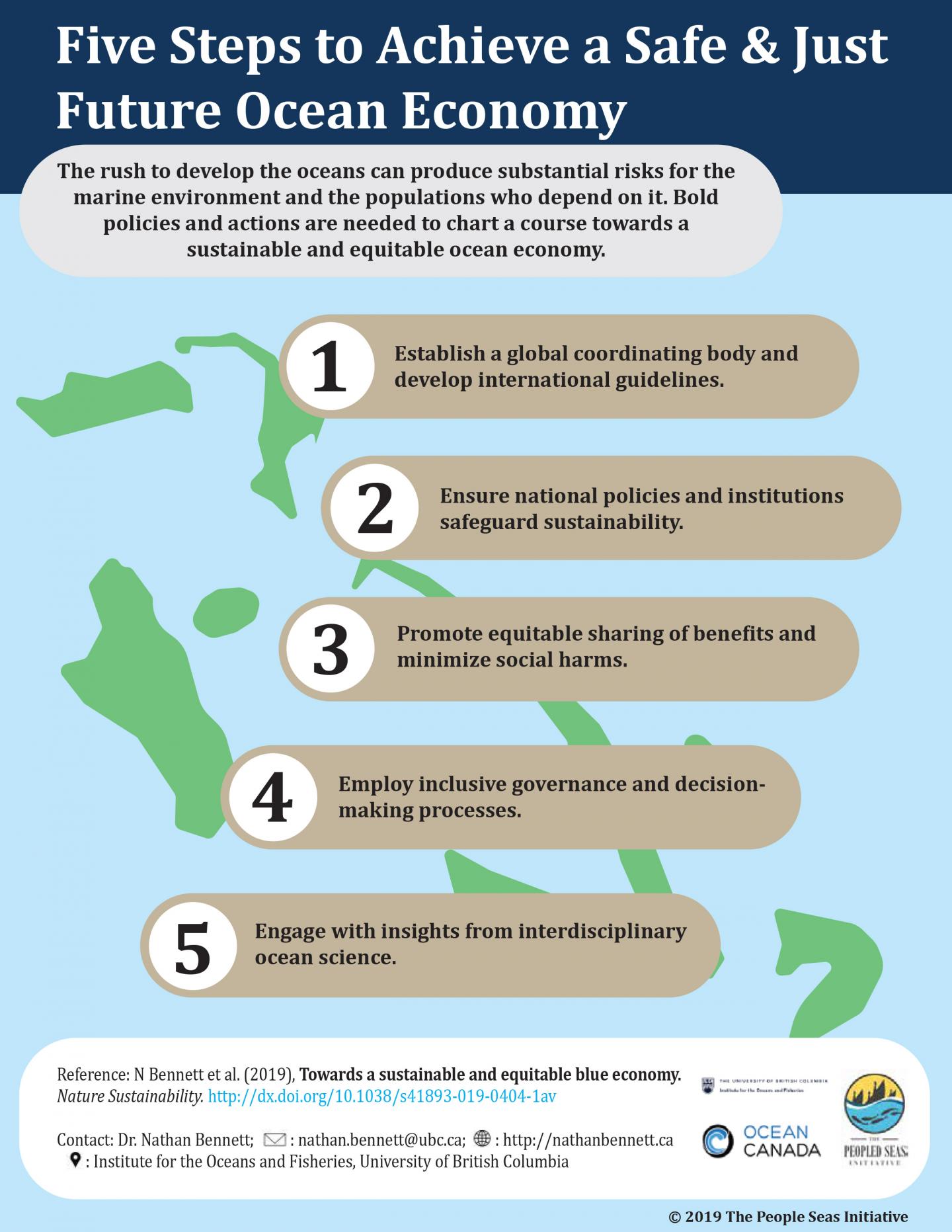
The five recommendations in the paper focus on managing for sustainability, benefit sharing, and creating inclusive decision-making processes at local, national and international levels:

    1. Establish a global coordinating body and develop international guidelines;

    2. Ensure national policies and institutions safeguard sustainability;

    3. Promote equitable sharing of benefits and minimization of harms;

    4. Employ inclusive governance and decision-making processes; and

    5. Engage with insights from interdisciplinary ocean science.

“There are currently no set of guidelines, or even an obvious international coordinating body, which focuses on the Blue Economy,” said Dr. Rashid Sumaila, senior author, professor at UBC’s Institute for the Oceans and Director of the OceanCanada Partnership. “Nothing exists in many nations either. This lack of coordination can lead to situations like we are already seeing in the global fishing industry, where harmful subsidies are leading to overfishing, human rights abuses are occurring, and local access to fish stocks and food security are being undermined.”

“The blue economy is already growing. But, we have an opportunity and responsibility to shape future growth so that it is sustainable and equitable,” said Bennett. “Including civil society, such as small-scale fishers, women and Indigenous people, in the decision-making and management processes will help to ensure that benefits are shared.”

###

This paper was released ahead of the Our Oceans international conference, taking place in Oslo Norway on October 23-24, 2019, where one of the focal themes is “sustainable blue economy”. Partnerships and commitments will be made at this conference to catalyze sustainable and inclusive blue growth. These topics will also be discussed at the World Ocean Council’s Sustainable Ocean Summit being held in Paris, France on November 20-22, 2019.

“Towards a sustainable and equitable blue economy” was published in Nature Sustainability today.

Media Contact
Katherine Came
[email protected]
604-827-4325

Related Journal Article

http://dx.doi.org/10.1038/s41893-019-0404-1

Tags: Business/EconomicsClimate ChangeCollaborationDeveloping CountriesGroup OrganizationGuidelines/Treaties/AgreementsHydrology/Water ResourcesMarine/Freshwater BiologyNatureScience/Health and the Law
Share12Tweet8Share2ShareShareShare2

Related Posts

Lanthanum Nanorods Deliver New Drug Candidate That Kills Parasitic Worms

Lanthanum Nanorods Deliver New Drug Candidate That Kills Parasitic Worms

September 26, 2026
Bumblebees and Flies Keep Pollination Networks Alive by Switching Teams All Season

Bumblebees and Flies Keep Pollination Networks Alive by Switching Teams All Season

September 26, 2026

High-Altitude Holsteins Reveal a Hidden RNA Code Behind Hypoxia Tolerance

September 26, 2026

Exercise Rejuvenates Aging Hearts and Clocks Through a Single Muscle Gene

September 26, 2026
Please login to join discussion

POPULAR NEWS

  • New Protocol Reveals Millions of Microplastic Clues Hidden in Greenhouse Soils

    29 shares
    Share 12 Tweet 7
  • Lanthanum Nanorods Deliver New Drug Candidate That Kills Parasitic Worms

    29 shares
    Share 12 Tweet 7
  • Tiny Blood RNAs Emerge as Early Warning Signals of Sepsis in Newborns

    29 shares
    Share 12 Tweet 7
  • Bumblebees and Flies Keep Pollination Networks Alive by Switching Teams All Season

    29 shares
    Share 12 Tweet 7

About

We bring you the latest biotechnology news from best research centers and universities around the world. Check our website.

Follow us

Recent News

New Protocol Reveals Millions of Microplastic Clues Hidden in Greenhouse Soils

Lanthanum Nanorods Deliver New Drug Candidate That Kills Parasitic Worms

Tiny Blood RNAs Emerge as Early Warning Signals of Sepsis in Newborns

Subscribe to Blog via Email

Enter your email address to subscribe to this blog and receive notifications of new posts by email.

Join 85 other subscribers
  • Contact Us

Bioengineer.org © Copyright 2023 All Rights Reserved.

Welcome Back!

Login to your account below

Forgotten Password?

Retrieve your password

Please enter your username or email address to reset your password.

Log In
No Result
View All Result
  • Homepages
    • Home Page 1
    • Home Page 2
  • News
  • National
  • Business
  • Health
  • Lifestyle
  • Science

Bioengineer.org © Copyright 2023 All Rights Reserved.