Biologists have reported the first evidence of brood parasitism in coral reef fish, finding unrelated young fish in groups of young being protected by their parents
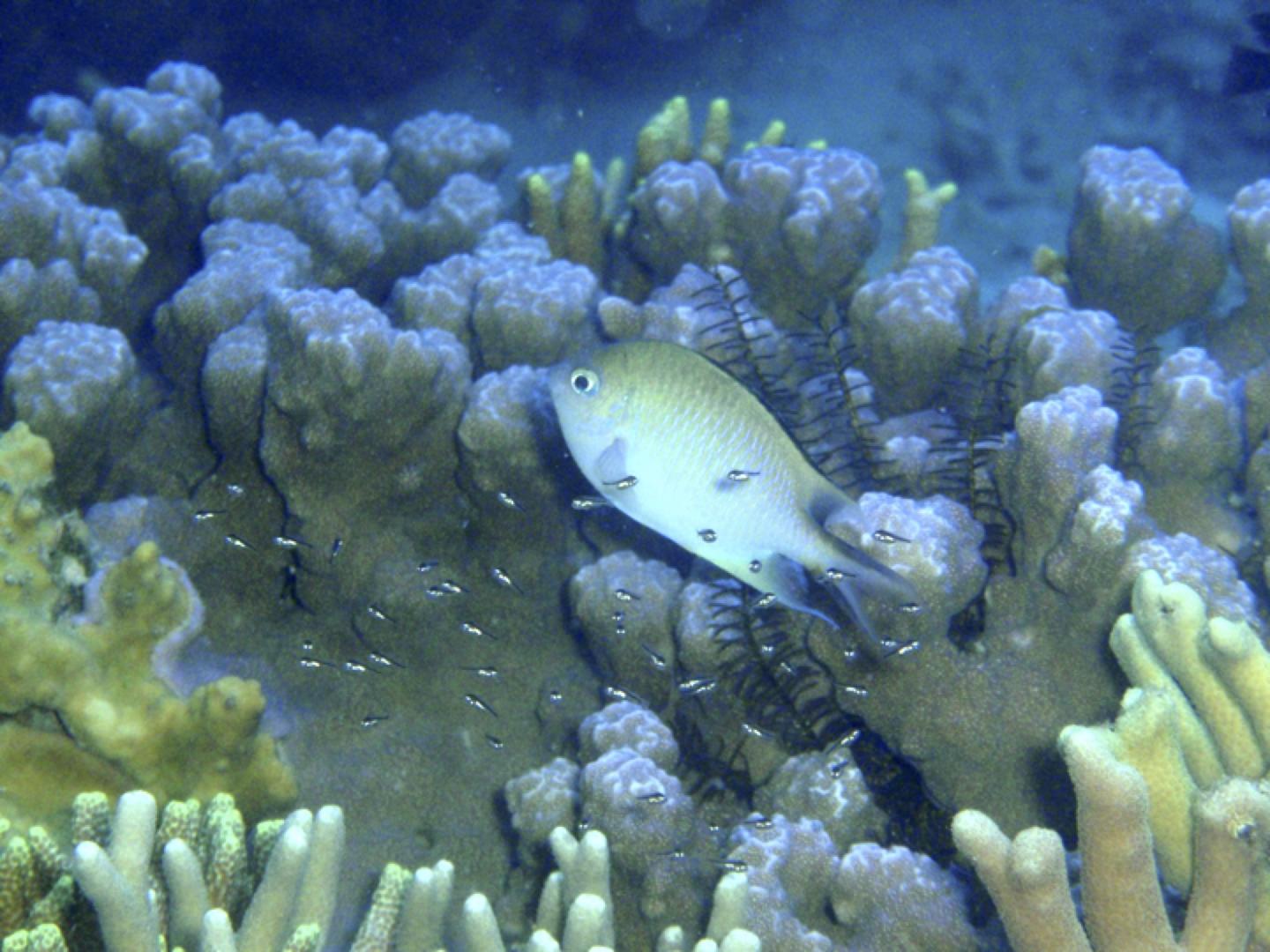
Credit: Giacomo Bernardi
Scroungers and parasites seem to show up in nature wherever life produces something useful, and that includes parental care. Among birds, for example, the practice of laying eggs in other birds’ nests is surprisingly common.
This phenomenon, known as brood parasitism, was unknown in coral reef fish because most marine fish don’t provide any parental care at all. Now, however, biologists studying an unusual kind of coral reef fish that does care for its young have found that, sure enough, other fish are taking advantage of this to get free parental care for their offspring.
Giacomo Bernardi, professor of ecology and evolutionary biology at UC Santa Cruz, went to the Philippines with his graduate students to study damselfish in the genus Altrichthys. Two species of Altrichthys were known to protect their young, and Bernardi’s team discovered a third species that also provides parental care.
“It is extremely rare in coral reef fish,” Bernardi said. “In most species, the larvae disperse and drift with the currents before they settle onto the reef, and 99 percent of them get eaten.”
As he was observing adult Altrichthys guarding their broods, Bernardi noticed that some of the young fish looked different from the others. Genetic tests revealed that the oddball fish belonged to a different species that does not provide parental care. More surpisingly, genetic testing of entire broods revealed that many Altrichthys parents were caring for mixed broods of young that were the same species but not offspring of the same parents.
“That was a complete surprise to me, and we only found it by doing the genetics,” Bernardi said.
To help him make sense of these findings, Bernardi turned to his UCSC colleague Bruce Lyon, a professor of ecology and evolutionary biology who studies brood parasitism in birds. They reported their findings in a paper published in the journal Molecular Ecology.
“It’s kind of a mine field in terms of how to interpret this,” Lyon said. “In birds or fish, there are two main ways you can end up with mixed broods–either adoption, where young from outside the family get accepted into the brood, or brood parasitism, where an adult lays eggs in somebody else’s nest.”
Bernardi’s team found evidence of both. When the young of other species show up in Altrichthys broods, it appears to be the result of baby fish gaining protection by integrating themselves into a brood. In mixed broods of the same species, however, the researchers often found broods composed of two genetically different families of similar sizes, making brood parasitism (laying eggs in another pair’s nest) a much more likely explanation.
“If it’s not brood parasitism, then a whole clutch of baby fish would have to swim over and get adopted. That seems unlikely because the nests are far apart, and the mortality is enormous for unprotected babies,” Bernardi said.
The few times Bernardi collected parents for genetic sampling, the baby fish they had been guarding were eaten by predators almost immediately. “It doesn’t look like the parents are aggressively defending their brood, but as soon as you remove them, predators move in within a matter of seconds. So the idea that a group of young fish would swim around and find another brood to integrate with seems very unlikely,” he said.
Genetic testing of the eggs in Altrichthys nests could provide definitive evidence of brood parasitism, but Bernardi said the nests are deep in the coral, and sampling them would be too destructive. “This place is pristine and gorgeous, and we would have to break a lot of live coral to get to the nests. But it’s a crucial test, so I’d like to do some experiments with Altrichthys in tanks,” he said.
Fish of other species do get adopted into broods of Altrichthys, and Bernardi’s observations suggest this may be an important survival strategy. One morning his team witnessed a large “recruitment event,” when damselfish larvae that had been drifting in the currents all settled onto the reef in massive numbers.
“There were clouds of this one species, tens of thousands of baby fish, and over the next few days we saw the clouds get thinner and thinner as they got eaten, until eventually the only survivors were the ones that had integrated into groups of Altrichthys,” Bernardi said. “I’m sure there were also some survivors hidden in the corals, but it suggests that adoption may play a significant role.”
According to Lyon, parental care and brood parasitism are closely connected in the tree of life. “In most taxonomic groups that have evolved parental care, some forms of reproductive parasitism also evolve,” he said. “Given the extreme rarity of parental care in reef fish, it is very interesting that these species also show forms of reproductive parasitism like adoption and brood parasitism. When organisms evolve to produce some resource, if it’s cheatable, evolution will produce a cheat.”
###
In addition to Bernardi and Lyon, the coauthors of the paper include first author Juliette Tariel, Angela Quiros, Kimberly Tenggardjaja, and Alexis Jackson at UC Santa Cruz, and Nicole Crane at Cabrillo College. This work was funded by the National Geographic Society and UC Santa Cruz.
Media Contact
Tim Stephens
[email protected]
Related Journal Article
http://dx.