• HOME
  • NEWS
  • EXPLORE
    • CAREER
      • Companies
      • Jobs
    • EVENTS
    • iGEM
      • News
      • Team
    • PHOTOS
    • VIDEO
    • WIKI
  • BLOG
  • COMMUNITY
    • FACEBOOK
    • INSTAGRAM
    • TWITTER
Sunday, June 28, 2026
BIOENGINEER.ORG
No Result
View All Result
  • Login
  • HOME
  • NEWS
  • EXPLORE
    • CAREER
      • Companies
      • Jobs
        • Lecturer
        • PhD Studentship
        • Postdoc
        • Research Assistant
    • EVENTS
    • iGEM
      • News
      • Team
    • PHOTOS
    • VIDEO
    • WIKI
  • BLOG
  • COMMUNITY
    • FACEBOOK
    • INSTAGRAM
    • TWITTER
  • HOME
  • NEWS
  • EXPLORE
    • CAREER
      • Companies
      • Jobs
        • Lecturer
        • PhD Studentship
        • Postdoc
        • Research Assistant
    • EVENTS
    • iGEM
      • News
      • Team
    • PHOTOS
    • VIDEO
    • WIKI
  • BLOG
  • COMMUNITY
    • FACEBOOK
    • INSTAGRAM
    • TWITTER
No Result
View All Result
Bioengineer.org
No Result
View All Result
Home NEWS Science News

Researchers repurpose failed cancer drug into printable semiconductor

Bioengineer by Bioengineer
October 2, 2019
in Science News
Reading Time: 2 mins read
0
IMAGE
Share on FacebookShare on TwitterShare on LinkedinShare on RedditShare on Telegram

IMAGE

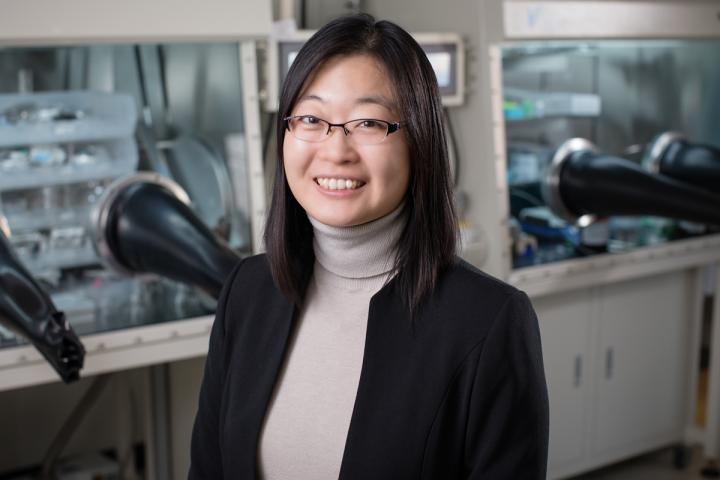
Credit: Photo by L. Brian Stauffer

CHAMPAIGN, Ill. — Many potential pharmaceuticals end up failing during clinical trials, but thanks to new research from the University of Illinois, biological molecules once considered for cancer treatment are now being repurposed as organic semiconductors for use in chemical sensors and transistors.

The researchers report their findings in the journal Nature Communications.

Organic semiconductors are responsible for things like flexible electronics and transparent solar cells, but researchers are working to expand their use in biomedicine and devices that require interaction between electrically active molecules and biological molecules.

Chemical and biomolecular engineering professor Ying Diao said she was surprised when the two avenues of her research – pharmaceutical development and printable electronics – merged in her lab with the discovery of semiconductorlike features in a well-studied bioactive molecule. The molecule, which inserts itself into DNA to prevent replication, was once explored as a potential anti-cancer agent.

“This convergence of my two research areas was totally unexpected,” Diao said. “While examining these pharmaceutical molecules, we noticed that their molecular structures looked much like the organic semiconductors we were working with in the rest of my group.”

These molecules, called DNA topoisomerase inhibitors, are flat and contain neatly stacked columns of electrically conductive molecular rings – features that make a good semiconductor. Distinct from a typical semiconductor, these molecular columns are linked together by hydrogen bonds that can move charges from column to column, forming bridges that transform the entire molecular assembly into a semiconductor – something rarely seen before this study, the researchers said.

“These molecules can interact with biological material with high specificity, making them good candidates for use in biosensors,” Diao said. “They are also easily printable but will require new solvents because they are chemically different than other organic semiconductors. The fabrication infrastructure is already in place.”

The team printed and tested the semiconductors and acknowledge that their efficiency and performance need improvement. Diao said the real excitement regarding this advance will come from the possibility of discovering similar molecules.

“We envision partnering with researchers in machine learning who can train computers to spot the unique characteristics of these molecules,” Diao said. “They can mine the vast pharmaceutical databases available today in search of molecules with similar, or maybe even better semiconducting properties.”

###

The Shen Postdoctoral Fellowship of the School of Chemical Sciences at the U. of I. and the National Science Foundation – Illinois Materials Research Science and Engineering Center supported this research.

Editor’s notes:

To reach Ying Diao, call 217-300-3505; email [email protected].

The paper “Repurposing DNA-binding agents as H-bonded organic semiconductors” is available online and from the U. of I. News Bureau. DOI: 10.1038/s41467-019-12248-9

Media Contact
Lois Yoksouian
[email protected]

Original Source

https://news.illinois.edu/view/6367

Related Journal Article

http://dx.doi.org/10.1038/s41467-019-12248-9

Tags: BiotechnologyChemistry/Physics/Materials SciencesMaterialsPharmaceutical SciencesSuperconductors/Semiconductors
Share13Tweet8Share2ShareShareShare2

Related Posts

Tracking Lanthanide-Labeled Microplastics in Plants

June 25, 2026

POSTECH Researchers Slash Cost of Reconstituted Cell-Free Systems by 95%

June 25, 2026

AI and Physics Collaborate to Design Advanced Hydrogen Storage Materials

June 25, 2026

Natural Hallucinogens: Evolution’s Ecological Tools, Not Mere Chemical Byproducts

June 25, 2026
Please login to join discussion

POPULAR NEWS

  • Saying Goodbye to PGY-6: Pediatric Fellowship Realities

    103 shares
    Share 41 Tweet 26
  • Multi-Hospital Study Reveals Long Covid Burden Is Twice as High as Current Estimates

    92 shares
    Share 36 Tweet 23
  • Detection of EDCs in Breast Milk and Infant Urine Up to Six Months Highlights Early Exposure Risks

    77 shares
    Share 31 Tweet 19
  • New Drug Candidate Developed at McMaster Shows Potential for Treating Brain Cancer

    58 shares
    Share 23 Tweet 15

About

We bring you the latest biotechnology news from best research centers and universities around the world. Check our website.

Follow us

Recent News

Tracking Lanthanide-Labeled Microplastics in Plants

POSTECH Researchers Slash Cost of Reconstituted Cell-Free Systems by 95%

AI and Physics Collaborate to Design Advanced Hydrogen Storage Materials

Subscribe to Blog via Email

Success! An email was just sent to confirm your subscription. Please find the email now and click 'Confirm' to start subscribing.

Join 82 other subscribers
  • Contact Us

Bioengineer.org © Copyright 2023 All Rights Reserved.

Welcome Back!

Login to your account below

Forgotten Password?

Retrieve your password

Please enter your username or email address to reset your password.

Log In
No Result
View All Result
  • Homepages
    • Home Page 1
    • Home Page 2
  • News
  • National
  • Business
  • Health
  • Lifestyle
  • Science

Bioengineer.org © Copyright 2023 All Rights Reserved.