• HOME
  • NEWS
  • EXPLORE
    • CAREER
      • Companies
      • Jobs
    • EVENTS
    • iGEM
      • News
      • Team
    • PHOTOS
    • VIDEO
    • WIKI
  • BLOG
  • COMMUNITY
    • FACEBOOK
    • INSTAGRAM
    • TWITTER
Saturday, March 28, 2026
BIOENGINEER.ORG
No Result
View All Result
  • Login
  • HOME
  • NEWS
  • EXPLORE
    • CAREER
      • Companies
      • Jobs
        • Lecturer
        • PhD Studentship
        • Postdoc
        • Research Assistant
    • EVENTS
    • iGEM
      • News
      • Team
    • PHOTOS
    • VIDEO
    • WIKI
  • BLOG
  • COMMUNITY
    • FACEBOOK
    • INSTAGRAM
    • TWITTER
  • HOME
  • NEWS
  • EXPLORE
    • CAREER
      • Companies
      • Jobs
        • Lecturer
        • PhD Studentship
        • Postdoc
        • Research Assistant
    • EVENTS
    • iGEM
      • News
      • Team
    • PHOTOS
    • VIDEO
    • WIKI
  • BLOG
  • COMMUNITY
    • FACEBOOK
    • INSTAGRAM
    • TWITTER
No Result
View All Result
Bioengineer.org
No Result
View All Result
Home NEWS Science News Health

Researcher hopes to make gene-editing device safer and more precise

Bioengineer by Bioengineer
September 26, 2019
in Health
Reading Time: 2 mins read
0
IMAGE
Share on FacebookShare on TwitterShare on LinkedinShare on RedditShare on Telegram

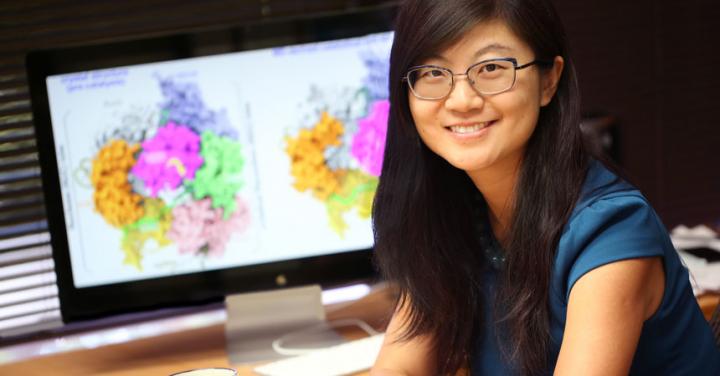
The CRISPR-Cas9 system allows researchers to make changes in a cell’s genetic code
IMAGE

Credit: UNTHSC

The mere mention of gene editing and DNA altering might conjure up images of designer babies, but that is not what researcher Jin Liu has in mind.

She wants help to find a cure for life-threatening diseases by making the gene-editing device CRISPR-Cas9 safer and more precise.

“Any genetic disease, the CRISPR-Cas9 technology has the potential to cure,” Dr. Liu said. “Cancer, eye diseases and sickle cell anemia for example.”

The CRISPR-Cas9 system allows researchers to make changes in a cell’s genetic code. The Cas9 enzyme is used to cut the DNA. But there is a problem standing in the way of successfully finding the cut position and altering the gene, said Dr. Liu, Assistant Professor of Pharmaceutical Sciences.

“When something is wrong with the DNA we can cut it out and repair it,” she said “But to bring the technology to the therapeutic field we have to be able to cut the DNA as accurately as possible.”

Finding a way to cut into the DNA with specificity is one of the goals that Dr. Liu wants to achieve with the help of a $437,864 National Institute of Health/National Heart Lung and Blood Institute grant.

When DNA is in the wrong place, it is called “off-target effects.”

“The goal is to reduce the off-target effects and increase the on-target effects,” she said. “You only want the DNA modification to be on-target.”

Using computer models to simulate how Cas9 enzyme interacts with DNA, Dr. Liu is working to better understand the mechanisms behind the off target effects.

“If we can figure that out, then we can understand the modifications that need to be made to eliminate undesirable results,” she said. “We can design a new enzyme that cuts DNA precisely.”

The next step is to test the approach in the lab to see if it performs as well as expected. Eye diseases will probably be the first model tested, Dr. Liu said. The technology could one day be used to cure lymphoma, HIV and sickle cell disease.

“There’s a lot of potential with this technology,” she said, “Many diseases could be cured.”

###

Media Contact
Alex Branch
[email protected]

Original Source

https://www.unthsc.edu/newsroom/story/researcher-hopes-to-make-gene-editing-device-safer-and-more-precise/

Tags: Gene TherapyGenesGeneticsMedicine/Health
Share13Tweet8Share2ShareShareShare2

Related Posts

Aversive Learning Hijacks Brain Sugar Sensor

March 25, 2026

Can Psychosocial Factors Influence Cancer Risk?

March 23, 2026

Depression Factors in Elderly: Pre vs. Post-COVID Analysis

March 23, 2026

Hidden Health Crises Among US and UK Volunteers in Ukraine Uncovered in New Study

March 23, 2026
Please login to join discussion

POPULAR NEWS

  • blank

    Revolutionary AI Model Enhances Precision in Detecting Food Contamination

    96 shares
    Share 38 Tweet 24
  • Imagine a Social Media Feed That Challenges Your Views Instead of Reinforcing Them

    1003 shares
    Share 397 Tweet 248
  • Uncovering Functions of Cavernous Malformation Proteins in Organoids

    54 shares
    Share 22 Tweet 14
  • Promising Outcomes from First Clinical Trials of Gene Regulation in Epilepsy

    51 shares
    Share 20 Tweet 13

About

We bring you the latest biotechnology news from best research centers and universities around the world. Check our website.

Follow us

Recent News

In-Sensor Cryptography Links Physical Process to Digital Identity

Can Psychosocial Factors Influence Cancer Risk?

Depression Factors in Elderly: Pre vs. Post-COVID Analysis

Subscribe to Blog via Email

Success! An email was just sent to confirm your subscription. Please find the email now and click 'Confirm' to start subscribing.

Join 78 other subscribers
  • Contact Us

Bioengineer.org © Copyright 2023 All Rights Reserved.

Welcome Back!

Login to your account below

Forgotten Password?

Retrieve your password

Please enter your username or email address to reset your password.

Log In
No Result
View All Result
  • Homepages
    • Home Page 1
    • Home Page 2
  • News
  • National
  • Business
  • Health
  • Lifestyle
  • Science

Bioengineer.org © Copyright 2023 All Rights Reserved.