• HOME
  • NEWS
  • EXPLORE
    • CAREER
      • Companies
      • Jobs
    • EVENTS
    • iGEM
      • News
      • Team
    • PHOTOS
    • VIDEO
    • WIKI
  • BLOG
  • COMMUNITY
    • FACEBOOK
    • INSTAGRAM
    • TWITTER
Saturday, February 7, 2026
BIOENGINEER.ORG
No Result
View All Result
  • Login
  • HOME
  • NEWS
  • EXPLORE
    • CAREER
      • Companies
      • Jobs
        • Lecturer
        • PhD Studentship
        • Postdoc
        • Research Assistant
    • EVENTS
    • iGEM
      • News
      • Team
    • PHOTOS
    • VIDEO
    • WIKI
  • BLOG
  • COMMUNITY
    • FACEBOOK
    • INSTAGRAM
    • TWITTER
  • HOME
  • NEWS
  • EXPLORE
    • CAREER
      • Companies
      • Jobs
        • Lecturer
        • PhD Studentship
        • Postdoc
        • Research Assistant
    • EVENTS
    • iGEM
      • News
      • Team
    • PHOTOS
    • VIDEO
    • WIKI
  • BLOG
  • COMMUNITY
    • FACEBOOK
    • INSTAGRAM
    • TWITTER
No Result
View All Result
Bioengineer.org
No Result
View All Result
Home NEWS Science News

NASA sees Karen regain tropical storm status

Bioengineer by Bioengineer
September 24, 2019
in Science News
Reading Time: 2 mins read
0
IMAGE
Share on FacebookShare on TwitterShare on LinkedinShare on RedditShare on Telegram

IMAGE

Credit: Credit: NASA/NOAA/NRL

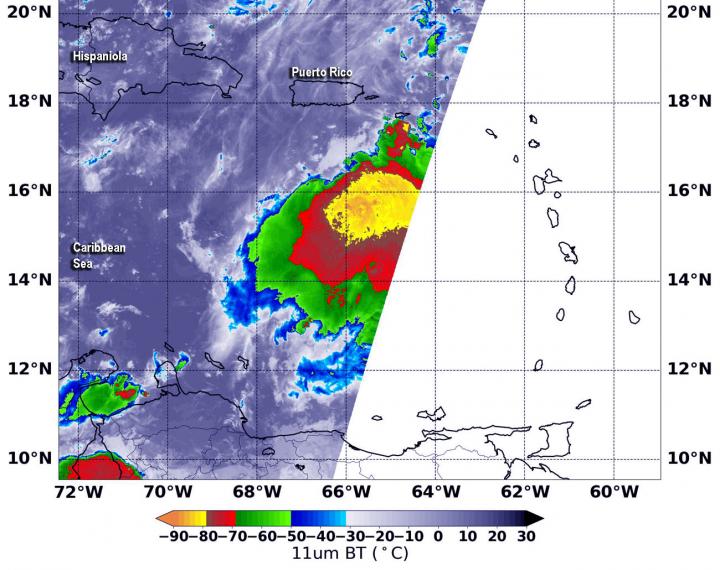
NASA-NOAA’s Suomi NPP satellite passed over the Caribbean Sea and used infrared light to obtain temperature information about Karen’s cloud tops. Data showed powerful thunderstorms re-developed in around the storm’s center as it strengthened back into a tropical storm.

NASA-NOAA’s Suomi NPP satellite used infrared light to analyze the strength of storms within the structure of what was Tropical Depression Karen. Infrared data provides temperature information, and the strongest thunderstorms that reach high into the atmosphere have the coldest cloud top temperatures. This data is helpful to forecasters because storms are not uniform around tropical cyclones and it helps pinpoint where the strongest storms are located.

On Sept. 24 at 2:48 a.m. EDT (0648 UTC), the Visible Infrared Imaging Radiometer Suite (VIIRS) instrument aboard the Suomi NPP satellite found that the strongest thunderstorms around Karen’s center had cloud top temperatures as cold as minus 80 degrees Fahrenheit (minus 62.2 degrees Celsius) appearing in yellow. Those storms were surrounded by strong storms with cloud top temperatures as cold as minus 70 degrees Fahrenheit (minus 56.6 Celsius).

NASA research has shown that storms with cloud top temperatures as cold as or colder than minus 63 degrees Fahrenheit (minus 53 degrees Celsius) have the ability to produce heavy rainfall. Karen has a large area of storms around the center with temperatures colder than that threshold.

At 8 a.m. EDT (1200 UTC) those heavy rains were already lashing Virgin Islands, Culebra, and Vieques.

A Tropical Storm Warning is in effect for U.S. Virgin Islands, Puerto Rico, including Vieques and Culebra, and the British Virgin Islands. NOAA’s National Hurricane Center (NHC) said Karen is expected to produce the following rainfall accumulations through Wednesday:  Puerto Rico and the Virgin Islands are forecast to get from 2 to 4 inches of rain with isolated totals to 8 inches. The Leeward Islands are expected to receive between 1 to 3 inches, with isolated totals to 5 inches.

At 8 a.m. EDT (1200 UTC), the center of Tropical Storm Karen was located by an Air Force Reserve Hurricane Hunter aircraft near latitude 17.2 degrees north and longitude 65.8 degrees west. That is about 85 miles (120 km) south of San Juan, Puerto Rico. Karen is moving toward the north at near 7 mph (11 kph), and this general motion is expected to continue today. Maximum sustained winds are near 40 mph (65 kph) with higher gusts. The minimum central pressure just reported by the Hurricane Hunter aircraft is 1006 millibars.

NHC said that strengthening is forecast during the next 48 hours. A north-northeastward motion is forecast tonight through Wednesday night. On the forecast track, the center of Karen will pass near or over Puerto Rico and the Virgin Islands today, and then move over the western Atlantic tonight and Wednesday.

Hurricanes are the most powerful weather event on Earth. NASA’s expertise in space and scientific exploration contributes to essential services provided to the American people by other federal agencies, such as hurricane weather forecasting.

###

By Rob Gutro

NASA’s Goddard Space Flight Center

Media Contact
Rob Gutro
[email protected]

Original Source

https://blogs.nasa.gov/hurricanes/2019/09/24/karen-atlantic-ocean-2/

Tags: Atmospheric ChemistryAtmospheric ScienceClimate ChangeClimate ScienceEarth ScienceMeteorologyTechnology/Engineering/Computer ScienceTemperature-Dependent PhenomenaWeather/Storms
Share14Tweet9Share2ShareShareShare2

Related Posts

Evaluating Pediatric Emergency Care Quality in Ethiopia

February 7, 2026

TPMT Expression Predictions Linked to Azathioprine Side Effects

February 7, 2026

Improving Dementia Care with Enhanced Activity Kits

February 7, 2026

Decoding Prostate Cancer Origins via snFLARE-seq, mxFRIZNGRND

February 7, 2026
Please login to join discussion

POPULAR NEWS

  • Robotic Ureteral Reconstruction: A Novel Approach

    Robotic Ureteral Reconstruction: A Novel Approach

    82 shares
    Share 33 Tweet 21
  • Digital Privacy: Health Data Control in Incarceration

    63 shares
    Share 25 Tweet 16
  • Study Reveals Lipid Accumulation in ME/CFS Cells

    57 shares
    Share 23 Tweet 14
  • Breakthrough in RNA Research Accelerates Medical Innovations Timeline

    53 shares
    Share 21 Tweet 13

About

We bring you the latest biotechnology news from best research centers and universities around the world. Check our website.

Follow us

Recent News

Evaluating Pediatric Emergency Care Quality in Ethiopia

TPMT Expression Predictions Linked to Azathioprine Side Effects

Improving Dementia Care with Enhanced Activity Kits

Subscribe to Blog via Email

Success! An email was just sent to confirm your subscription. Please find the email now and click 'Confirm' to start subscribing.

Join 73 other subscribers
  • Contact Us

Bioengineer.org © Copyright 2023 All Rights Reserved.

Welcome Back!

Login to your account below

Forgotten Password?

Retrieve your password

Please enter your username or email address to reset your password.

Log In
No Result
View All Result
  • Homepages
    • Home Page 1
    • Home Page 2
  • News
  • National
  • Business
  • Health
  • Lifestyle
  • Science

Bioengineer.org © Copyright 2023 All Rights Reserved.