• HOME
  • NEWS
  • EXPLORE
    • CAREER
      • Companies
      • Jobs
    • EVENTS
    • iGEM
      • News
      • Team
    • PHOTOS
    • VIDEO
    • WIKI
  • BLOG
  • COMMUNITY
    • FACEBOOK
    • INSTAGRAM
    • TWITTER
Thursday, March 26, 2026
BIOENGINEER.ORG
No Result
View All Result
  • Login
  • HOME
  • NEWS
  • EXPLORE
    • CAREER
      • Companies
      • Jobs
        • Lecturer
        • PhD Studentship
        • Postdoc
        • Research Assistant
    • EVENTS
    • iGEM
      • News
      • Team
    • PHOTOS
    • VIDEO
    • WIKI
  • BLOG
  • COMMUNITY
    • FACEBOOK
    • INSTAGRAM
    • TWITTER
  • HOME
  • NEWS
  • EXPLORE
    • CAREER
      • Companies
      • Jobs
        • Lecturer
        • PhD Studentship
        • Postdoc
        • Research Assistant
    • EVENTS
    • iGEM
      • News
      • Team
    • PHOTOS
    • VIDEO
    • WIKI
  • BLOG
  • COMMUNITY
    • FACEBOOK
    • INSTAGRAM
    • TWITTER
No Result
View All Result
Bioengineer.org
No Result
View All Result
Home NEWS Science News Chemistry

Researchers can now place single ions into solids

Bioengineer by Bioengineer
September 24, 2019
in Chemistry
Reading Time: 2 mins read
0
IMAGE
Share on FacebookShare on TwitterShare on LinkedinShare on RedditShare on Telegram

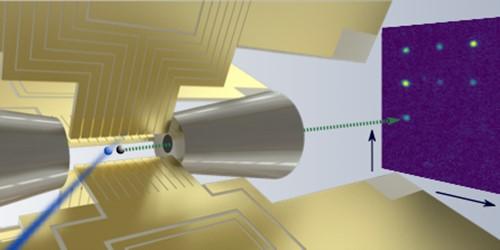
New technique enables implantation of individual ions into crystals with an accuracy of 35 nanometers
IMAGE

Credit: Ill./©: QUANTUM, Institute of Physics, JGU

Modern electronics is based on doped semiconductors. To synthesize electronic components, dopant atoms such as aluminum or phosphorus are embedded into crystals of ultrapure silicon. This allows for tailoring semiconductor conductivity according to the desired application. In modern electronic computer processors, miniaturized to just a few nanometers, only less than ten dopant atoms are relevant for the functionality. Quantum components, which are used for novel quantum computers or quantum simulators, will go even one step further in that they require an array with only single dopant atoms in a high-purity crystal.

Physicists at Johannes Gutenberg University Mainz (JGU) led by Professor Ferdinand Schmidt-Kaler now have developed a method to implant precise numbers of individual dopant ions into a solid crystal. Their technique implants the rare earth element praseodymium into an yttrium-aluminum garnet crystal. These crystals were subsequently examined under a high-resolution confocal microscope in collaboration with a team of researchers headed by Professor Jörg Wrachtrup at the University of Stuttgart. They determined a positioning accuracy of 35 nanometers. In principle, this accuracy is already sufficient to implant arrays of dopant ions into components for future quantum processors.

The research results were published as a highlight in the current volume of the international journal Physical Review Letters and represent an important innovation with a wide potential for applications, as the method can be extended to other crystals and dopant atoms.

###

Media Contact
Professor Dr. Ferdinand Schmidt-Kaler
[email protected]

Original Source

https://www.uni-mainz.de/presse/aktuell/9443_ENG_HTML.php

Related Journal Article

http://dx.doi.org/10.1103/PhysRevLett.123.106802

Tags: Atomic PhysicsChemistry/Physics/Materials SciencesElectrical Engineering/ElectronicsElectromagneticsMaterialsResearch/DevelopmentSuperconductors/SemiconductorsTechnology/Engineering/Computer Science
Share12Tweet8Share2ShareShareShare2

Related Posts

Isolated H2-Reduced Clusters Boost CO2-to-Methanol Catalysis

Isolated H2-Reduced Clusters Boost CO2-to-Methanol Catalysis

March 25, 2026
blank

Physicists Identify Electronic Drivers Behind Flat Band Quantum Materials

March 21, 2026

Würzburg Chemistry Professor Claudia Höbartner Receives Prestigious Honor

March 20, 2026

Scientists Reveal How Magnets Control Metamaterial Behavior

March 20, 2026
Please login to join discussion

POPULAR NEWS

  • blank

    Revolutionary AI Model Enhances Precision in Detecting Food Contamination

    96 shares
    Share 38 Tweet 24
  • Imagine a Social Media Feed That Challenges Your Views Instead of Reinforcing Them

    1003 shares
    Share 397 Tweet 248
  • Uncovering Functions of Cavernous Malformation Proteins in Organoids

    54 shares
    Share 22 Tweet 14
  • Promising Outcomes from First Clinical Trials of Gene Regulation in Epilepsy

    51 shares
    Share 20 Tweet 13

About

We bring you the latest biotechnology news from best research centers and universities around the world. Check our website.

Follow us

Recent News

In-Sensor Cryptography Links Physical Process to Digital Identity

Can Psychosocial Factors Influence Cancer Risk?

Depression Factors in Elderly: Pre vs. Post-COVID Analysis

Subscribe to Blog via Email

Success! An email was just sent to confirm your subscription. Please find the email now and click 'Confirm' to start subscribing.

Join 78 other subscribers
  • Contact Us

Bioengineer.org © Copyright 2023 All Rights Reserved.

Welcome Back!

Login to your account below

Forgotten Password?

Retrieve your password

Please enter your username or email address to reset your password.

Log In
No Result
View All Result
  • Homepages
    • Home Page 1
    • Home Page 2
  • News
  • National
  • Business
  • Health
  • Lifestyle
  • Science

Bioengineer.org © Copyright 2023 All Rights Reserved.