• HOME
  • NEWS
  • EXPLORE
    • CAREER
      • Companies
      • Jobs
    • EVENTS
    • iGEM
      • News
      • Team
    • PHOTOS
    • VIDEO
    • WIKI
  • BLOG
  • COMMUNITY
    • FACEBOOK
    • INSTAGRAM
    • TWITTER
Thursday, May 14, 2026
BIOENGINEER.ORG
No Result
View All Result
  • Login
  • HOME
  • NEWS
  • EXPLORE
    • CAREER
      • Companies
      • Jobs
        • Lecturer
        • PhD Studentship
        • Postdoc
        • Research Assistant
    • EVENTS
    • iGEM
      • News
      • Team
    • PHOTOS
    • VIDEO
    • WIKI
  • BLOG
  • COMMUNITY
    • FACEBOOK
    • INSTAGRAM
    • TWITTER
  • HOME
  • NEWS
  • EXPLORE
    • CAREER
      • Companies
      • Jobs
        • Lecturer
        • PhD Studentship
        • Postdoc
        • Research Assistant
    • EVENTS
    • iGEM
      • News
      • Team
    • PHOTOS
    • VIDEO
    • WIKI
  • BLOG
  • COMMUNITY
    • FACEBOOK
    • INSTAGRAM
    • TWITTER
No Result
View All Result
Bioengineer.org
No Result
View All Result
Home NEWS Science News Chemistry

Catch-22 in graphene based molecular devices resolved

Bioengineer by Bioengineer
September 16, 2019
in Chemistry
Reading Time: 2 mins read
0
IMAGE
Share on FacebookShare on TwitterShare on LinkedinShare on RedditShare on Telegram

IMAGE

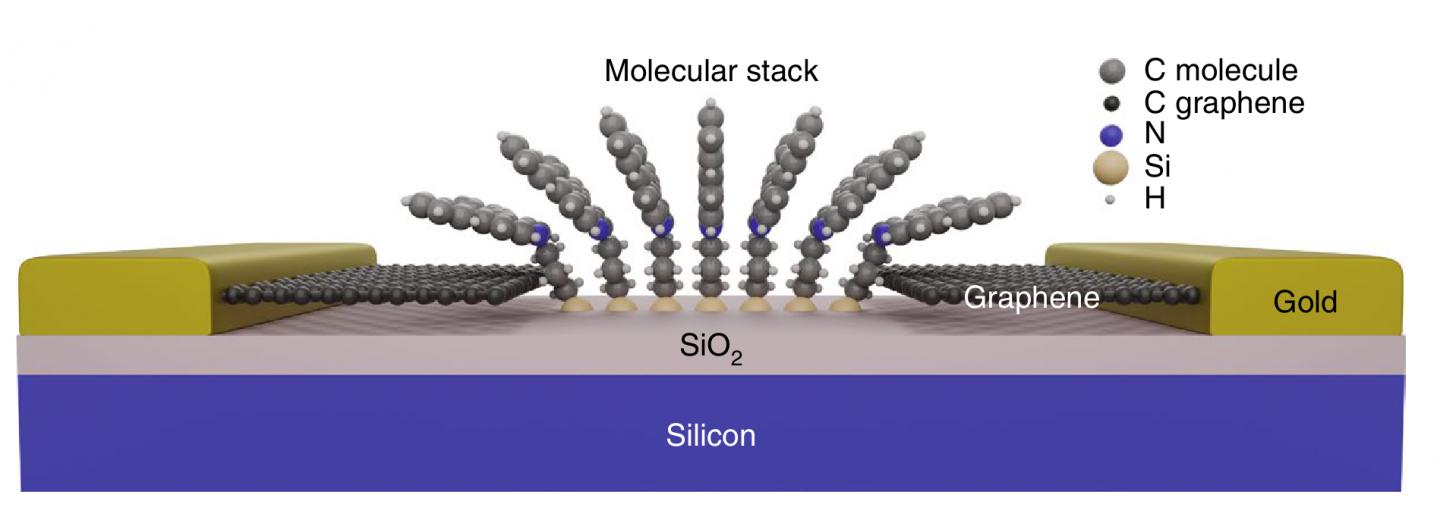
Credit: University of Warwick

The conductivity of Graphene has made it a target for many researchers seeking to exploit it to create molecular scale devices and now a research team jointly led by University of Warwick and EMPA have found a way past a frustrating catch 22 issue of stability and reproducibility that meant that graphene based junctions were either mechanically stable or electrically stable but not both at the same time.

Graphene and graphene like molecules are attractive choice as an electronic component in molecular devices but up till now it has proven very challenging to use them in large scale production of molecular devices that will work and be robust at room temperatures. In a joint effort research teams from the University of Warwick, EMPA and Lancaster and Bern Universities have reached both electrical and mechanical stability in graphene based junctions million times smaller than diameter of human hair. They have today (Monday 16 September 2019) published their findings in a paper entitled “Robust graphene-based molecular devices” in the journal Nature Nanotechnology.

Simple mechanically stable structures such as graphene-like molecules are easy to produce by chemical synthesis but at this very small scale these are subject to a range of limits when they placed in a junction to form an electronic device such as variations in molecule electrode interface. The researchers overcome these limits by separating the requirements for mechanical and electronic stability at the molecular level.

They produced an electrically effective structure by building a graphene-like molecule stack to form a electron path through the graphene-like molecules P orbitals (these are dumbbell shaped electron clouds within which an electron can be found, within a certain degree of probability) This would open new avenues to use fascinating molecular properties such as quantum interference which occurs at such a small scale provided a sufficiently mechanical robust structures achieved. For this, the research team also created bonds between each molecule and a silicon-oxide substrate. This gave the structure significant mechanical stability by effectively anchoring the graphene-like molecule stack to the substrate using a silanization reaction. This is illustrated in the simplified diagram accompanying this press release.

Dr Hatef Sadeghi from the University of Warwick’s School of Engineering who led the theoretical modelling of this work said:

“This method allowed us to design and produce graphene-based molecular devices that are electronically and mechanically stable over a large temperature range. This was achieved by decoupling the mechanical anchoring from the electronic pathways by combining a covalent binding of the molecules to the substrate and large π-conjugated head groups.

“The junctions were reproducible over several devices and operated from 20 Kelvin up to room temperature. Our approach represents a simple but powerful strategy for the future integration of molecule-based functions into stable and controllable nanoelectronic devices.”

###

Media Contact
Peter Dunn
[email protected]

Related Journal Article

http://dx.doi.org/10.1038/s41565-019-0533-8

Tags: Chemistry/Physics/Materials SciencesMaterialsNanotechnology/Micromachines
Share12Tweet8Share2ShareShareShare2

Related Posts

Researchers Develop High-Efficiency Hydrogen Separation Membranes Using Innovative ‘Mortar-and-Brick’ Design — Chemistry

Researchers Develop High-Efficiency Hydrogen Separation Membranes Using Innovative ‘Mortar-and-Brick’ Design

May 13, 2026
Green Electrosynthesis Paves the Way for Direct Amines Production from Atmospheric Nitrogen — Chemistry

Green Electrosynthesis Paves the Way for Direct Amines Production from Atmospheric Nitrogen

May 13, 2026

Decoding Life’s Chemistry: A Revolutionary Search Engine from Molecules to Meaning

May 13, 2026

How Olympic Weightlifting Harnesses the Barbell’s ‘Whip’ for Peak Performance #ASA190

May 13, 2026
Please login to join discussion

POPULAR NEWS

  • Research Indicates Potential Connection Between Prenatal Medication Exposure and Elevated Autism Risk

    842 shares
    Share 337 Tweet 211
  • New Study Reveals Plants Can Detect the Sound of Rain

    729 shares
    Share 291 Tweet 182
  • Salmonella Haem Blocks Macrophages, Boosts Infection

    62 shares
    Share 25 Tweet 16
  • Breastmilk Balances E. coli and Beneficial Bacteria in Infant Gut Microbiomes

    57 shares
    Share 23 Tweet 14

About

We bring you the latest biotechnology news from best research centers and universities around the world. Check our website.

Follow us

Recent News

ALS Progresses Through a Domino-Like Chain Reaction Initiated in Nerve Cells

Liquid Metal Nano-Gyroid Enables Ultra-Resilient Electronics

Intense Precipitation Reduces Terrestrial Water Storage

Subscribe to Blog via Email

Enter your email address to subscribe to this blog and receive notifications of new posts by email.

Join 82 other subscribers
  • Contact Us

Bioengineer.org © Copyright 2023 All Rights Reserved.

Welcome Back!

Login to your account below

Forgotten Password?

Retrieve your password

Please enter your username or email address to reset your password.

Log In
No Result
View All Result
  • Homepages
    • Home Page 1
    • Home Page 2
  • News
  • National
  • Business
  • Health
  • Lifestyle
  • Science

Bioengineer.org © Copyright 2023 All Rights Reserved.