• HOME
  • NEWS
  • EXPLORE
    • CAREER
      • Companies
      • Jobs
    • EVENTS
    • iGEM
      • News
      • Team
    • PHOTOS
    • VIDEO
    • WIKI
  • BLOG
  • COMMUNITY
    • FACEBOOK
    • INSTAGRAM
    • TWITTER
Tuesday, May 12, 2026
BIOENGINEER.ORG
No Result
View All Result
  • Login
  • HOME
  • NEWS
  • EXPLORE
    • CAREER
      • Companies
      • Jobs
        • Lecturer
        • PhD Studentship
        • Postdoc
        • Research Assistant
    • EVENTS
    • iGEM
      • News
      • Team
    • PHOTOS
    • VIDEO
    • WIKI
  • BLOG
  • COMMUNITY
    • FACEBOOK
    • INSTAGRAM
    • TWITTER
  • HOME
  • NEWS
  • EXPLORE
    • CAREER
      • Companies
      • Jobs
        • Lecturer
        • PhD Studentship
        • Postdoc
        • Research Assistant
    • EVENTS
    • iGEM
      • News
      • Team
    • PHOTOS
    • VIDEO
    • WIKI
  • BLOG
  • COMMUNITY
    • FACEBOOK
    • INSTAGRAM
    • TWITTER
No Result
View All Result
Bioengineer.org
No Result
View All Result
Home NEWS Science News Biology

Ancient Australia was home to strange marsupial giants, some weighing over 1,000 kg

Bioengineer by Bioengineer
September 14, 2019
in Biology
Reading Time: 3 mins read
0
IMAGE
Share on FacebookShare on TwitterShare on LinkedinShare on RedditShare on Telegram

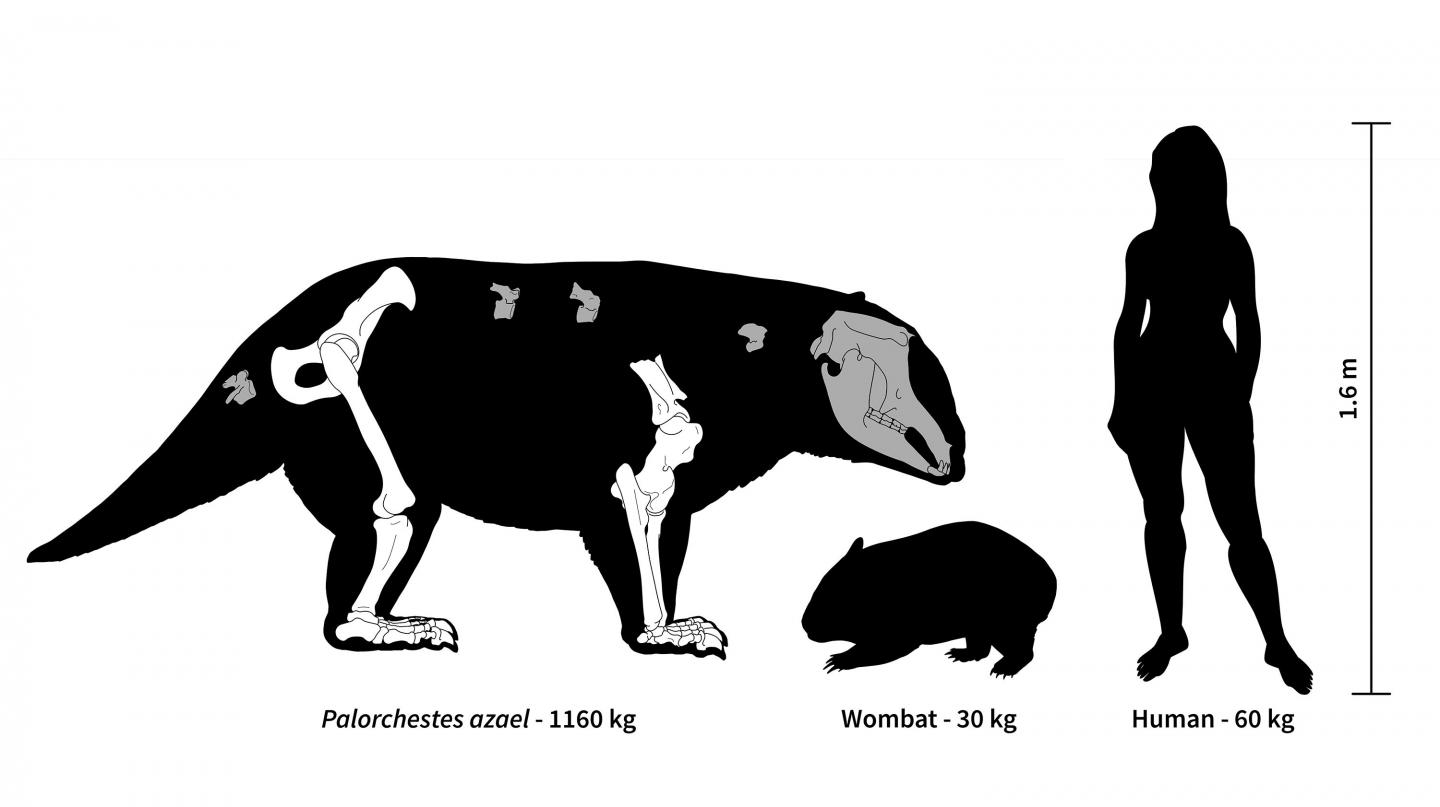
Extinct palorchestid marsupials likely filled a niche no longer occupied in modern Australia
IMAGE

Credit: Hazel Richards (2019)

Palorchestid marsupials, an extinct group of Australian megafauna, had strange bodies and lifestyles unlike any living species, according to a study released September 13, 2019 in the open-access journal PLOS ONE by Hazel Richards of Monash University, Australia and colleagues.

For most of the last 25 million years, eastern Australia was home to a now-extinct group of marsupials called palorchestids. These animals are well known for their large size, strange tapir-like skulls, and large claws, but so far there has been no detailed study of their limb morphology. In this study, Richards and colleagues examined more than 60 fossil specimens of palorchestids of varying geologic ages to characterize the function and evolution of their arms and legs.

Over the course of their evolution, palorchestids grew larger and stranger. Using limb proportions as a proxy for body size, these authors estimated that the latest and largest of the palorchestids may have weighed over 1,000kg. Furthermore, their forelimbs were extremely muscular and were likely adapted for grabbing or scraping at leaves and branches. Uniquely among known mammals, the elbow joints of the largest palorchestids appear to have been immobile and fixed at roughly a 100-degree angle, so that the arms served as permanently flexed food-gathering tools.

This study provides the first formal description of limb morphology in palorchestid marsupials and reveals a group of giant herbivores that probably filled a niche no longer occupied in modern Australian ecosystems. Fossil remains are still missing for certain parts of the palorchestid body, such as the shoulders and wrists, but the authors are hopeful that more material may be found in existing museum collections.

The authors add: “This study has allowed us for the first time to appreciate just how huge these mega-marsupial palorchestids were, while also providing the first comprehensive view of a strange limb anatomy unprecedented in the mammalian world. This research reveals yet more about the diversity of unique large marsupials that once roamed Australia not so long ago.”

###

Citation: Richards HL, Wells RT, Evans AR, Fitzgerald EMG, Adams JW (2019) The extraordinary osteology and functional morphology of the limbs in Palorchestidae, a family of strange extinct marsupial giants. PLoS ONE 14(9): e0221824. https://doi.org/10.1371/journal.pone.0221824

Funding: This research was supported by an Australian Government Research Training Program Scholarship, Robert Blackwood Partnership PhD Top-Up Scholarship (HLR), internal funds from the Department of Anatomy and Developmental Biology, Monash University (JWA), and the Australian Research Council DP180101797 (ARE). The funders had no role in study design, data collection and analysis, decision to publish, or preparation of the manuscript.

Competing Interests: ARE is a Section Editor of Paleontology and JWA is an Academic Editor with PLOS ONE; however, they confirm that their positions do not alter the authors’ adherence to the PLOS ONE policies. They and the other authors have declared that no other competing interests exist. This does not alter our adherence to PLOS ONE policies on sharing data and materials.

In your coverage please use this URL to provide access to the freely available article in PLOS ONE: https://journals.plos.org/plosone/article?id=10.1371/journal.pone.0221824

Media Contact
Hazel Richards
[email protected]

Related Journal Article

http://dx.doi.org/10.1371/journal.pone.0221824

Tags: ArchaeologyBiodiversityBiologyEcology/EnvironmentEvolutionNew WorldPaleontologyPhysiology
Share12Tweet8Share2ShareShareShare2

Related Posts

From Complexity to Clarity: Unraveling the “Topological Laws” Governing Cell Death — Biology

From Complexity to Clarity: Unraveling the “Topological Laws” Governing Cell Death

May 11, 2026
New Classification Framework Identifies Tumor-Associated Bacterial Effectors as Crucial Drivers of Tumor Biology and Immune Response — Biology

New Classification Framework Identifies Tumor-Associated Bacterial Effectors as Crucial Drivers of Tumor Biology and Immune Response

May 11, 2026

HIV-1 Strains Reveal Varied Paths to Antibody Escape

May 11, 2026

CRISPRi Screening Identifies Fungal-Specific Drug Targets

May 11, 2026
Please login to join discussion

POPULAR NEWS

  • Research Indicates Potential Connection Between Prenatal Medication Exposure and Elevated Autism Risk

    841 shares
    Share 336 Tweet 210
  • New Study Reveals Plants Can Detect the Sound of Rain

    728 shares
    Share 290 Tweet 182
  • Salmonella Haem Blocks Macrophages, Boosts Infection

    62 shares
    Share 25 Tweet 16
  • Breastmilk Balances E. coli and Beneficial Bacteria in Infant Gut Microbiomes

    57 shares
    Share 23 Tweet 14

About

We bring you the latest biotechnology news from best research centers and universities around the world. Check our website.

Follow us

Recent News

Humans and Zebra Finches Share Similar Speech Learning Techniques #ASA190

New Study Uncovers How Fungal Parasites Attack Strawberries and Raspberries

City of Hope Researchers to Present Groundbreaking Immunotherapy and Precision Medicine Advances Across Multiple Cancer Types at ASCO 2026

Subscribe to Blog via Email

Enter your email address to subscribe to this blog and receive notifications of new posts by email.

Join 82 other subscribers
  • Contact Us

Bioengineer.org © Copyright 2023 All Rights Reserved.

Welcome Back!

Login to your account below

Forgotten Password?

Retrieve your password

Please enter your username or email address to reset your password.

Log In
No Result
View All Result
  • Homepages
    • Home Page 1
    • Home Page 2
  • News
  • National
  • Business
  • Health
  • Lifestyle
  • Science

Bioengineer.org © Copyright 2023 All Rights Reserved.