• HOME
  • NEWS
  • EXPLORE
    • CAREER
      • Companies
      • Jobs
    • EVENTS
    • iGEM
      • News
      • Team
    • PHOTOS
    • VIDEO
    • WIKI
  • BLOG
  • COMMUNITY
    • FACEBOOK
    • INSTAGRAM
    • TWITTER
Thursday, March 26, 2026
BIOENGINEER.ORG
No Result
View All Result
  • Login
  • HOME
  • NEWS
  • EXPLORE
    • CAREER
      • Companies
      • Jobs
        • Lecturer
        • PhD Studentship
        • Postdoc
        • Research Assistant
    • EVENTS
    • iGEM
      • News
      • Team
    • PHOTOS
    • VIDEO
    • WIKI
  • BLOG
  • COMMUNITY
    • FACEBOOK
    • INSTAGRAM
    • TWITTER
  • HOME
  • NEWS
  • EXPLORE
    • CAREER
      • Companies
      • Jobs
        • Lecturer
        • PhD Studentship
        • Postdoc
        • Research Assistant
    • EVENTS
    • iGEM
      • News
      • Team
    • PHOTOS
    • VIDEO
    • WIKI
  • BLOG
  • COMMUNITY
    • FACEBOOK
    • INSTAGRAM
    • TWITTER
No Result
View All Result
Bioengineer.org
No Result
View All Result
Home NEWS Science News Cancer

Sclerosing agent delivery improvements to protect against malignant pleural effusion

Bioengineer by Bioengineer
July 25, 2019
in Cancer
Reading Time: 2 mins read
0
IMAGE
Share on FacebookShare on TwitterShare on LinkedinShare on RedditShare on Telegram

Kazan Federal University and Fox Chase Cancer Center have unveiled promising research results in BMC Cancer.
IMAGE

Credit: Kazan Federal University

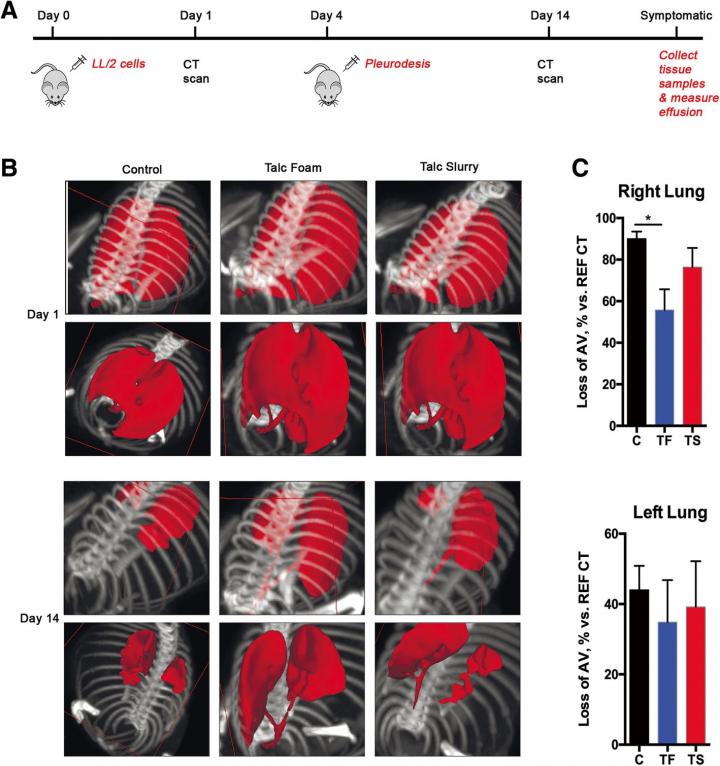
Preclinical trials were held on mice. Senior Research Associate Alexander Deneka (Laboratory of Molecular and Biochemical Bases of Pathogenesis and Therapy of Cancer Diseases, Kazan Federal University) explains that the method in question was first proposed by British scientists; they proved that liquid can be drained from a pleural cavity with the help of a talcum powder solution.

Tests showed that only a half of patients can be assisted in this way, so new ways of drainage were sought. The authors of this new paper found a safer and more reliable alternative while experimenting with hydrogels.

Talcum and hydrogel are combined in such a way as to be evenly distributed between pleurae and absorb liquid more effectively. Experiments on cancer-stricken mice proved that the method is promising. Health deterioration was stalled, and they lived up 55% longer than those who received standard therapy.

“Importantly, the increased effectiveness of hydrogel infusion allows to remove a suction tube quicker. This reduces the risk of pleural inflammation or aeration of the pleural cavity,” adds Deneka.

Further research is planned and can down the road help save thousands of lives.

###

Media Contact
Yury Nurmeev
[email protected]

Original Source

https://kpfu.ru/eng/news-eng/sclerosing-agent-delivery-pulmonary-pleurae.html

Related Journal Article

http://dx.doi.org/10.1186/s12885-019-5777-z

Tags: cancerCardiologyMedicine/HealthPharmaceutical/Combinatorial ChemistryPulmonary/Respiratory Medicine
Share12Tweet8Share2ShareShareShare2

Related Posts

Microtubules Found to Actively Ensure Accurate Chromosome Distribution During Cell Division

March 25, 2026

Alectinib Enhances CAR T-Cell Attack in ALK Neuroblastoma

March 23, 2026

Dr. Chun Li Honored with SNMMI Mars Shot Research Fund Award

March 20, 2026

Pre-Chemotherapy Exercise Demonstrates Potential to Alleviate Cancer-Related Fatigue

March 20, 2026
Please login to join discussion

POPULAR NEWS

  • blank

    Revolutionary AI Model Enhances Precision in Detecting Food Contamination

    96 shares
    Share 38 Tweet 24
  • Imagine a Social Media Feed That Challenges Your Views Instead of Reinforcing Them

    1003 shares
    Share 397 Tweet 248
  • Uncovering Functions of Cavernous Malformation Proteins in Organoids

    54 shares
    Share 22 Tweet 14
  • Promising Outcomes from First Clinical Trials of Gene Regulation in Epilepsy

    51 shares
    Share 20 Tweet 13

About

We bring you the latest biotechnology news from best research centers and universities around the world. Check our website.

Follow us

Recent News

In-Sensor Cryptography Links Physical Process to Digital Identity

Can Psychosocial Factors Influence Cancer Risk?

Depression Factors in Elderly: Pre vs. Post-COVID Analysis

Subscribe to Blog via Email

Success! An email was just sent to confirm your subscription. Please find the email now and click 'Confirm' to start subscribing.

Join 78 other subscribers
  • Contact Us

Bioengineer.org © Copyright 2023 All Rights Reserved.

Welcome Back!

Login to your account below

Forgotten Password?

Retrieve your password

Please enter your username or email address to reset your password.

Log In
No Result
View All Result
  • Homepages
    • Home Page 1
    • Home Page 2
  • News
  • National
  • Business
  • Health
  • Lifestyle
  • Science

Bioengineer.org © Copyright 2023 All Rights Reserved.