• HOME
  • NEWS
  • EXPLORE
    • CAREER
      • Companies
      • Jobs
    • EVENTS
    • iGEM
      • News
      • Team
    • PHOTOS
    • VIDEO
    • WIKI
  • BLOG
  • COMMUNITY
    • FACEBOOK
    • INSTAGRAM
    • TWITTER
Thursday, January 15, 2026
BIOENGINEER.ORG
No Result
View All Result
  • Login
  • HOME
  • NEWS
  • EXPLORE
    • CAREER
      • Companies
      • Jobs
        • Lecturer
        • PhD Studentship
        • Postdoc
        • Research Assistant
    • EVENTS
    • iGEM
      • News
      • Team
    • PHOTOS
    • VIDEO
    • WIKI
  • BLOG
  • COMMUNITY
    • FACEBOOK
    • INSTAGRAM
    • TWITTER
  • HOME
  • NEWS
  • EXPLORE
    • CAREER
      • Companies
      • Jobs
        • Lecturer
        • PhD Studentship
        • Postdoc
        • Research Assistant
    • EVENTS
    • iGEM
      • News
      • Team
    • PHOTOS
    • VIDEO
    • WIKI
  • BLOG
  • COMMUNITY
    • FACEBOOK
    • INSTAGRAM
    • TWITTER
No Result
View All Result
Bioengineer.org
No Result
View All Result
Home NEWS Science News Chemistry

How nature builds hydrogen-producing enzymes

Bioengineer by Bioengineer
July 24, 2019
in Chemistry
Reading Time: 2 mins read
0
IMAGE
Share on FacebookShare on TwitterShare on LinkedinShare on RedditShare on Telegram

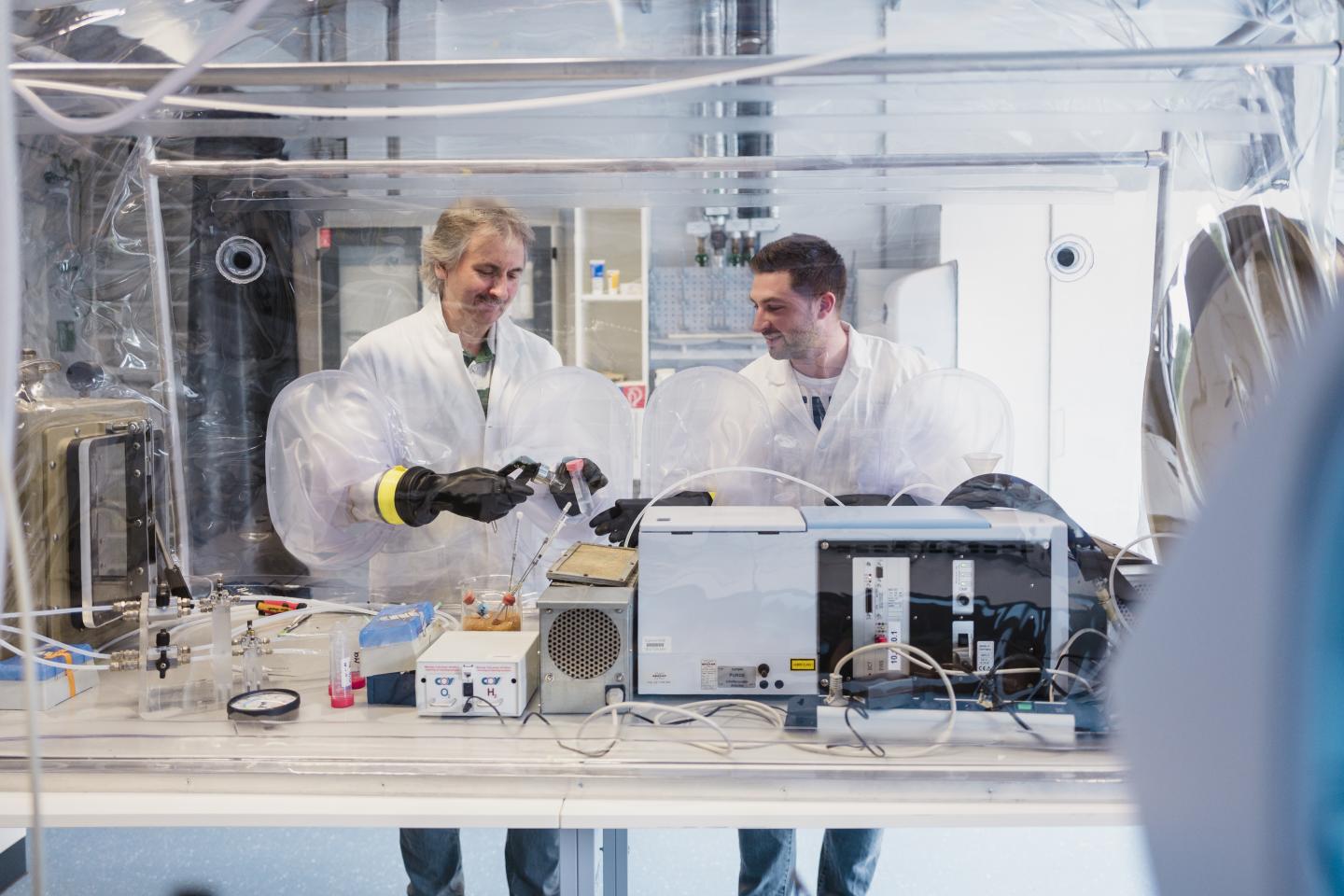
The heart of the biological catalyst is only introduced during the last step. The process is complex.
IMAGE

Credit: RUB, Kramer

A team from Ruhr-Universität Bochum and the University of Oxford has discovered how hydrogen-producing enzymes, called hydrogenases, are activated during their biosynthesis. They showed how the cofactor – part of the active centre and also the heart of the enzyme – is introduced inside.

Hydrogenases are of biotechnological interest as they are able to efficiently produce hydrogen. “In order to optimise them for an industrial application, we first need to understand the process of how the protein shell takes up and activates the chemical cofactor,” says Professor Thomas Happe. A team led by Oliver Lampret and Thomas Happe from the Bochum-based Photobiotechnology Research Group published the results in the journal Proceedings of the National Academy of Sciences, PNAS for short, on 23 July 2019.

The researchers investigated the subgroup of [FeFe]-hydrogenases, which are the most efficient hydrogen producers. In nature, they can be found in green algae. Within their protein scaffold, the enzymes have an active centre, the so-called H-cluster, where the hydrogen is produced. It is comprised of two structural elements: a cluster containing four iron and four sulphur atoms, and the catalytic cofactor, which consists of two iron and two sulphur atoms. “This cofactor is the linchpin of the enzyme,” explains Oliver Lampret.

Final step of biosynthesis

In nature, the cofactor is subsequently incorporated into the enzyme following the biosynthesis of the protein scaffold – a highly complex process. Only then is the hydrogenase catalytically active. The researchers clarified the precise sequence of the process using protein engineering, protein film electrochemistry and infrared spectroscopy.

The team showed that the negatively charged cofactor is specifically transported through a positively charged maturation channel into the interior of the enzyme before it is firmly anchored into the protein shell. Particularly flexible structural elements act as hinges here, ensuring that the protein folds differently and firmly envelopes and protects the integrated cofactor. The interaction of protein environment and cofactor is essential in order to stabilise the cofactor in its catalytic form.

“We assume that not only do [FeFe]-hydrogenases obtain their cofactor in this way but that the mechanism also occurs in other metalliferous enzymes,” says Happe.

###

Media Contact
Thomas Happe
[email protected]

Original Source

https://news.rub.de/english/press-releases/2019-07-24-biology-how-nature-builds-hydrogen-producing-enzymes

Related Journal Article

http://dx.doi.org/10.1073/pnas.1908121116

Tags: BiochemistryBiologyMolecular Biology
Share12Tweet8Share2ShareShareShare2

Related Posts

blank

Thermal [2+2] Cycloaddition Builds Gem-Difluoro Bicycloalkanes

January 13, 2026
blank

Cobalt-Catalyzed Thioester Coupling via Siloxycarbene

January 12, 2026

Advancing Alkene Chemistry: Homologative Difunctionalization Breakthrough

January 8, 2026

Biocompatible Ligand Enables Safe In-Cell Protein Arylation

January 8, 2026
Please login to join discussion

POPULAR NEWS

  • Enhancing Spiritual Care Education in Nursing Programs

    155 shares
    Share 62 Tweet 39
  • PTSD, Depression, Anxiety in Childhood Cancer Survivors, Parents

    147 shares
    Share 59 Tweet 37
  • Robotic Ureteral Reconstruction: A Novel Approach

    75 shares
    Share 30 Tweet 19
  • Study Reveals Lipid Accumulation in ME/CFS Cells

    53 shares
    Share 21 Tweet 13

About

We bring you the latest biotechnology news from best research centers and universities around the world. Check our website.

Follow us

Recent News

HOGE: Advancing Masked Face Recognition with Transfer Learning

Mosaic Lateral Heterostructures Boost 2D Perovskites

New Genes and Factors Linked to Colorectal Cancer

Subscribe to Blog via Email

Enter your email address to subscribe to this blog and receive notifications of new posts by email.

Join 71 other subscribers
  • Contact Us

Bioengineer.org © Copyright 2023 All Rights Reserved.

Welcome Back!

Login to your account below

Forgotten Password?

Retrieve your password

Please enter your username or email address to reset your password.

Log In
No Result
View All Result
  • Homepages
    • Home Page 1
    • Home Page 2
  • News
  • National
  • Business
  • Health
  • Lifestyle
  • Science

Bioengineer.org © Copyright 2023 All Rights Reserved.