• HOME
  • NEWS
  • EXPLORE
    • CAREER
      • Companies
      • Jobs
    • EVENTS
    • iGEM
      • News
      • Team
    • PHOTOS
    • VIDEO
    • WIKI
  • BLOG
  • COMMUNITY
    • FACEBOOK
    • INSTAGRAM
    • TWITTER
Saturday, February 7, 2026
BIOENGINEER.ORG
No Result
View All Result
  • Login
  • HOME
  • NEWS
  • EXPLORE
    • CAREER
      • Companies
      • Jobs
        • Lecturer
        • PhD Studentship
        • Postdoc
        • Research Assistant
    • EVENTS
    • iGEM
      • News
      • Team
    • PHOTOS
    • VIDEO
    • WIKI
  • BLOG
  • COMMUNITY
    • FACEBOOK
    • INSTAGRAM
    • TWITTER
  • HOME
  • NEWS
  • EXPLORE
    • CAREER
      • Companies
      • Jobs
        • Lecturer
        • PhD Studentship
        • Postdoc
        • Research Assistant
    • EVENTS
    • iGEM
      • News
      • Team
    • PHOTOS
    • VIDEO
    • WIKI
  • BLOG
  • COMMUNITY
    • FACEBOOK
    • INSTAGRAM
    • TWITTER
No Result
View All Result
Bioengineer.org
No Result
View All Result
Home NEWS Science News Chemistry

Artificial throat could someday help mute people ‘speak’

Bioengineer by Bioengineer
July 24, 2019
in Chemistry
Reading Time: 2 mins read
0
IMAGE
Share on FacebookShare on TwitterShare on LinkedinShare on RedditShare on Telegram

IMAGE

Credit: Adapted from ACS Nano 2019, 10.1021/acsnano.9b03218

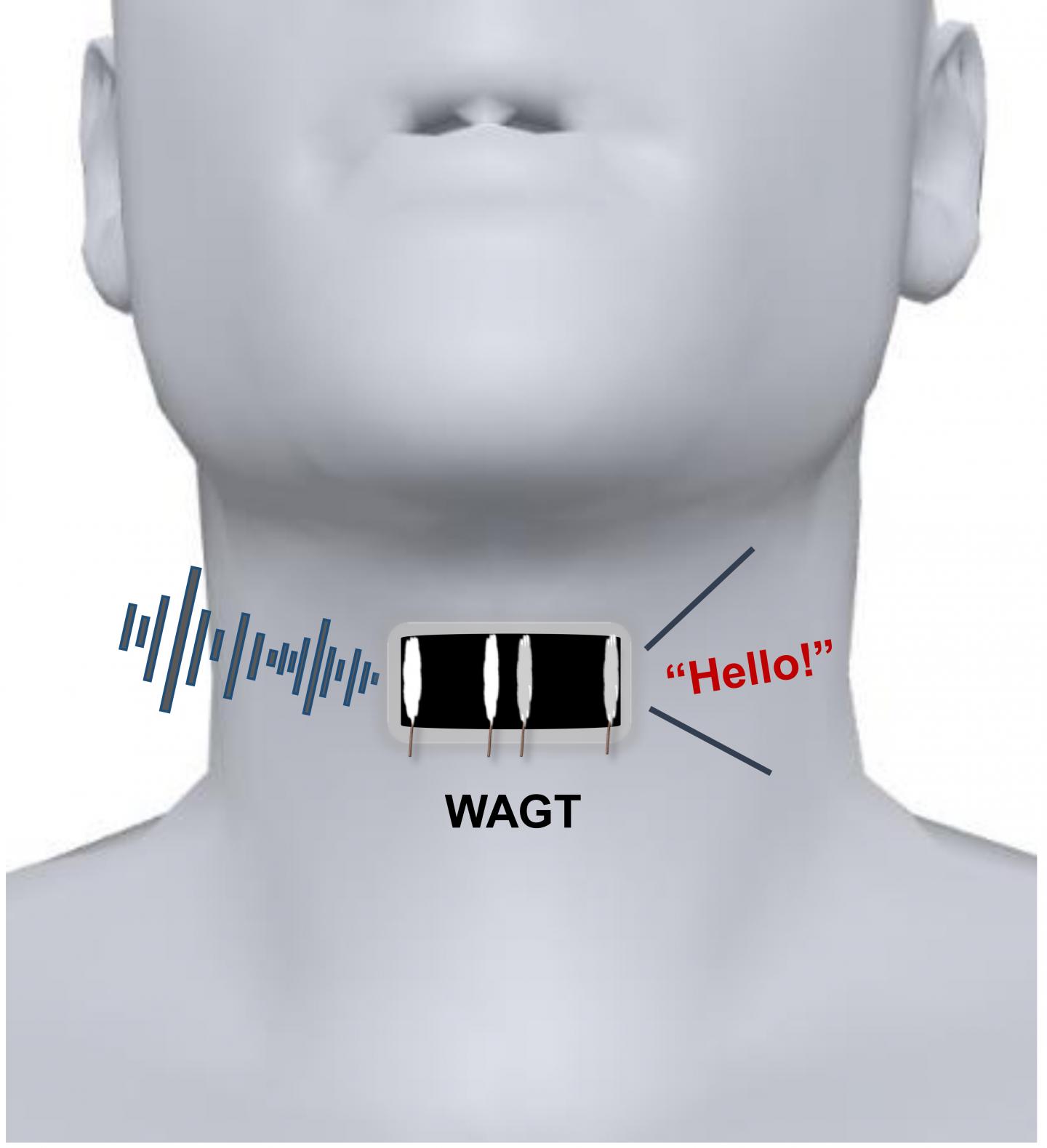
Most people take speech for granted, but it’s actually a complex process that involves both motions of the mouth and vibrations of folded tissues, called vocal cords, within the throat. If the vocal cords sustain injuries or other lesions, a person can lose the ability to speak. Now, researchers reporting in ACS Nano have developed a wearable artificial throat that, when attached to the neck like a temporary tattoo, can transform throat movements into sounds.

Scientists have developed detectors that measure movements on human skin, such as pulse or heartbeat. However, the devices typically can’t convert these motions into sounds. Recently, He Tian, Yi Yang, Tian-Ling Ren and colleagues developed a prototype artificial throat with both capabilities, but because the device needed to be taped to the skin, it wasn’t comfortable enough to wear for long periods of time. So the researchers wanted to develop a thinner, skin-like artificial throat that would adhere to the neck like a temporary tattoo.

To make their artificial throat, the researchers laser-scribed graphene on a thin sheet of polyvinyl alcohol film. The flexible device measured 0.6 by 1.2 inches, or about double the size of a person’s thumbnail. The researchers used water to attach the film to the skin over a volunteer’s throat and connected it with electrodes to a small armband that contained a circuit board, microcomputer, power amplifier and decoder. When the volunteer noiselessly imitated the throat motions of speech, the instrument converted these movements into emitted sounds, such as the words “OK” and “No.” The researchers say that, in the future, mute people could be trained to generate signals with their throats that the device would translate into speech.

###

The authors acknowledge funding from the National Key R&D Program of China, the National Natural Science Foundation of China, the National Basic Research Program of China, the Beijing Innovation Center for Future Chip, the Beijing Natural Science Foundation and the Shenzhen Science and Technology Program.

The abstract that accompanies this study is available here.

The American Chemical Society, the world’s largest scientific society, is a not-for-profit organization chartered by the U.S. Congress. ACS is a global leader in providing access to chemistry-related information and research through its multiple databases, peer-reviewed journals and scientific conferences. ACS does not conduct research, but publishes and publicizes peer-reviewed scientific studies. Its main offices are in Washington, D.C., and Columbus, Ohio.

To automatically receive news releases from the American Chemical Society, contact [email protected].

Follow us on Twitter | Facebook

Media Contact
Katie Cottingham
[email protected]

Tags: Biomedical/Environmental/Chemical EngineeringBiotechnologyChemistry/Physics/Materials SciencesHearing/SpeechLanguage/Linguistics/SpeechNanotechnology/Micromachines
Share12Tweet8Share2ShareShareShare2

Related Posts

blank

Breakthrough in Environmental Cleanup: Scientists Develop Solar-Activated Biochar for Faster Remediation

February 7, 2026
blank

Cutting Costs: Making Hydrogen Fuel Cells More Affordable

February 6, 2026

Scientists Develop Hand-Held “Levitating” Time Crystals

February 6, 2026

Observing a Key Green-Energy Catalyst Dissolve Atom by Atom

February 6, 2026
Please login to join discussion

POPULAR NEWS

  • Robotic Ureteral Reconstruction: A Novel Approach

    Robotic Ureteral Reconstruction: A Novel Approach

    82 shares
    Share 33 Tweet 21
  • Digital Privacy: Health Data Control in Incarceration

    63 shares
    Share 25 Tweet 16
  • Study Reveals Lipid Accumulation in ME/CFS Cells

    57 shares
    Share 23 Tweet 14
  • Breakthrough in RNA Research Accelerates Medical Innovations Timeline

    53 shares
    Share 21 Tweet 13

About

We bring you the latest biotechnology news from best research centers and universities around the world. Check our website.

Follow us

Recent News

Personalized Guide to Understanding and Reducing Chemicals

Inflammasome Protein ASC Drives Pancreatic Cancer Metabolism

Phage-Antibiotic Combo Beats Resistant Peritoneal Infection

Subscribe to Blog via Email

Enter your email address to subscribe to this blog and receive notifications of new posts by email.

Join 73 other subscribers
  • Contact Us

Bioengineer.org © Copyright 2023 All Rights Reserved.

Welcome Back!

Login to your account below

Forgotten Password?

Retrieve your password

Please enter your username or email address to reset your password.

Log In
No Result
View All Result
  • Homepages
    • Home Page 1
    • Home Page 2
  • News
  • National
  • Business
  • Health
  • Lifestyle
  • Science

Bioengineer.org © Copyright 2023 All Rights Reserved.