• HOME
  • NEWS
  • EXPLORE
    • CAREER
      • Companies
      • Jobs
    • EVENTS
    • iGEM
      • News
      • Team
    • PHOTOS
    • VIDEO
    • WIKI
  • BLOG
  • COMMUNITY
    • FACEBOOK
    • INSTAGRAM
    • TWITTER
Saturday, March 28, 2026
BIOENGINEER.ORG
No Result
View All Result
  • Login
  • HOME
  • NEWS
  • EXPLORE
    • CAREER
      • Companies
      • Jobs
        • Lecturer
        • PhD Studentship
        • Postdoc
        • Research Assistant
    • EVENTS
    • iGEM
      • News
      • Team
    • PHOTOS
    • VIDEO
    • WIKI
  • BLOG
  • COMMUNITY
    • FACEBOOK
    • INSTAGRAM
    • TWITTER
  • HOME
  • NEWS
  • EXPLORE
    • CAREER
      • Companies
      • Jobs
        • Lecturer
        • PhD Studentship
        • Postdoc
        • Research Assistant
    • EVENTS
    • iGEM
      • News
      • Team
    • PHOTOS
    • VIDEO
    • WIKI
  • BLOG
  • COMMUNITY
    • FACEBOOK
    • INSTAGRAM
    • TWITTER
No Result
View All Result
Bioengineer.org
No Result
View All Result
Home NEWS Science News Biology

New technique could help engineer polluted water filter, human tissues

Bioengineer by Bioengineer
July 24, 2019
in Biology
Reading Time: 2 mins read
0
IMAGE
Share on FacebookShare on TwitterShare on LinkedinShare on RedditShare on Telegram

Rutgers-led team’s protein patterns look like flowers, trees, snowflakes
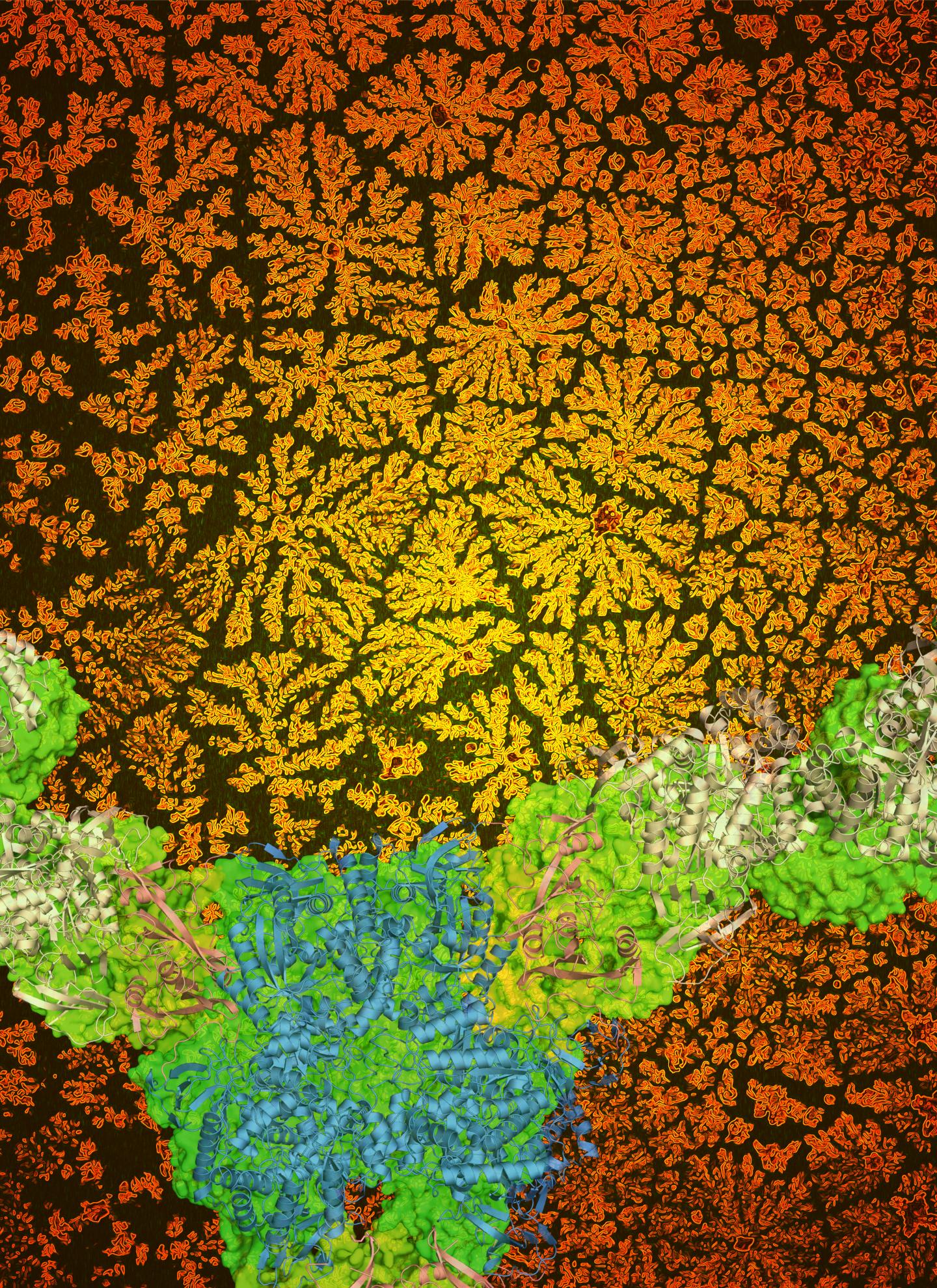
IMAGE

Credit: Nancy Hernandez, William Hansen and Slava Manichev

Scientists can turn proteins into never-ending patterns that look like flowers, trees or snowflakes, a technique that could help engineer a filter for tainted water and human tissues.

Their study, led by researchers at Rutgers University-New Brunswick, appears in the journal Nature Chemistry.

“Biomolecular engineers have been working on modifying the building blocks of life – proteins, DNA and lipids – to mimic nature and form interesting and useful shapes and structures,” said senior author Sagar D. Khare, an associate professor in the Department of Chemistry and Chemical Biology in the School of Arts and Sciences at Rutgers-New Brunswick. “Our team developed a framework for engineering existing proteins into fractal shapes.”

In nature, building blocks such as protein molecules are assembled into larger structures for specific purposes. A classic example is collagen, which forms connective tissue in our bodies and is strong and flexible because of how it is organized. Tiny protein molecules assemble to form structures that are scaled up and can be as long as tendons. Assemblies of natural proteins are also dynamic, forming and dissolving in response to stimuli.

The research team developed a technique for assembling proteins into fractal, or geometric, shapes that are repeated over and over. Examples include trees, leaves and pineapples. The team used protein engineering software to design proteins that bind to each other, so they form a fractal, tree-like shape in response to a biological stimulus, such as in a cell, tissue or organism. They can also manipulate the dimensions of the shapes, so they resemble flowers, trees or snowflakes, which are visualized using special microscopy techniques.

These techniques could lead to new technologies such as a filter for bioremediation, which uses biological molecules to remove herbicides from tainted water, or synthetic matrices to help study human disease or aid tissue engineering to restore, improve or preserve damaged tissues or organs.

The next steps are to further develop the technology and expand the range of proteins that form fractal shapes as well as use different stimuli, such as chemicals and light. The scientists also want to study how fractal shapes form in greater detail, so they could gain greater control over the process and the shapes and sizes of designer biomaterials.

align=”center”>###

The study also included scientists at Baylor College of Medicine and the University of Minnesota.

Media Contact
Todd Bates
[email protected]

Original Source

https://news.rutgers.edu/new-technique-could-help-engineer-polluted-water-filter-human-tissues/20190722#.XTcraehKi70

Related Journal Article

http://dx.doi.org/10.1038/s41557-019-0277-y

Tags: BiochemistryBiomedical/Environmental/Chemical EngineeringChemistry/Physics/Materials SciencesEcology/EnvironmentEnvironmental HealthMaterialsMolecular BiologyPollution/RemediationPublic Health
Share12Tweet8Share2ShareShareShare2

Related Posts

How to sway group opinions: Encourage opponents to stay undecided

How to sway group opinions: Encourage opponents to stay undecided

March 23, 2026
Deep Learning Model Maps How Individual Cells Shape Disease Outcomes

Deep Learning Model Maps How Individual Cells Shape Disease Outcomes

March 20, 2026

Removing only 15 female sharks annually could endanger the entire population, scientists warn

March 20, 2026

Scientists Urge Fragrance Industry to Transition from Sustainability Talk to Active Funding of Plant Conservation

March 20, 2026
Please login to join discussion

POPULAR NEWS

  • blank

    Revolutionary AI Model Enhances Precision in Detecting Food Contamination

    96 shares
    Share 38 Tweet 24
  • Imagine a Social Media Feed That Challenges Your Views Instead of Reinforcing Them

    1004 shares
    Share 397 Tweet 248
  • Uncovering Functions of Cavernous Malformation Proteins in Organoids

    54 shares
    Share 22 Tweet 14
  • Promising Outcomes from First Clinical Trials of Gene Regulation in Epilepsy

    51 shares
    Share 20 Tweet 13

About

We bring you the latest biotechnology news from best research centers and universities around the world. Check our website.

Follow us

Recent News

In-Sensor Cryptography Links Physical Process to Digital Identity

Can Psychosocial Factors Influence Cancer Risk?

Depression Factors in Elderly: Pre vs. Post-COVID Analysis

Subscribe to Blog via Email

Enter your email address to subscribe to this blog and receive notifications of new posts by email.

Join 78 other subscribers
  • Contact Us

Bioengineer.org © Copyright 2023 All Rights Reserved.

Welcome Back!

Login to your account below

Forgotten Password?

Retrieve your password

Please enter your username or email address to reset your password.

Log In
No Result
View All Result
  • Homepages
    • Home Page 1
    • Home Page 2
  • News
  • National
  • Business
  • Health
  • Lifestyle
  • Science

Bioengineer.org © Copyright 2023 All Rights Reserved.