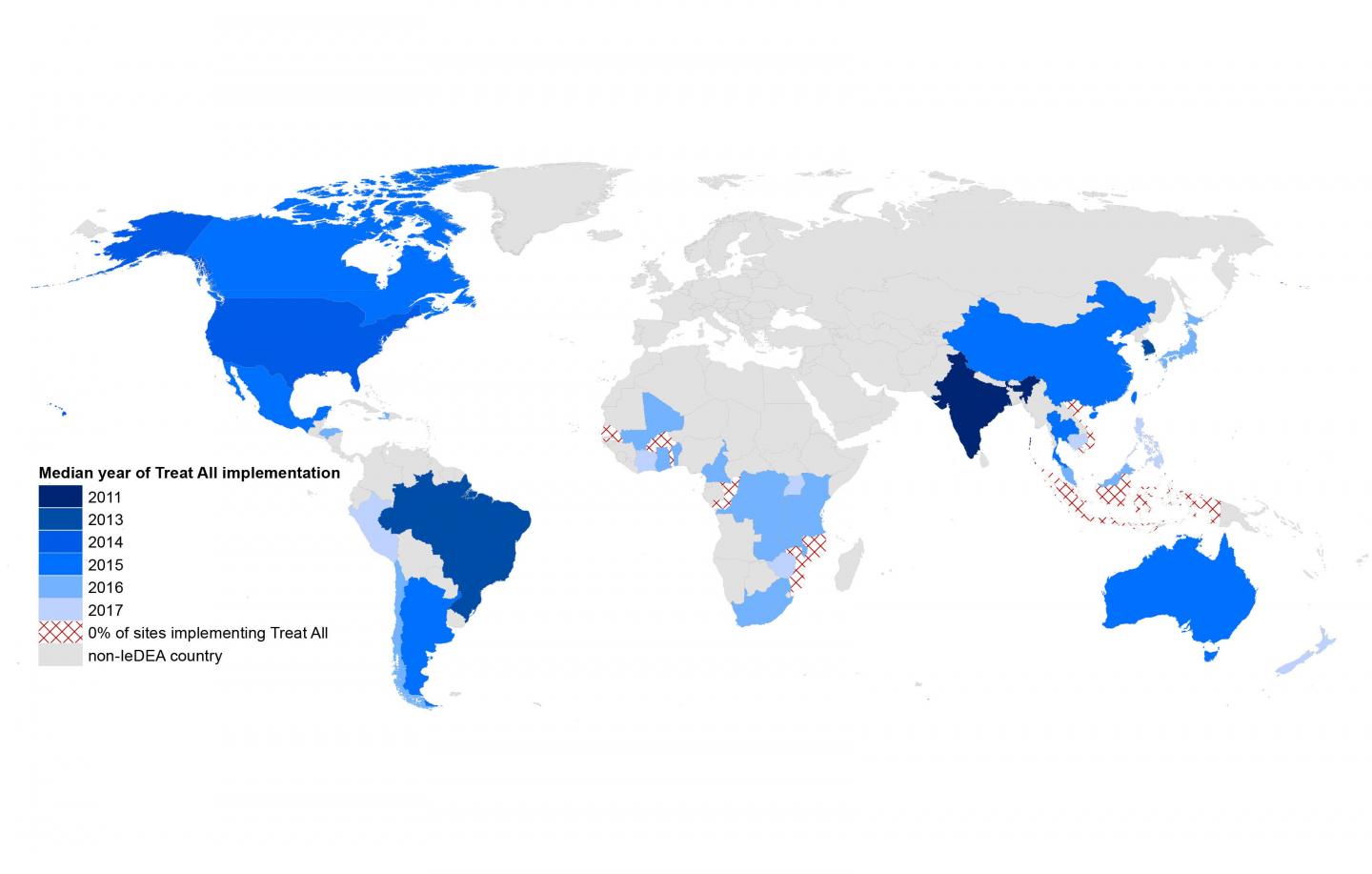
Credit: CUNY ISPH
A new study published in the Journal of the International AIDS Society shows that the World Health Organization’s (WHO) 2015 recommendation for immediate treatment of all people living with HIV has become the standard of care across HIV clinics in countries around the world. While most countries have adopted the WHO’s “Treat All” recommendation, the extent to which these guidelines had been translated into practice at HIV clinics around the world was previously unknown.
Based on a survey conducted at more than 200 HIV care and treatment sites in the 41 countries that participate in the International epidemiology Databases to Evaluate AIDS (IeDEA) research consortium, this study found that site-level uptake of the Treat All practice is almost universal. While studies of prior changes in HIV treatment guidelines had shown delays in implementation, this study found the roll-out of Treat All practices has been rapid, with a median lag of one month between national policy change and site-level introduction. The study also found that sites in low- and lower-middle income countries generally initiate patients on HIV treatment within 14 days of confirming HIV diagnoses. The study found no significant differences in introduction of Treat All at the service delivery level by geographic region, country income level, urban/rural location or other facility characteristic, which suggests that gaps in treatment access have narrowed. However, the study also found that the majority of HIV care and treatment sites in low-resource settings do not have the capacity for routine viral load monitoring once a patient starts HIV treatment.
The study was led by researchers at the CUNY Institute for Implementation Science in Population Health (ISPH) at the CUNY Graduate School of Public Health and Health Policy (CUNY SPH).
“These findings are promising, in terms of the ability to broadly improve access to earlier treatment in low-resource settings, which will improve health outcomes among people living with HIV and prevent new infections,” said Ellen Brazier, the study’s lead author.
Dr. Denis Nash, distinguished professor of epidemiology at CUNY SPH and the study’s senior author, noted that widescale and rapid introduction of Treat All at the service delivery level may reflect the fact that its guidelines are simpler to implement in low resource settings than prior guidelines, which required assessing each patient’s immune status to determine if they were eligible to start HIV treatment. However, he cautioned that limited capacity for laboratory testing remains a concern.
“Many of the sites that are initiating patients on antiretroviral therapy do not have adequate resources to monitor key patient outcomes through viral load testing, including treatment failure or the development of drug resistance,” said Nash. “This is an issue that requires urgent attention, as it is critical to assess and optimize longer term HIV care outcomes in the Treat All era.”
###
Funding
Funding for the study came from research grants U01AI069907, U01AI069923, U01AI096299, U01AI069911, U01AI069918, U01AI069924, U01AI069919 from the National Institutes of Health.
For more information, contact:
Ellen Brazier
[email protected]
646-364-9622
About the Institute for Implementation Science in Population Health
The CUNY Institute for Implementation Science in Population Health (ISPH) was founded on the notion that substantial improvements in population health can be efficiently achieved through better implementation of existing strategies, policies, and interventions across multiple sectors. We study how to translate and scale-up evidence-based interventions and policies within clinical and community settings in order to improve population health and reduce health disparities. CUNY ISPH. Pursing population health gains through better implementation. http://www.
About the CUNY Graduate School of Public Health and Health Policy
The CUNY Graduate School of Public Health and Health Policy (CUNY SPH) is committed to teaching, research and service that creates a healthier New York City and helps promote equitable, efficient and evidence-based solutions to pressing health problems facing cities around the world. For more information, visit sph.cuny.edu.
Citation:
“Implementation of ‘Treat-all’ at adult HIV care and treatment sites in the Global IeDEA Consortium: Results from the Site Assessment Survey,” Ellen Brazier, Fernanda Maruri, Stephany N. Duda, Olga Tymejczyk, C. William Wester, Geoffrey Somi, Jeremy Ross, Aimee Freeman, Morna Cornell, Armel Poda, Beverly S. Musick, Fujie Zhang, Keri N. Althoff, Catrina Mugglin, April D. Kimmel, Marcel Yotebieng, Denis Nash for the IeDEA Consortium, Journal of the International AIDS Society, issue. doi. 10.1002/jia2.25331
Media Contact
Ariana Costakes
[email protected]
Original Source
http://sph.
Related Journal Article
http://dx.