Researchers from the University of Geneva and the University of Manchester have confirmed experimentally the theory of very strong magneto-optical resonance in graphene
Credit: © UNIGE, Ievgeniia Nedoliuk
The ability to control infrared and terahertz waves using magnetic or electric fields is one of the great challenges in physics that could revolutionise opto-electronics, telecommunications and medical diagnostics. A theory from 2006 predicts that it should be possible to use graphene – a monoatomic layer of carbon atoms- in a magnetic field not only to absorb terahertz and infrared light on demand but also to control the direction of the circular polarisation. Researchers from the University of Geneva (UNIGE), Switzerland, and the University of Manchester have succeeded in testing this theory and achieved the predicted results. The study, to be published in the journal Nature Nanotechnology, shows that the scientists found an efficient way to control infrared and terahertz waves. It also shows that graphene is keeping its initial promises, and is making its way to be the material of the the future, whether on earth or in space.
“There exist a class of the so-called Dirac materials, where the electrons behave as if they do not have a mass, similar to the light particles, the photons”, explains Alexey Kuzmenko, a researcher in the Department of Quantum Matter Physics in UNIGE’s Science Faculty, who conducted this research together with Ievgeniia Nedoliuk. One of such materials is graphene, a monolayer of carbon atoms arranged in honeycomb structure, analogue to graphite used, in particular to make pencils.
The interaction between graphene and light suggests that this material could be used to control infrared and terahertz waves. “That would be a huge step forward for optoelectronics, security, telecommunications and medical diagnostics,” points out the Geneva-based researcher.
Backing up an old theory via experimentation
A theoretical prediction from 2006 posited that if a Dirac material, is placed in a magnetic field, it will produce a very strong cyclotron resonance. “When a charged particle is in the magnetic field, it moves on a circular orbit and absorbs the electromagnetic energy at the orbiting, or cyclotron, frequency, as for example it happens in the Large Hadron Collider at CERN”, explains Alexey Kuzmenko. “And when the particles have charge but no mass, as electrons in graphene, the absorption of light is at its maximum!”
To demonstrate this maximum absorption, the physicists needed a very pure graphene, so that the electrons travelling long distances would not scatter on impurities or crystal defects. But this level of purity and lattice order are very difficult to obtain and are only achieved when graphene is encapsulated in another two-dimensional material – boron nitride.
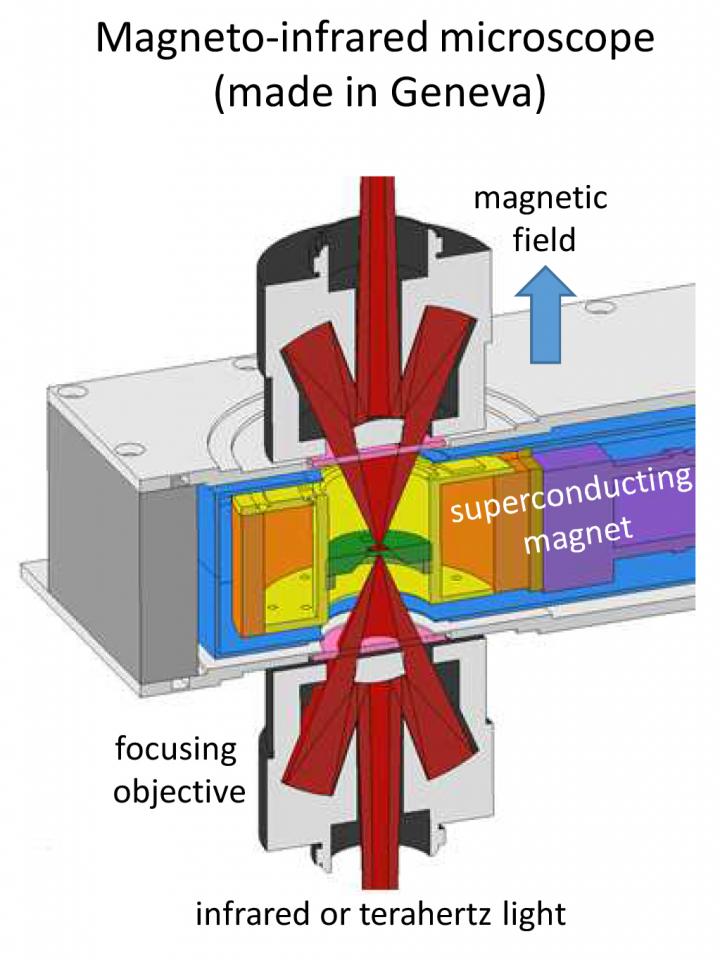
The UNIGE researchers teamed up with the group from the University of Manchester led by André Geim – the 2010 Nobel Prize winner in Physics for discovering graphene – to develop extremely pure graphene samples. These samples, which were exceptionally large for this type of graphene, were nevertheless too small to quantify the cyclotron resonance with well-established techniques. This is is why the Geneva researchers built a special experimental setup to concentrate the infrared and terahertz radiation on small samples of pure graphene in the magnetic field. “And the result of the experiment confirmed the theory from 2006!” adds Alexey Kuzmenko.
Custom-controlled polarisation
The results demonstrated for the first time that a colossal magneto-optical effect occurs indeed if a layer of pure graphene is used. “The maximum possible magneto-absorption of the infrared light is now achieved in a monoatomic layer,” says Alexey Kuzmenko.
In addition, the physicists found that it was possible to choose which circular polarisation – left or right – should be absorbed. “Natural or intrinsic graphene is electrically neutral and absorbs all the light, regardless of its polarisation. But if we introduce electrically charged carriers, either positive or negative, we can choose which polarisation is absorbed, and this works both in the infrared and terahertz ranges,” continues the scientist. This ability plays a crucial role, especially in the pharmacy, where certain key drug molecules interact with light depending on polarization direction. Interestingly, this control is considered promising for the search of life on exoplanets, since it is possible to observe the signatures of the molecular chirality inherent in the biological matter.
Finally, the physicists found that to observe a strong effect in the terahertz range, it is sufficient to apply magnetic fields, which could be generated already by inexpensive permanent magnet .
Now that the theory has been confirmed, the researchers will continue to work on magnetically adjustable sources and detectors of terahertz and infrared light. Graphene continues to surprise them
###
Media Contact
Alexey Kuzmenko
[email protected]
Related Journal Article
http://dx.