• HOME
  • NEWS
  • EXPLORE
    • CAREER
      • Companies
      • Jobs
    • EVENTS
    • iGEM
      • News
      • Team
    • PHOTOS
    • VIDEO
    • WIKI
  • BLOG
  • COMMUNITY
    • FACEBOOK
    • INSTAGRAM
    • TWITTER
Thursday, March 26, 2026
BIOENGINEER.ORG
No Result
View All Result
  • Login
  • HOME
  • NEWS
  • EXPLORE
    • CAREER
      • Companies
      • Jobs
        • Lecturer
        • PhD Studentship
        • Postdoc
        • Research Assistant
    • EVENTS
    • iGEM
      • News
      • Team
    • PHOTOS
    • VIDEO
    • WIKI
  • BLOG
  • COMMUNITY
    • FACEBOOK
    • INSTAGRAM
    • TWITTER
  • HOME
  • NEWS
  • EXPLORE
    • CAREER
      • Companies
      • Jobs
        • Lecturer
        • PhD Studentship
        • Postdoc
        • Research Assistant
    • EVENTS
    • iGEM
      • News
      • Team
    • PHOTOS
    • VIDEO
    • WIKI
  • BLOG
  • COMMUNITY
    • FACEBOOK
    • INSTAGRAM
    • TWITTER
No Result
View All Result
Bioengineer.org
No Result
View All Result
Home NEWS Science News Biology

Two new species of parasitic wasps described from an altitude of over 3,400 m in Tibet

Bioengineer by Bioengineer
July 3, 2019
in Biology
Reading Time: 2 mins read
0
IMAGE
Share on FacebookShare on TwitterShare on LinkedinShare on RedditShare on Telegram

IMAGE

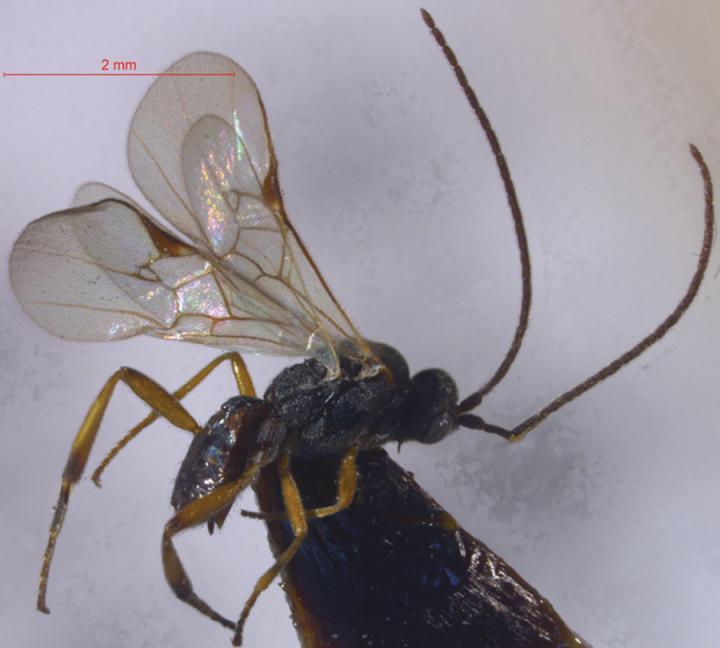
Credit: Wangzhen Zhang

Specimens kept in the collection of the Institute of Beneficial Insects at the Fujian Agriculture and Forestry University (FAFU, China) revealed the existence of two previously unknown species of endoparasitoid wasps. Originally collected in 2013, the insects are known to inhabit prairies and bushes at above 3,400 m, which is quite an unusual altitude for this group of wasps.

The new to science wasps are described and illustrated in a paper published in the open-access, peer-reviewed scholarly journal ZooKeys by the team of Dr Wangzhen Zhang (FAFU and Fuzhou Airport Inspection and Quarantine Bureau) and his colleagues at FAFU: Dr Dongbao Song and Prof Jiahua Chen.

Looking very similar to each other, the species were found to belong to one and the same genus (Microplitis), which, however, is clearly distinct from any other within the subfamily, called Microgastrinae. The latter group comprises tiny, mostly black or brown wasps that develop in the larvae of specific moths or butterflies. Interestingly, once parasitised, the host continues living and does not even terminate its own growth. It is only killed when the wasp eggs hatch and feed on its organs and body fluids before spinning cocoons.

From now on, the newly described wasps will be called by the scientific names Microplitis paizhensis and Microplitis bomiensis, where their species names refer to the localities from where they were originally collected: Paizhen town and Bomi county, respectively.

Due to their parasitism, some microgastrine wasps are considered important pest biocontrol agents. Unfortunately, the hosts of the newly described species remain unknown.

In addition, the scientists also mention a third new to science species spotted amongst the specimens they studied. However, so far they have only found its male, whereas a reliable description of a new microgastrine wasp requires the presence of a female.

###

Original source:

Zhang W, Song D, Chen J (2019) Two new species of the genus Microplitis Förster, 1862 (Hymenoptera, Braconidae, Microgastrinae) from China. ZooKeys 859: 49-61. https://doi.org/10.3897/zookeys.859.31720

Contacts:

Wangzhen Zhang

Email: [email protected]

Jiahua Chen

Email: [email protected]

Dongbao Song

Email: [email protected]

Media Contact
Wangzhen Zhang
[email protected]

Related Journal Article

http://dx.doi.org/10.3897/zookeys.859.31720

Tags: BiodiversityBiologyEcology/EnvironmentEntomologyEvolutionPopulation BiologyZoology/Veterinary Science
Share12Tweet8Share2ShareShareShare2

Related Posts

How to sway group opinions: Encourage opponents to stay undecided

How to sway group opinions: Encourage opponents to stay undecided

March 23, 2026
Deep Learning Model Maps How Individual Cells Shape Disease Outcomes

Deep Learning Model Maps How Individual Cells Shape Disease Outcomes

March 20, 2026

Removing only 15 female sharks annually could endanger the entire population, scientists warn

March 20, 2026

Scientists Urge Fragrance Industry to Transition from Sustainability Talk to Active Funding of Plant Conservation

March 20, 2026
Please login to join discussion

POPULAR NEWS

  • blank

    Revolutionary AI Model Enhances Precision in Detecting Food Contamination

    96 shares
    Share 38 Tweet 24
  • Imagine a Social Media Feed That Challenges Your Views Instead of Reinforcing Them

    1003 shares
    Share 397 Tweet 248
  • Uncovering Functions of Cavernous Malformation Proteins in Organoids

    54 shares
    Share 22 Tweet 14
  • Promising Outcomes from First Clinical Trials of Gene Regulation in Epilepsy

    51 shares
    Share 20 Tweet 13

About

We bring you the latest biotechnology news from best research centers and universities around the world. Check our website.

Follow us

Recent News

In-Sensor Cryptography Links Physical Process to Digital Identity

Can Psychosocial Factors Influence Cancer Risk?

Depression Factors in Elderly: Pre vs. Post-COVID Analysis

Subscribe to Blog via Email

Success! An email was just sent to confirm your subscription. Please find the email now and click 'Confirm' to start subscribing.

Join 78 other subscribers
  • Contact Us

Bioengineer.org © Copyright 2023 All Rights Reserved.

Welcome Back!

Login to your account below

Forgotten Password?

Retrieve your password

Please enter your username or email address to reset your password.

Log In
No Result
View All Result
  • Homepages
    • Home Page 1
    • Home Page 2
  • News
  • National
  • Business
  • Health
  • Lifestyle
  • Science

Bioengineer.org © Copyright 2023 All Rights Reserved.